 Add to Chrome
 Add to Firefox
 Add to Edge
A Bayesian Framework for Evaluating Scenario Compatibility in Generative Population Synthesis
Jul 03, 2026
Scenario-based transportation analysis specifies future assumptions through aggregate population targets, whereas generative population synthesis models produce detailed individual-level realizations. When scenario targets are imposed on generative models, current practice relies on deterministic marginal calibration, implicitly assuming that the targets are compatible with the model's learned structural support. However, whether scenario-level constraints lie within the generative support--and how strongly they distort structural uncertainty--remains largely unexamined. We propose an ensemble-based Bayesian updating framework to quantify scenario compatibility in conditional population synthesis. A population-aware conditional variational autoencoder is developed to learn a distribution over plausible population structures while preserving aggregate fidelity. An ensemble of realizations sampled from the learned prior provides an empirical approximation of structural uncertainty. Scenario targets are treated as probabilistic evidence over aggregate statistics, and posterior weights are obtained through Bayesian updating across the ensemble. Scenario compatibility is quantified using effective sample size (ESS), which measures posterior concentration and the compression of structural uncertainty induced by conditioning. Experiments demonstrate that scenario impact depends not only on target magnitude but also on alignment with the learned joint structure, and reveal structural failure modes when targets fall outside prior ensemble support. The proposed framework provides a probabilistic diagnostic model for evaluating scenario feasibility and structural consistency before downstream projection and transportation planning.

SemaPop: Semantic-Persona Conditioned Population Synthesis
Feb 12, 2026Population synthesis is a critical component of individual-level socio-economic simulation, yet remains challenging due to the need to jointly represent statistical structure and latent behavioral semantics. Existing population synthesis approaches predominantly rely on structured attributes and statistical constraints, leaving a gap in semantic-conditioned population generation that can capture abstract behavioral patterns implicitly in survey data. This study proposes SemaPop, a semantic-statistical population synthesis model that integrates large language models (LLMs) with generative population modeling. SemaPop derives high-level persona representations from individual survey records and incorporates them as semantic conditioning signals for population generation, while marginal regularization is introduced to enforce alignment with target population marginals. In this study, the framework is instantiated using a Wasserstein GAN with gradient penalty (WGAN-GP) backbone, referred to as SemaPop-GAN. Extensive experiments demonstrate that SemaPop-GAN achieves improved generative performance, yielding closer alignment with target marginal and joint distributions while maintaining sample-level feasibility and diversity under semantic conditioning. Ablation studies further confirm the contribution of semantic persona conditioning and architectural design choices to balancing marginal consistency and structural realism. These results demonstrate that SemaPop-GAN enables controllable and interpretable population synthesis through effective semantic-statistical information fusion. SemaPop-GAN also provides a promising modular foundation for developing generative population projection systems that integrate individual-level behavioral semantics with population-level statistical constraints.
A Foundational individual Mobility Prediction Model based on Open-Source Large Language Models
Mar 19, 2025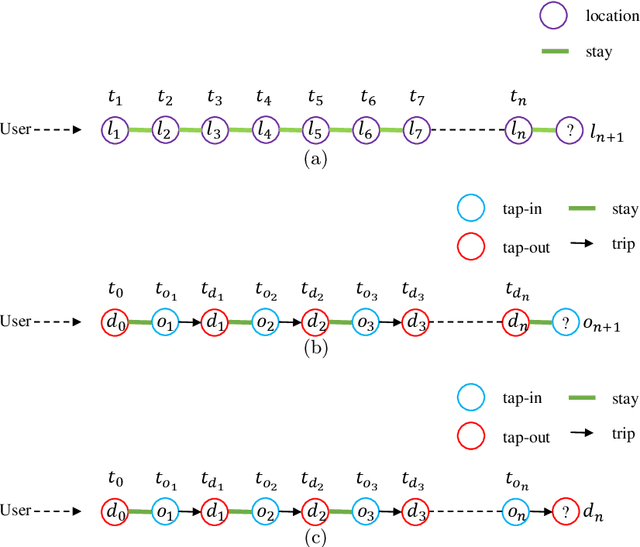
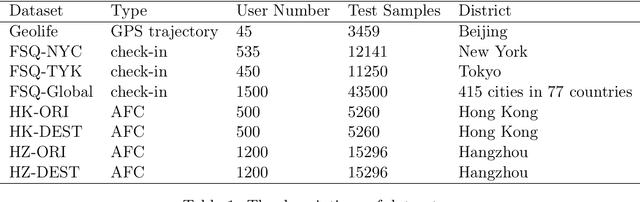
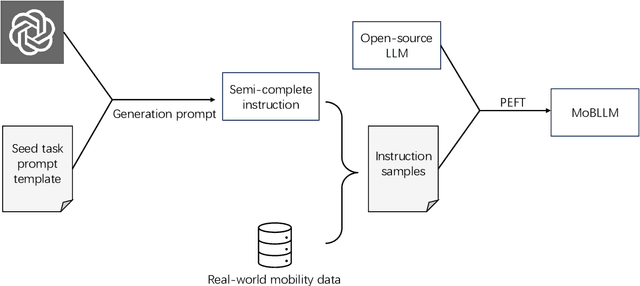
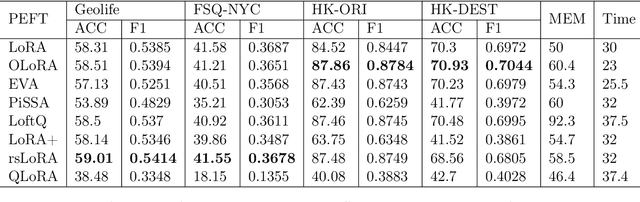
Large Language Models (LLMs) are widely applied to domain-specific tasks due to their massive general knowledge and remarkable inference capacities. Current studies on LLMs have shown immense potential in applying LLMs to model individual mobility prediction problems. However, most LLM-based mobility prediction models only train on specific datasets or use single well-designed prompts, leading to difficulty in adapting to different cities and users with diverse contexts. To fill these gaps, this paper proposes a unified fine-tuning framework to train a foundational open source LLM-based mobility prediction model. We conducted extensive experiments on six real-world mobility datasets to validate the proposed model. The results showed that the proposed model achieved the best performance in prediction accuracy and transferability over state-of-the-art models based on deep learning and LLMs.