 Add to Chrome
 Add to Firefox
 Add to Edge
DoubleHelix: Structured Cross-Modal Fusion for Audio-Visual Speech Recognition with LLMs
Jul 31, 2026
Audio-visual speech recognition (AVSR) relies on effective fusion of audio and visual modalities, yet existing approaches treat cross-modal interaction as a single-step operation without structured iterative refinement. We present DoubleHelix, a multimodal fusion framework that reformulates fusion as an iterative cross-modal interaction process with adaptive degradation-aware enhancement. The framework comprises three components including ReverseParallelHelix for multi-turn structured interaction with learned alignment constraints, QualitySensor for learning degradation-aware gating signals, and HelixReplication for consistency-guided conditional feature enhancement. Experiments on LRS3 demonstrate that DoubleHelix achieves 0.68% WER on clean audio, outperforming previous best results by 5.6% relative improvement under matched backbone settings. Comprehensive ablation studies validate each component contribution, including targeted analysis of design choices such as asymmetric pathway weighting. The framework shows improved robustness under evaluated babble-noise conditions, achieving 11.6% WER at SNR -5dB.

Logistic-ELM: A Novel Fault Diagnosis Method for Rolling Bearings
Apr 23, 2022
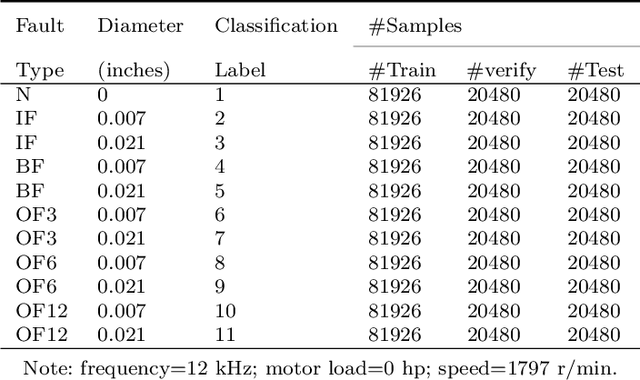
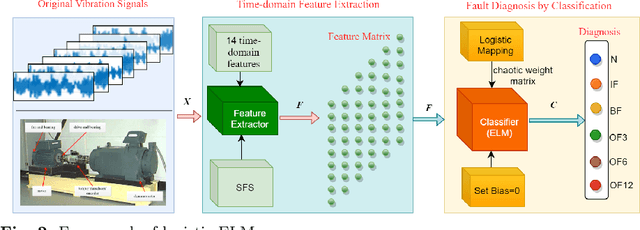

The fault diagnosis of rolling bearings is a critical technique to realize predictive maintenance for mechanical condition monitoring. In real industrial systems, the main challenges for the fault diagnosis of rolling bearings pertain to the accuracy and real-time requirements. Most existing methods focus on ensuring the accuracy, and the real-time requirement is often neglected. In this paper, considering both requirements, we propose a novel fast fault diagnosis method for rolling bearings, based on extreme learning machine (ELM) and logistic mapping, named logistic-ELM. First, we identify 14 kinds of time-domain features from the original vibration signals according to mechanical vibration principles and adopt the sequential forward selection (SFS) strategy to select optimal features from them to ensure the basic predictive accuracy and efficiency. Next, we propose the logistic-ELM for fast fault classification, where the biases in ELM are omitted and the random input weights are replaced by the chaotic logistic mapping sequence which involves a higher uncorrelation to obtain more accurate results with fewer hidden neurons. We conduct extensive experiments on the rolling bearing vibration signal dataset of the Case Western Reserve University (CWRU) Bearing Data Centre. The experimental results show that the proposed approach outperforms existing SOTA comparison methods in terms of the predictive accuracy, and the highest accuracy is 100% in seven separate sub data environments. The relevant code is publicly available at https://github.com/TAN-OpenLab/logistic-ELM.