 Add to Chrome
 Add to Firefox
 Add to Edge
NetworkNet: A Deep Neural Network Approach for Random Networks with Sparse Nodal Attributes and Complex Nodal Heterogeneity
Apr 13, 2026
Heterogeneous network data with rich nodal information become increasingly prevalent across multidisciplinary research, yet accurately modeling complex nodal heterogeneity and simultaneously selecting influential nodal attributes remains an open challenge. This problem is central to many applications in economics and sociology, when both nodal heterogeneity and high-dimensional individual characteristics highly affect network formation. We propose a statistically grounded, unified deep neural network approach for modeling nodal heterogeneity in random networks with high-dimensional nodal attributes, namely ``NetworkNet''. A key innovation of NetworkNet lies in a tailored neural architecture that explicitly parameterizes attribute-driven heterogeneity, and at the same time, embeds a scalable attribute selection mechanism. NetworkNet consistently estimates two types of latent heterogeneity functions, i.e., nodal expansiveness and popularity, while simultaneously performing data-driven attribute selection to extract influential nodal attributes. By unifying classical statistical network modeling with deep learning, NetworkNet delivers the expressive power of DNNs with methodological interpretability, algorithmic scalability, and statistical rigor with a non-asymptotic approximation error bound. Empirically, simulations demonstrate strong performance in both heterogeneity estimation and high-dimensional attribute selection. We further apply NetworkNet to a large-scale author-citation network among statisticians, revealing new insights into the dynamic evolution of research fields and scholarly impact.

PALMS: Parallel Adaptive Lasso with Multi-directional Signals for Latent Networks Reconstruction
Nov 18, 2024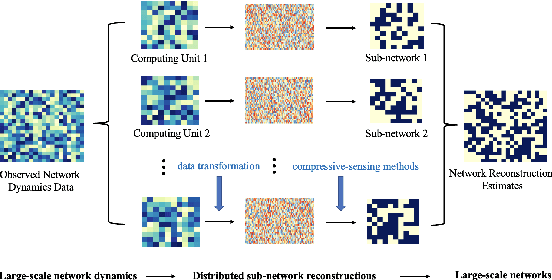
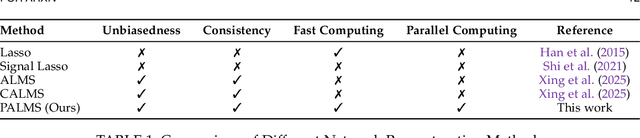
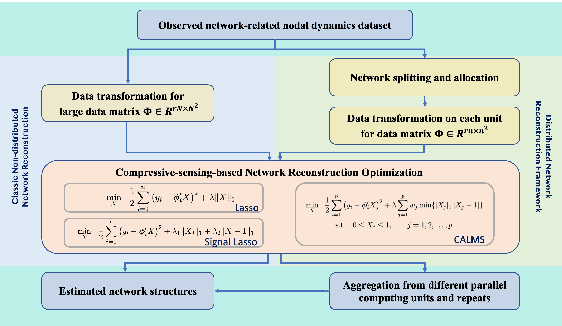
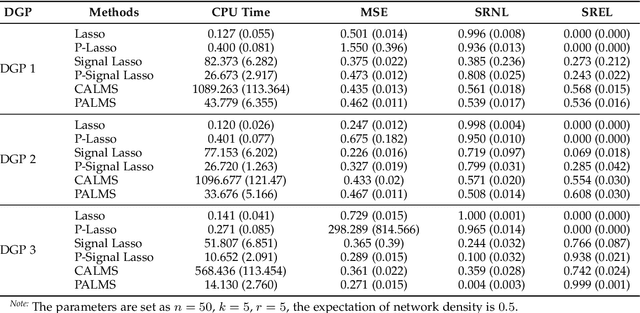
Large-scale networks exist in many field and play an important role in real-world dynamics. However, the networks are usually latent and expensive to detect, which becomes the main challenging for many applications and empirical analysis. Several statistical methods were proposed to infer the edges, but the complexity of algorithms make them hard to be applied for large-scale networks. In this paper, we proposed a general distributed and parallel computing framework for network reconstruction methods via compressive sensing technical, to make them feasible for inferring the super large networks in practice. Combining with the CALMS, we proposed for those estimators enjoy additional theoretical properties, such as the consistency and asymptotic normality, we prove that the approximate estimation utilizing the distributed algorithm can keep the theoretical results.