 Add to Chrome
 Add to Firefox
 Add to Edge
InjectRBP: Steering Large Language Model Reasoning Behavior via Pattern Injection
Feb 12, 2026
Reasoning can significantly enhance the performance of Large Language Models. While recent studies have exploited behavior-related prompts adjustment to enhance reasoning, these designs remain largely intuitive and lack a systematic analysis of the underlying behavioral patterns. Motivated by this, we investigate how models' reasoning behaviors shape reasoning from the perspective of behavioral patterns. We observe that models exhibit adaptive distributions of reasoning behaviors when responding to specific types of questions, and that structurally injecting these patterns can substantially influence the quality of the models' reasoning processes and outcomes. Building on these findings, we propose two optimization methods that require no parameter updates: InjectCorrect and InjectRLOpt. InjectCorrect guides the model by imitating behavioral patterns derived from its own past correct answers. InjectRLOpt learns a value function from historical behavior-pattern data and, via our proposed Reliability-Aware Softmax Policy, generates behavioral injectant during inference to steer the reasoning process. Our experiments demonstrate that both methods can improve model performance across various reasoning tasks without requiring any modifications to model parameters, achieving gains of up to 5.34% and 8.67%, respectively.

Test-driven Reinforcement Learning
Nov 15, 2025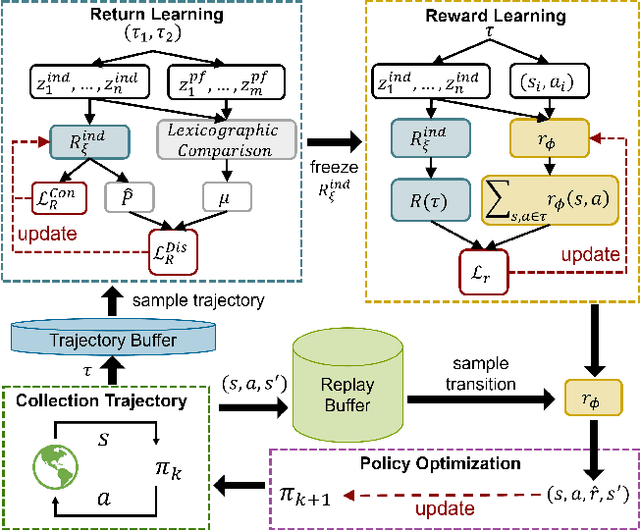
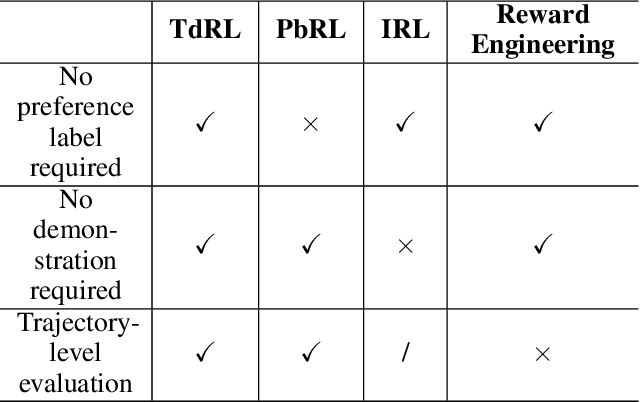
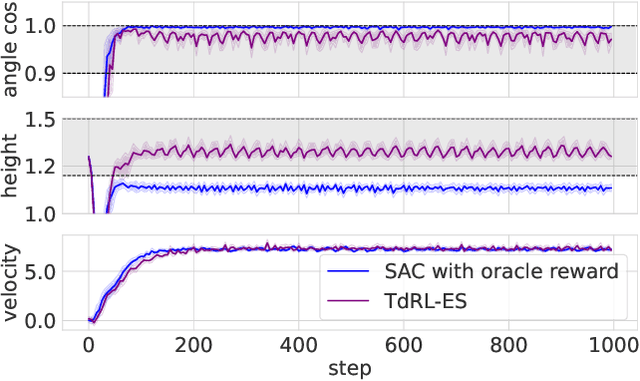
Reinforcement learning (RL) has been recognized as a powerful tool for robot control tasks. RL typically employs reward functions to define task objectives and guide agent learning. However, since the reward function serves the dual purpose of defining the optimal goal and guiding learning, it is challenging to design the reward function manually, which often results in a suboptimal task representation. To tackle the reward design challenge in RL, inspired by the satisficing theory, we propose a Test-driven Reinforcement Learning (TdRL) framework. In the TdRL framework, multiple test functions are used to represent the task objective rather than a single reward function. Test functions can be categorized as pass-fail tests and indicative tests, each dedicated to defining the optimal objective and guiding the learning process, respectively, thereby making defining tasks easier. Building upon such a task definition, we first prove that if a trajectory return function assigns higher returns to trajectories closer to the optimal trajectory set, maximum entropy policy optimization based on this return function will yield a policy that is closer to the optimal policy set. Then, we introduce a lexicographic heuristic approach to compare the relative distance relationship between trajectories and the optimal trajectory set for learning the trajectory return function. Furthermore, we develop an algorithm implementation of TdRL. Experimental results on the DeepMind Control Suite benchmark demonstrate that TdRL matches or outperforms handcrafted reward methods in policy training, with greater design simplicity and inherent support for multi-objective optimization. We argue that TdRL offers a novel perspective for representing task objectives, which could be helpful in addressing the reward design challenges in RL applications.
A Structure-Aware Lane Graph Transformer Model for Vehicle Trajectory Prediction
May 30, 2024Accurate prediction of future trajectories for surrounding vehicles is vital for the safe operation of autonomous vehicles. This study proposes a Lane Graph Transformer (LGT) model with structure-aware capabilities. Its key contribution lies in encoding the map topology structure into the attention mechanism. To address variations in lane information from different directions, four Relative Positional Encoding (RPE) matrices are introduced to capture the local details of the map topology structure. Additionally, two Shortest Path Distance (SPD) matrices are employed to capture distance information between two accessible lanes. Numerical results indicate that the proposed LGT model achieves a significantly higher prediction performance on the Argoverse 2 dataset. Specifically, the minFDE$_6$ metric was decreased by 60.73% compared to the Argoverse 2 baseline model (Nearest Neighbor) and the b-minFDE$_6$ metric was reduced by 2.65% compared to the baseline LaneGCN model. Furthermore, ablation experiments demonstrated that the consideration of map topology structure led to a 4.24% drop in the b-minFDE$_6$ metric, validating the effectiveness of this model.