 Add to Chrome
 Add to Firefox
 Add to Edge
Learning Graph Foundation Models on Riemannian Graph-of-Graphs
May 11, 2026
Graph foundation models (GFMs), pretrained on massive graph data, have transformed graph machine learning by supporting general-purpose reasoning across diverse graph tasks and domains. Existing GFMs pretrained with fixed-hop subgraph sampling impose a fixed receptive field, causing scale mismatch on diverse tasks, which often require heterogeneous and unknown structural contexts beyond a fixed sampling scale. We propose R-GFM, a Riemannian Graph-of-Graphs (GoG) based foundation model, that treats structural scale as a first-class citizen in modeling. R-GFM constructs a multi-scale GoG over-sampled subgraphs at different hop distances and learns geometry-adaptive representations from Riemannian manifolds. Theoretical analysis shows that R-GFM reduces structural domain generalization error compared to fixed-scale GFMs. Experiments on various datasets demonstrate that R-GFM achieves state-of-the-art performance, with up to a 49% relative improvement on downstream tasks. Our code is available at https://github.com/USTC-DataDarknessLab/R-GFM.

GraphInsight: Unlocking Insights in Large Language Models for Graph Structure Understanding
Sep 05, 2024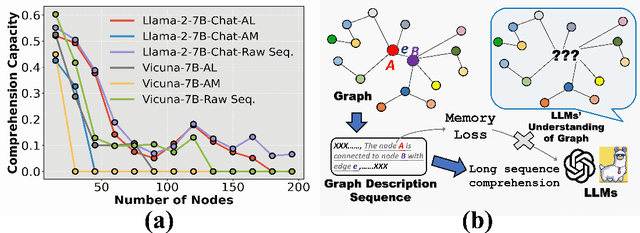
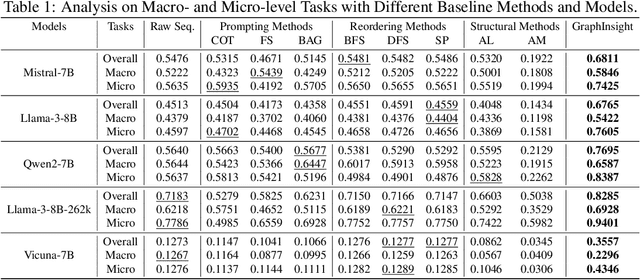
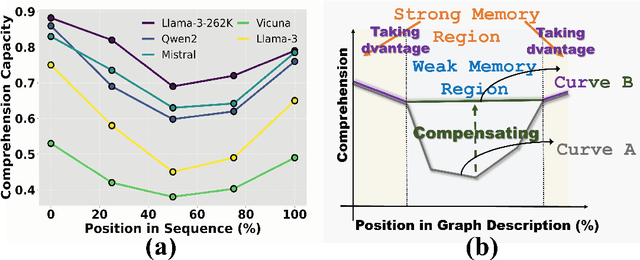
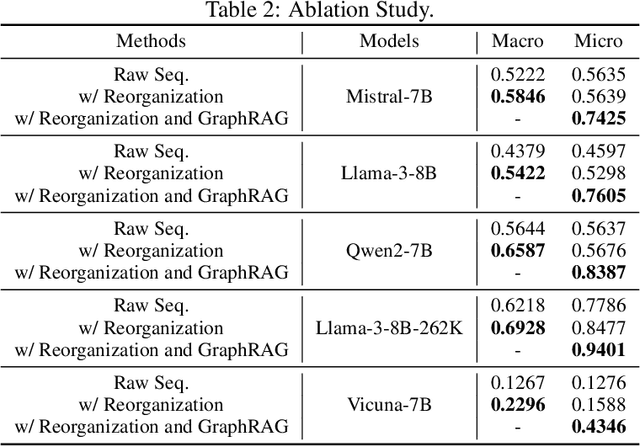
Although Large Language Models (LLMs) have demonstrated potential in processing graphs, they struggle with comprehending graphical structure information through prompts of graph description sequences, especially as the graph size increases. We attribute this challenge to the uneven memory performance of LLMs across different positions in graph description sequences, known as ''positional biases''. To address this, we propose GraphInsight, a novel framework aimed at improving LLMs' comprehension of both macro- and micro-level graphical information. GraphInsight is grounded in two key strategies: 1) placing critical graphical information in positions where LLMs exhibit stronger memory performance, and 2) investigating a lightweight external knowledge base for regions with weaker memory performance, inspired by retrieval-augmented generation (RAG). Moreover, GraphInsight explores integrating these two strategies into LLM agent processes for composite graph tasks that require multi-step reasoning. Extensive empirical studies on benchmarks with a wide range of evaluation tasks show that GraphInsight significantly outperforms all other graph description methods (e.g., prompting techniques and reordering strategies) in understanding graph structures of varying sizes.