 Add to Chrome
 Add to Firefox
 Add to Edge
Channel Knowledge Map Reconstruction From Sparse Measurements via Pilot-Anchored Layout-Conditioned Fourier Refinement
Jul 01, 2026
Channel knowledge maps (CKMs) enable environment-aware wireless systems by providing location-specific channel knowledge, but long-term environmental variations, such as construction, traffic redistribution, and foliage changes, require periodic map refresh. In practice, channel measurements are often sparse and irregular, while environmental knowledge may be limited to coarse layout or topology descriptors. This paper studies CKM reconstruction from sparse measurements. We show that reconstruction pipelines that apply local aggregation or spectral operators directly to a zero-filled pilot grid can entangle the sampling mask with the channel field, allowing structural priors to act on mask-induced distortions before the measurements define a supported radio field. To address this issue, we propose Anchor-CKM, a measurement-first, knowledge-aided reconstruction framework. Anchor-CKM first uses support-aware partial convolutions to construct a pilot-supported representation, and then performs layout-conditioned dual-path Fourier refinement followed by coordinate-based heteroscedastic prediction of the CKM mean and per-location predictive variance. Experiments on transmitter-disjoint DeepMIMO scenarios cover missing ratios from 0.3 to 0.95, including stringent 5% to 10% pilot-coverage settings. In explicit-layout outdoor scenarios, Anchor-CKM reduces received-power root-mean-square error (RMSE) by 0.79 to 1.33 dB relative to the strongest reproduced baseline, while ablations identify pilot-support stabilization as the largest contributor and layout conditioning as beneficial for line-of-sight/non-line-of-sight (LOS/NLOS) boundary fidelity.

RieIF: Knowledge-Driven Riemannian Information Flow for Robust Spatio-Temporal Graph Signal Prediction in 6G Wireless Networks
Apr 08, 2026With 6G evolving towards intelligent network autonomy, artificial intelligence (AI)-native operations are becoming pivotal. Wireless networks continuously generate rich and heterogeneous data, which inherently exhibits spatio-temporal graph structure. However, limited radio resources result in incomplete and noisy network measurements. This challenge is further intensified when a target variable and its strongest correlates are missing over contiguous intervals, forming systemic blind spots. To tackle this issue, we propose RieIF (Knowledge-driven Riemannian Information Flow), a geometry-consistent framework that incorporates knowledge graphs (KGs) for robust spatio-temporal graph signal prediction. For analytical tractability within the Fisher-Rao geometry, we project the input from a Riemannian manifold onto a positive unit hypersphere, where angular similarity is computationally efficient. This projection is implemented via a graph transformer, using the KG as a structural prior to constrain attention and generate a micro stream. Simultaneously, a Long Short-Term Memory (LSTM) model captures temporal dynamics to produce a macro stream. Finally, the micro stream (highlighting geometric shape) and the macro stream (emphasizing signal strength) are adaptively fused through a geometric gating mechanism for signal recovery. Experiments on three wireless datasets show consistent improvements under systemic blind spots, including up to 31% reduction in root mean squared error and up to 3.2 dB gain in recovery signal-to-noise ratio, while maintaining robustness to graph sparsity and measurement noise.
The Future of Combating Rumors? Retrieval, Discrimination, and Generation
Mar 29, 2024
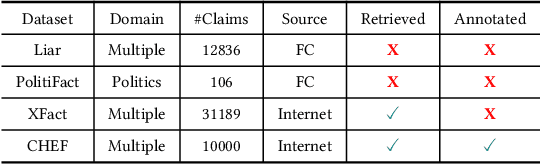
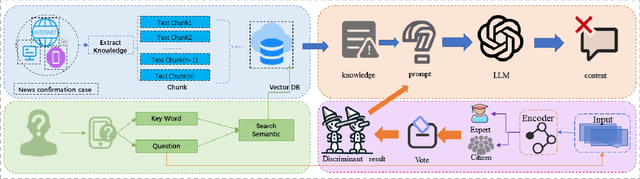
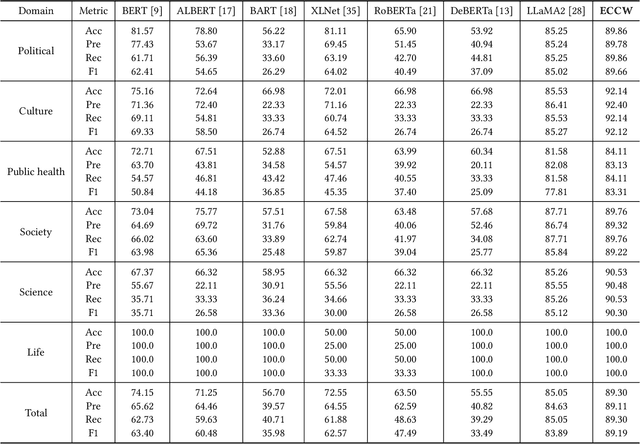
Artificial Intelligence Generated Content (AIGC) technology development has facilitated the creation of rumors with misinformation, impacting societal, economic, and political ecosystems, challenging democracy. Current rumor detection efforts fall short by merely labeling potentially misinformation (classification task), inadequately addressing the issue, and it is unrealistic to have authoritative institutions debunk every piece of information on social media. Our proposed comprehensive debunking process not only detects rumors but also provides explanatory generated content to refute the authenticity of the information. The Expert-Citizen Collective Wisdom (ECCW) module we designed aensures high-precision assessment of the credibility of information and the retrieval module is responsible for retrieving relevant knowledge from a Real-time updated debunking database based on information keywords. By using prompt engineering techniques, we feed results and knowledge into a LLM (Large Language Model), achieving satisfactory discrimination and explanatory effects while eliminating the need for fine-tuning, saving computational costs, and contributing to debunking efforts.
Dynamic Domain Discrepancy Adjustment for Active Multi-Domain Adaptation
Jul 26, 2023Multi-source unsupervised domain adaptation (MUDA) aims to transfer knowledge from related source domains to an unlabeled target domain. While recent MUDA methods have shown promising results, most focus on aligning the overall feature distributions across source domains, which can lead to negative effects due to redundant features within each domain. Moreover, there is a significant performance gap between MUDA and supervised methods. To address these challenges, we propose a novel approach called Dynamic Domain Discrepancy Adjustment for Active Multi-Domain Adaptation (D3AAMDA). Firstly, we establish a multi-source dynamic modulation mechanism during the training process based on the degree of distribution differences between source and target domains. This mechanism controls the alignment level of features between each source domain and the target domain, effectively leveraging the local advantageous feature information within the source domains. Additionally, we propose a Multi-source Active Boundary Sample Selection (MABS) strategy, which utilizes a guided dynamic boundary loss to design an efficient query function for selecting important samples. This strategy achieves improved generalization to the target domain with minimal sampling costs. We extensively evaluate our proposed method on commonly used domain adaptation datasets, comparing it against existing UDA and ADA methods. The experimental results unequivocally demonstrate the superiority of our approach.