 Add to Chrome
 Add to Firefox
 Add to Edge
Spinverse: Differentiable Physics for Permeability-Aware Microstructure Reconstruction from Diffusion MRI
Mar 04, 2026
Diffusion MRI (dMRI) is sensitive to microstructural barriers, yet most existing methods either assume impermeable boundaries or estimate voxel-level parameters without recovering explicit interfaces. We present Spinverse, a permeability-aware reconstruction method that inverts dMRI measurements through a fully differentiable Bloch-Torrey simulator. Spinverse represents tissue on a fixed tetrahedral grid and treats each interior face permeability as a learnable parameter; low-permeability faces act as diffusion barriers, so microstructural boundaries whose topology is not fixed a priori (up to the resolution of the ambient mesh) emerge without changing mesh connectivity or vertex positions. Given a target signal, we optimize face permeabilities by backpropagating a signal-matching loss through the PDE forward model, and recover an interface by thresholding the learned permeability field. To mitigate the ill-posedness of permeability inversion, we use mesh-based geometric priors; to avoid local minima, we use a staged multi-sequence optimization curriculum. Across a collection of synthetic voxel meshes, Spinverse reconstructs diverse geometries and demonstrates that sequence scheduling and regularization are critical to avoid outline-only solutions while improving both boundary accuracy and structural validity.

ReMiDi: Reconstruction of Microstructure Using a Differentiable Diffusion MRI Simulator
Feb 04, 2025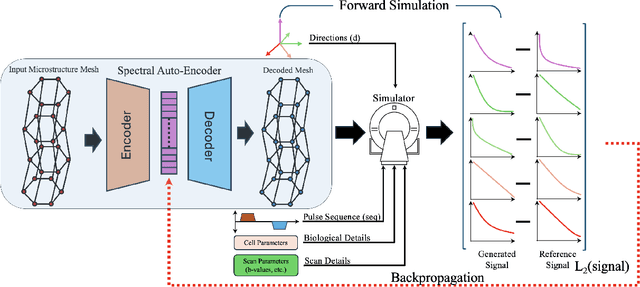
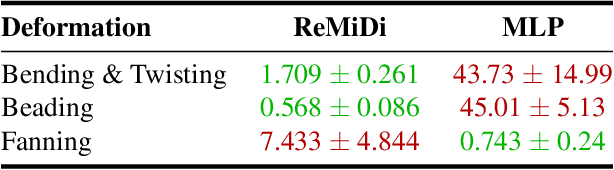
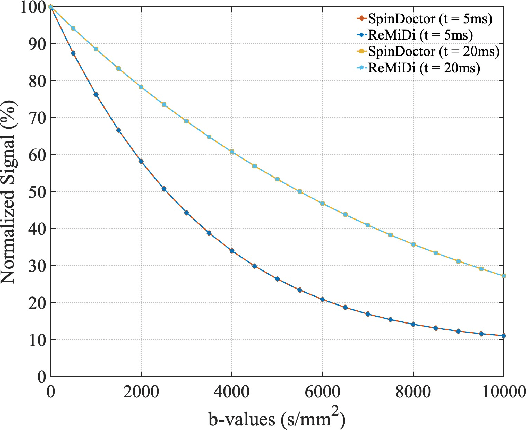
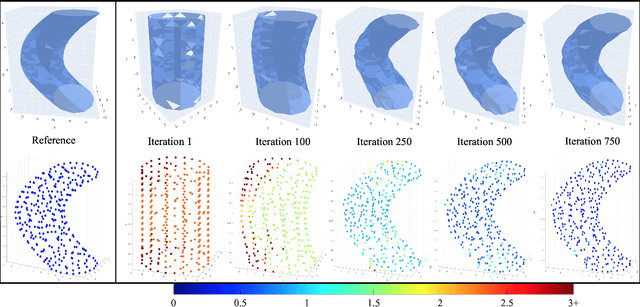
We propose ReMiDi, a novel method for inferring neuronal microstructure as arbitrary 3D meshes using a differentiable diffusion Magnetic Resonance Imaging (dMRI) simulator. We first implemented in PyTorch a differentiable dMRI simulator that simulates the forward diffusion process using a finite-element method on an input 3D microstructure mesh. To achieve significantly faster simulations, we solve the differential equation semi-analytically using a matrix formalism approach. Given a reference dMRI signal $S_{ref}$, we use the differentiable simulator to iteratively update the input mesh such that it matches $S_{ref}$ using gradient-based learning. Since directly optimizing the 3D coordinates of the vertices is challenging, particularly due to ill-posedness of the inverse problem, we instead optimize a lower-dimensional latent space representation of the mesh. The mesh is first encoded into spectral coefficients, which are further encoded into a latent $\textbf{z}$ using an auto-encoder, and are then decoded back into the true mesh. We present an end-to-end differentiable pipeline that simulates signals that can be tuned to match a reference signal by iteratively updating the latent representation $\textbf{z}$. We demonstrate the ability to reconstruct microstructures of arbitrary shapes represented by finite-element meshes, with a focus on axonal geometries found in the brain white matter, including bending, fanning and beading fibers. Our source code will be made available online.