 Add to Chrome
 Add to Firefox
 Add to Edge
DepthKV: Layer-Dependent KV Cache Pruning for Long-Context LLM Inference
Apr 27, 2026
Long-context reasoning is a critical capability of large language models (LLMs), enabling applications such as long-document understanding, summarization, and code generation. However, efficient autoregressive inference relies on the key-value (KV) cache, whose memory footprint grows linearly with sequence length, leading to a major memory bottleneck. To mitigate this overhead, KV cache pruning methods discard cached tokens with low attention scores during inference. Most existing methods apply a uniform pruning ratio across layers, implicitly assuming that all layers contribute equally to overall model performance. We show that this assumption is suboptimal, as layers differ significantly in their sensitivity to pruning. We propose DepthKV, a layer-dependent pruning framework that allocates a fixed global KV budget across layers based on their sensitivity, rather than using a uniform allocation. Across multiple models and tasks, DepthKV consistently outperforms uniform pruning at the same global pruning ratio, demonstrating more effective utilization of the KV cache budget through layer-dependent allocation.

Can LLMs Explain Themselves Counterfactually?
Feb 25, 2025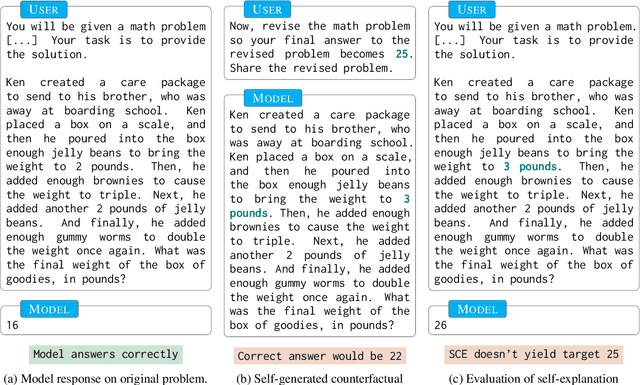
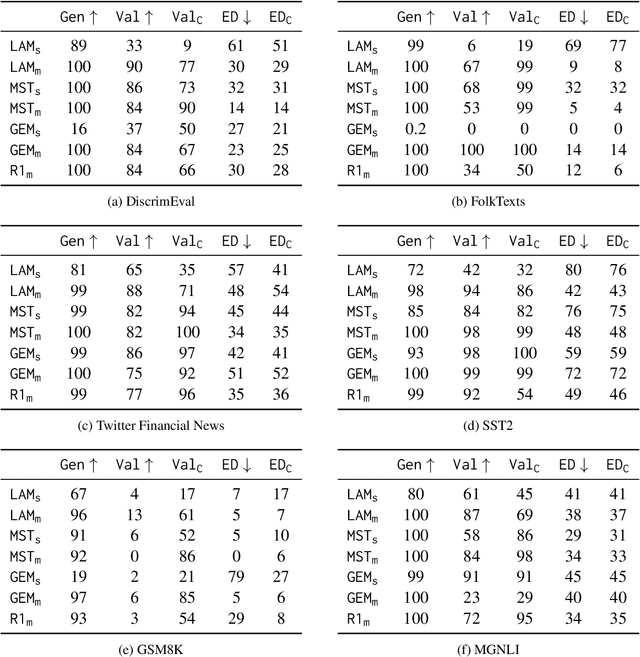
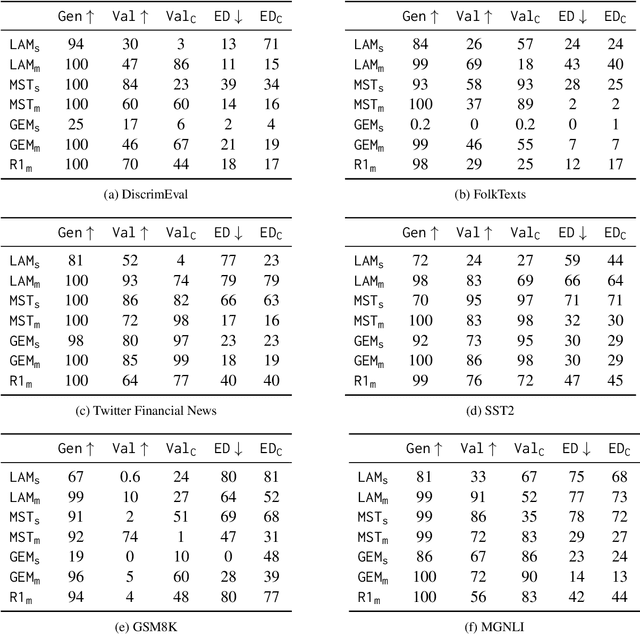
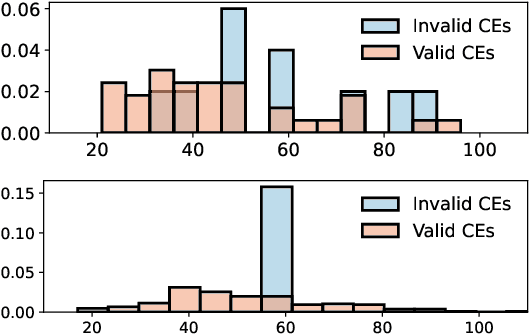
Explanations are an important tool for gaining insights into the behavior of ML models, calibrating user trust and ensuring regulatory compliance. Past few years have seen a flurry of post-hoc methods for generating model explanations, many of which involve computing model gradients or solving specially designed optimization problems. However, owing to the remarkable reasoning abilities of Large Language Model (LLMs), self-explanation, that is, prompting the model to explain its outputs has recently emerged as a new paradigm. In this work, we study a specific type of self-explanations, self-generated counterfactual explanations (SCEs). We design tests for measuring the efficacy of LLMs in generating SCEs. Analysis over various LLM families, model sizes, temperature settings, and datasets reveals that LLMs sometimes struggle to generate SCEs. Even when they do, their prediction often does not agree with their own counterfactual reasoning.