 Add to Chrome
 Add to Firefox
 Add to Edge
Stage-dependent integer-binary encoding in factorization-machine black-box optimization
Jun 22, 2026
Black-box optimization (BBO) deals with problems where objective functions lack explicit analytical forms and are expensive to evaluate. Factorization machine with quadratic-optimization annealing (FMQA) constructs a surrogate model using a factorization machine (FM) and optimizes it with an Ising machine. Conventional FMQA applies a single integer-binary encoding throughout the optimization process, although the encoding best suited to surrogate learning may differ from the one best suited to Ising-machine solution search. We propose a stage-dependent FMQA framework and derive conversion formulas between one-hot and domain-wall QUBO matrices that preserve the surrogate objective over feasible integer states up to an additive constant. We evaluate the OhDw variant, which employs one-hot encoding for learning and domain-wall encoding for search, on the Rastrigin function with input dimensions N = 2 and 5 and discretization levels q = 61 and 301. Across all conditions, the dominant factor governing optimization performance is the encoding used in the learning stage, with one-hot encoding consistently yielding lower residual errors than domain-wall or binary encoding. The additional benefit of switching to domain-wall encoding for solution search is condition-dependent. For N = 5 and q = 301, OhDw achieves a lower residual error and solutions closer to the global optimum than one-hot-only FMQA, whereas for N = 5 and q = 61 the latter achieves a lower residual error. These results indicate that one-hot encoding in the learning stage is the primary performance driver and that stage-dependent encoding can provide further improvement under finer discretization.

Improving FMQA via Initial Training Data Design Considering Marginal Bit Coverage in One-Hot Encoding
May 06, 2026Factorization machine with quadratic-optimization annealing (FMQA) is a black-box optimization method that combines a factorization machine (FM) surrogate with QUBO-based search by an Ising machine. When FMQA is applied to integer or discretized continuous variables via one-hot encoding, uniform random initial sampling can leave many binary variables never active in the initial training data, and the corresponding FM parameters receive no direct gradient updates from the observed responses. We address this by designing the initial training data to achieve complete marginal bit coverage, namely, ensuring that every binary variable obtained by one-hot encoding takes the value one at least once. We use two space-filling sampling methods, Latin hypercube sampling (LHS) and the Sobol' sequence, yielding LHS-FMQA and Sobol'-FMQA. On the human-powered aircraft wing-shape optimization benchmark with 17 and 32 design variables, both proposed methods achieved numerically higher mean final cruising speeds than the baseline FMQA, with the advantage more pronounced on the 32-variable problem.
Optimization Performance of Factorization Machine with Annealing under Limited Training Data
Jul 28, 2025Black-box (BB) optimization problems aim to identify an input that minimizes the output of a function (the BB function) whose input-output relationship is unknown. Factorization machine with annealing (FMA) is a promising approach to this task, employing a factorization machine (FM) as a surrogate model to iteratively guide the solution search via an Ising machine. Although FMA has demonstrated strong optimization performance across various applications, its performance often stagnates as the number of optimization iterations increases. One contributing factor to this stagnation is the growing number of data points in the dataset used to train FM. It is hypothesized that as more data points are accumulated, the contribution of newly added data points becomes diluted within the entire dataset, thereby reducing their impact on improving the prediction accuracy of FM. To address this issue, we propose a novel method for sequential dataset construction that retains at most a specified number of the most recently added data points. This strategy is designed to enhance the influence of newly added data points on the surrogate model. Numerical experiments demonstrate that the proposed FMA achieves lower-cost solutions with fewer BB function evaluations compared to the conventional FMA.
Initialization Method for Factorization Machine Based on Low-Rank Approximation for Constructing a Corrected Approximate Ising Model
Oct 16, 2024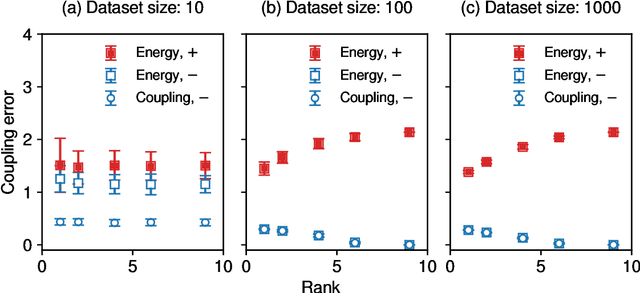
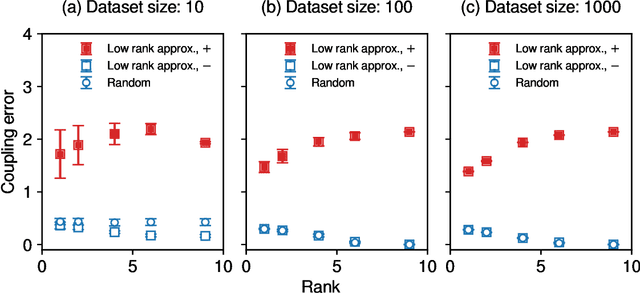
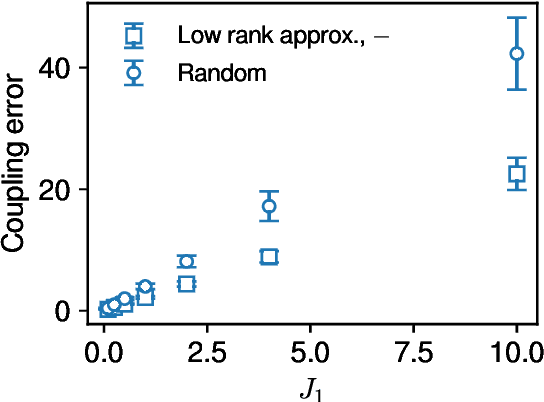
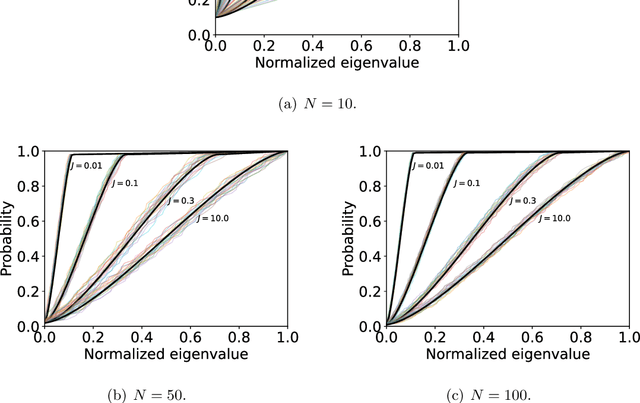
This paper presents an initialization method that can approximate a given approximate Ising model with a high degree of accuracy using the Factorization Machine (FM), a machine learning model. The construction of Ising models using FM is applied to the combinatorial optimization problem using the factorization machine with quantum annealing. It is anticipated that the optimization performance of FMQA will be enhanced through the implementation of the warm-start method. Nevertheless, the optimal initialization method for leveraging the warm-start approach in FMQA remains undetermined. Consequently, the present study compares a number of initialization methods and identifies the most appropriate for use with a warm-start in FMQA through numerical experimentation. Furthermore, the properties of the proposed FM initialization method are analyzed using random matrix theory, demonstrating that the approximation accuracy of the proposed method is not significantly influenced by the specific Ising model under consideration. The findings of this study will facilitate the advancement of combinatorial optimization problem-solving through the use of Ising machines.