 Add to Chrome
 Add to Firefox
 Add to Edge
PAC-Bayesian Reward-Certified Outcome Weighted Learning
Apr 02, 2026
Estimating optimal individualized treatment rules (ITRs) via outcome weighted learning (OWL) often relies on observed rewards that are noisy or optimistic proxies for the true latent utility. Ignoring this reward uncertainty leads to the selection of policies with inflated apparent performance, yet existing OWL frameworks lack the finite-sample guarantees required to systematically embed such uncertainty into the learning objective. To address this issue, we propose PAC-Bayesian Reward-Certified Outcome Weighted Learning (PROWL). Given a one-sided uncertainty certificate, PROWL constructs a conservative reward and a strictly policy-dependent lower bound on the true expected value. Theoretically, we prove an exact certified reduction that transforms robust policy learning into a unified, split-free cost-sensitive classification task. This formulation enables the derivation of a nonasymptotic PAC-Bayes lower bound for randomized ITRs, where we establish that the optimal posterior maximizing this bound is exactly characterized by a general Bayes update. To overcome the learning-rate selection problem inherent in generalized Bayesian inference, we introduce a fully automated, bounds-based calibration procedure, coupled with a Fisher-consistent certified hinge surrogate for efficient optimization. Our experiments demonstrate that PROWL achieves improvements in estimating robust, high-value treatment regimes under severe reward uncertainty compared to standard methods for ITR estimation.

Reconstructing Continuous Light Field From Single Coded Image
Nov 16, 2023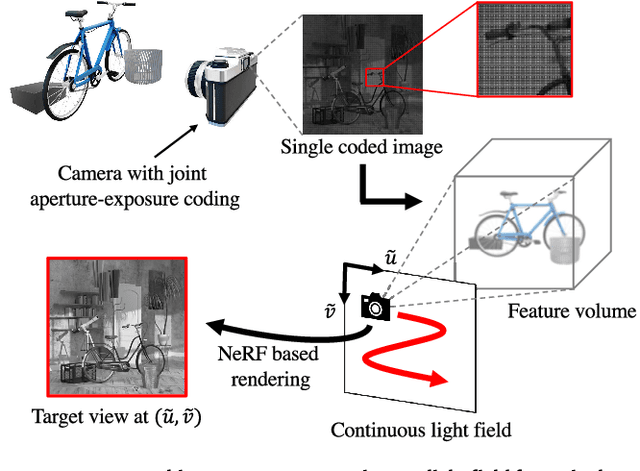

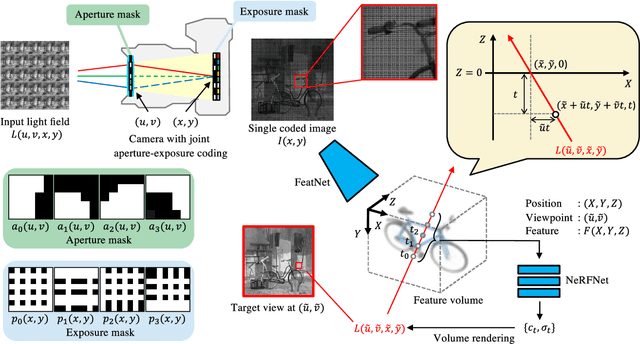

We propose a method for reconstructing a continuous light field of a target scene from a single observed image. Our method takes the best of two worlds: joint aperture-exposure coding for compressive light-field acquisition, and a neural radiance field (NeRF) for view synthesis. Joint aperture-exposure coding implemented in a camera enables effective embedding of 3-D scene information into an observed image, but in previous works, it was used only for reconstructing discretized light-field views. NeRF-based neural rendering enables high quality view synthesis of a 3-D scene from continuous viewpoints, but when only a single image is given as the input, it struggles to achieve satisfactory quality. Our method integrates these two techniques into an efficient and end-to-end trainable pipeline. Trained on a wide variety of scenes, our method can reconstruct continuous light fields accurately and efficiently without any test time optimization. To our knowledge, this is the first work to bridge two worlds: camera design for efficiently acquiring 3-D information and neural rendering.