 Add to Chrome
 Add to Firefox
 Add to Edge
Adaptive Gradient-Based Methods for a Broader Class of Optimization Problems under Performative Prediction
Jul 29, 2026
We study optimization under performative prediction, where deploying a model affects the future data distribution. For this setting, several gradient-based approaches have been proposed. However, they typically assume specific data distributions or loss functions, which limit their practical applicability. To overcome these limitations, we propose a gradient-based optimization method with convergence guarantees under substantially weaker assumptions. Our method explicitly estimates the induced distribution shift through finite differences. It enables higher-dimensional optimization across broader classes of loss functions and data distributions. We also propose a practical variant that reduces the number of samples required. Numerical experiments demonstrate that our proposed algorithms converge faster and more consistently than existing ones.

Zeroth-Order Methods for Nonconvex Stochastic Problems with Decision-Dependent Distributions
Dec 29, 2024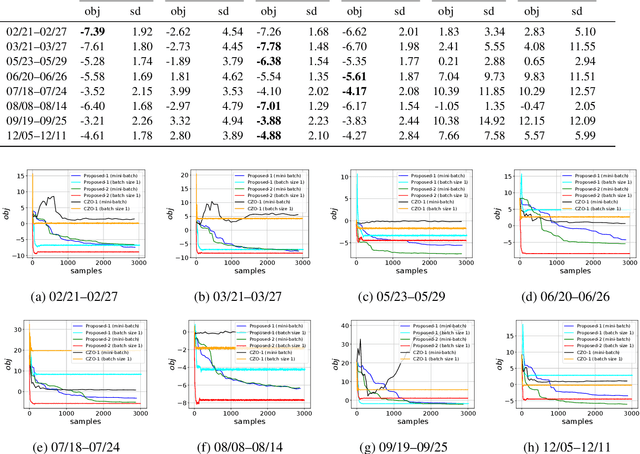
In this study, we consider an optimization problem with uncertainty dependent on decision variables, which has recently attracted attention due to its importance in machine learning and pricing applications. In this problem, the gradient of the objective function cannot be obtained explicitly because the decision-dependent distribution is unknown. Therefore, several zeroth-order methods have been proposed, which obtain noisy objective values by sampling and update the iterates. Although these existing methods have theoretical convergence for optimization problems with decision-dependent uncertainty, they require strong assumptions about the function and distribution or exhibit large variances in their gradient estimators. To overcome these issues, we propose two zeroth-order methods under mild assumptions. First, we develop a zeroth-order method with a new one-point gradient estimator including a variance reduction parameter. The proposed method updates the decision variables while adjusting the variance reduction parameter. Second, we develop a zeroth-order method with a two-point gradient estimator. There are situations where only one-point estimators can be used, but if both one-point and two-point estimators are available, it is more practical to use the two-point estimator. As theoretical results, we show the convergence of our methods to stationary points and provide the worst-case iteration and sample complexity analysis. Our simulation experiments with real data on a retail service application show that our methods output solutions with lower objective values than the conventional zeroth-order methods.