 Add to Chrome
 Add to Firefox
 Add to Edge
LAtent Phase Inference from Short time sequences using SHallow REcurrent Decoders (LAPIS-SHRED)
Apr 01, 2026
Reconstructing full spatio-temporal dynamics from sparse observations in both space and time remains a central challenge in complex systems, as measurements can be spatially incomplete and can be also limited to narrow temporal windows. Yet approximating the complete spatio-temporal trajectory is essential for mechanistic insight and understanding, model calibration, and operational decision-making. We introduce LAPIS-SHRED (LAtent Phase Inference from Short time sequence using SHallow REcurrent Decoders), a modular architecture that reconstructs and/or forecasts complete spatiotemporal dynamics from sparse sensor observations confined to short temporal windows. LAPIS-SHRED operates through a three-stage pipeline: (i) a SHRED model is pre-trained entirely on simulation data to map sensor time-histories into a structured latent space, (ii) a temporal sequence model, trained on simulation-derived latent trajectories, learns to propagate latent states forward or backward in time to span unobserved temporal regions from short observational time windows, and (iii) at deployment, only a short observation window of hyper-sparse sensor measurements from the true system is provided, from which the frozen SHRED model and the temporal model jointly reconstruct or forecast the complete spatiotemporal trajectory. The framework supports bidirectional inference, inherits data assimilation and multiscale reconstruction capabilities from its modular structure, and accommodates extreme observational constraints including single-frame terminal inputs. We evaluate LAPIS-SHRED on six experiments spanning complex spatio-temporal physics: turbulent flows, multiscale propulsion physics, volatile combustion transients, and satellite-derived environmental fields, highlighting a lightweight, modular architecture suited for operational settings where observation is constrained by physical or logistical limitations.

UQ-SHRED: uncertainty quantification of shallow recurrent decoder networks for sparse sensing via engression
Apr 01, 2026Reconstructing high-dimensional spatiotemporal fields from sparse sensor measurements is critical in a wide range of scientific applications. The SHallow REcurrent Decoder (SHRED) architecture is a recent state-of-the-art architecture that reconstructs high-quality spatial domain from hyper-sparse sensor measurement streams. An important limitation of SHRED is that in complex, data-scarce, high-frequency, or stochastic systems, portions of the spatiotemporal field must be modeled with valid uncertainty estimation. We introduce UQ-SHRED, a distributional learning framework for sparse sensing problems that provides uncertainty quantification through a neural network-based distributional regression called engression. UQ-SHRED models the uncertainty by learning the predictive distribution of the spatial state conditioned on the sensor history. By injecting stochastic noise into sensor inputs and training with an energy score loss, UQ-SHRED produces predictive distributions with minimal computational overhead, requiring only noise injection at the input and resampling through a single architecture without retraining or additional network structures. On complicated synthetic and real-life datasets including turbulent flow, atmospheric dynamics, neuroscience and astrophysics, UQ-SHRED provides a distributional approximation with well-calibrated confidence intervals. We further conduct ablation studies to understand how each model setting affects the quality of the UQ-SHRED performance, and its validity on uncertainty quantification over a set of different experimental setups.
SENDAI: A Hierarchical Sparse-measurement, EfficieNt Data AssImilation Framework
Jan 29, 2026Bridging the gap between data-rich training regimes and observation-sparse deployment conditions remains a central challenge in spatiotemporal field reconstruction, particularly when target domains exhibit distributional shifts, heterogeneous structure, and multi-scale dynamics absent from available training data. We present SENDAI, a hierarchical Sparse-measurement, EfficieNt Data AssImilation Framework that reconstructs full spatial states from hyper sparse sensor observations by combining simulation-derived priors with learned discrepancy corrections. We demonstrate the performance on satellite remote sensing, reconstructing MODIS (Moderate Resolution Imaging Spectroradiometer) derived vegetation index fields across six globally distributed sites. Using seasonal periods as a proxy for domain shift, the framework consistently outperforms established baselines that require substantially denser observations -- SENDAI achieves a maximum SSIM improvement of 185% over traditional baselines and a 36% improvement over recent high-frequency-based methods. These gains are particularly pronounced for landscapes with sharp boundaries and sub-seasonal dynamics; more importantly, the framework effectively preserves diagnostically relevant structures -- such as field topologies, land cover discontinuities, and spatial gradients. By yielding corrections that are more structurally and spectrally separable, the reconstructed fields are better suited for downstream inference of indirectly observed variables. The results therefore highlight a lightweight and operationally viable framework for sparse-measurement reconstruction that is applicable to physically grounded inference, resource-limited deployment, and real-time monitor and control.
Cheap2Rich: A Multi-Fidelity Framework for Data Assimilation and System Identification of Multiscale Physics -- Rotating Detonation Engines
Jan 28, 2026Bridging the sim2real gap between computationally inexpensive models and complex physical systems remains a central challenge in machine learning applications to engineering problems, particularly in multi-scale settings where reduced-order models typically capture only dominant dynamics. In this work, we present Cheap2Rich, a multi-scale data assimilation framework that reconstructs high-fidelity state spaces from sparse sensor histories by combining a fast low-fidelity prior with learned, interpretable discrepancy corrections. We demonstrate the performance on rotating detonation engines (RDEs), a challenging class of systems that couple detonation-front propagation with injector-driven unsteadiness, mixing, and stiff chemistry across disparate scales. Our approach successfully reconstructs high-fidelity RDE states from sparse measurements while isolating physically meaningful discrepancy dynamics associated with injector-driven effects. The results highlight a general multi-fidelity framework for data assimilation and system identification in complex multi-scale systems, enabling rapid design exploration and real-time monitoring and control while providing interpretable discrepancy dynamics. Code for this project is is available at: github.com/kro0l1k/Cheap2Rich.
Information theory and discriminative sampling for model discovery
Dec 17, 2025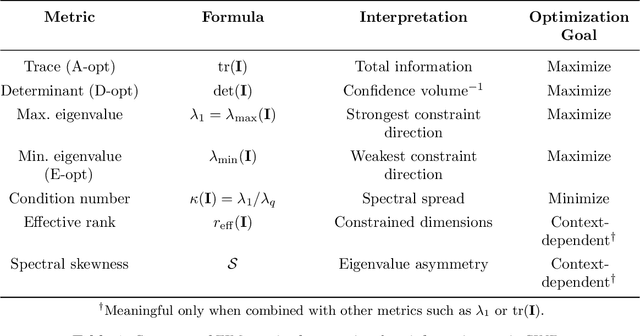
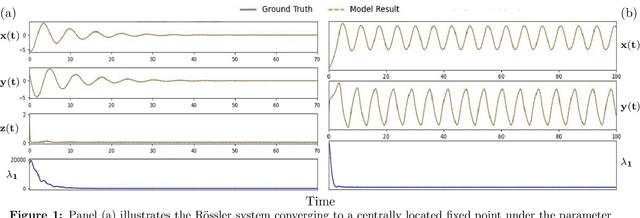
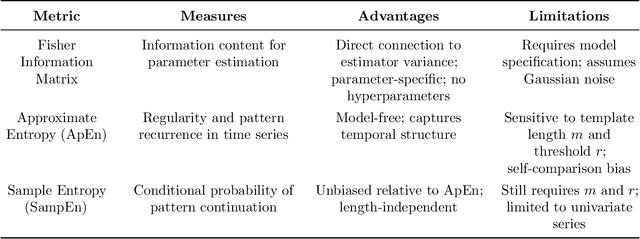
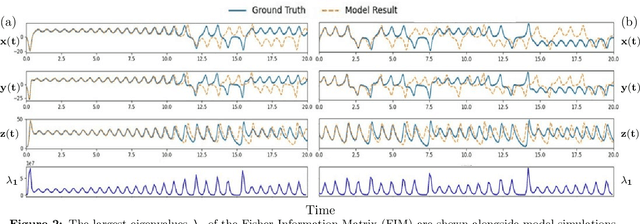
Fisher information and Shannon entropy are fundamental tools for understanding and analyzing dynamical systems from complementary perspectives. They can characterize unknown parameters by quantifying the information contained in variables, or measure how different initial trajectories or temporal segments of a trajectory contribute to learning or inferring system dynamics. In this work, we leverage the Fisher Information Matrix (FIM) within the data-driven framework of {\em sparse identification of nonlinear dynamics} (SINDy). We visualize information patterns in chaotic and non-chaotic systems for both single trajectories and multiple initial conditions, demonstrating how information-based analysis can improve sampling efficiency and enhance model performance by prioritizing more informative data. The benefits of statistical bagging are further elucidated through spectral analysis of the FIM. We also illustrate how Fisher information and entropy metrics can promote data efficiency in three scenarios: when only a single trajectory is available, when a tunable control parameter exists, and when multiple trajectories can be freely initialized. As data-driven model discovery continues to gain prominence, principled sampling strategies guided by quantifiable information metrics offer a powerful approach for improving learning efficiency and reducing data requirements.
BountyBench: Dollar Impact of AI Agent Attackers and Defenders on Real-World Cybersecurity Systems
May 21, 2025AI agents have the potential to significantly alter the cybersecurity landscape. To help us understand this change, we introduce the first framework to capture offensive and defensive cyber-capabilities in evolving real-world systems. Instantiating this framework with BountyBench, we set up 25 systems with complex, real-world codebases. To capture the vulnerability lifecycle, we define three task types: Detect (detecting a new vulnerability), Exploit (exploiting a specific vulnerability), and Patch (patching a specific vulnerability). For Detect, we construct a new success indicator, which is general across vulnerability types and provides localized evaluation. We manually set up the environment for each system, including installing packages, setting up server(s), and hydrating database(s). We add 40 bug bounties, which are vulnerabilities with monetary awards from \$10 to \$30,485, and cover 9 of the OWASP Top 10 Risks. To modulate task difficulty, we devise a new strategy based on information to guide detection, interpolating from identifying a zero day to exploiting a specific vulnerability. We evaluate 5 agents: Claude Code, OpenAI Codex CLI, and custom agents with GPT-4.1, Gemini 2.5 Pro Preview, and Claude 3.7 Sonnet Thinking. Given up to three attempts, the top-performing agents are Claude Code (5% on Detect, mapping to \$1,350), Custom Agent with Claude 3.7 Sonnet Thinking (5% on Detect, mapping to \$1,025; 67.5% on Exploit), and OpenAI Codex CLI (5% on Detect, mapping to \$2,400; 90% on Patch, mapping to \$14,422). OpenAI Codex CLI and Claude Code are more capable at defense, achieving higher Patch scores of 90% and 87.5%, compared to Exploit scores of 32.5% and 57.5% respectively; in contrast, the custom agents are relatively balanced between offense and defense, achieving Exploit scores of 40-67.5% and Patch scores of 45-60%.