 Add to Chrome
 Add to Firefox
 Add to Edge
HyperQuant: A Rate-Distortion-Optimal Quantization Pipeline for Large Language and Diffusion Models
Jun 22, 2026
We present HyperQuant (Hadamard, optimallY Packing, Entropy Rice-coding), a unified post-training quantization pipeline for the weights and the KV cache of large language and diffusion transformers. Across a suite of self-contained experiments (Table 1), HyperQuant outperforms the recent HIGGS scheme at every operating point from 3 to 5 bits per scalar (bps) on weights, and beats both TurboQuant and OCTOPUS on KV quantization down to 1.7 bps. Beyond the LLM setting, HyperQuant quantizes the 19B-parameter LTX-2 DiT video model with no observable per-frame artifacts. End-to-end on an H100 at 4 bps, HyperQuant compresses the linear weights ~3.9x and the KV cache ~3.79x at near-lossless quality. HyperQuant combines four known ideas into a single construction: (i) a per-tile Randomized Hadamard Transform that makes the per-coordinate distribution of weights and activations approximately Gaussian; (ii) quantization to a low-dimensional optimal lattice (E8, D4, A2, or Z); (iii) lossless bit-stripping and near-entropy-optimal variable-length Rice coding of the lattice indices; and (iv) bias-correction methods for the KV cache that keep the reconstruction unbiased under inner products, preserving attention semantics. We further integrate the pipeline with 8-bit and 4-bit Tensor-Core MMA paths (fp8-e4m3, int8, nvfp4, mxfp4), and find that int8 beats fp8 on the post-RHT lattice output. Project page: https://moonmath.ai/hyperquant/

LiteAttention: A Temporal Sparse Attention for Diffusion Transformers
Nov 14, 2025

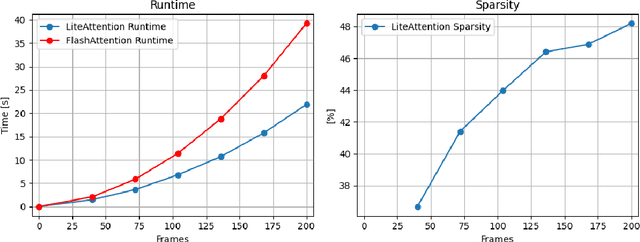
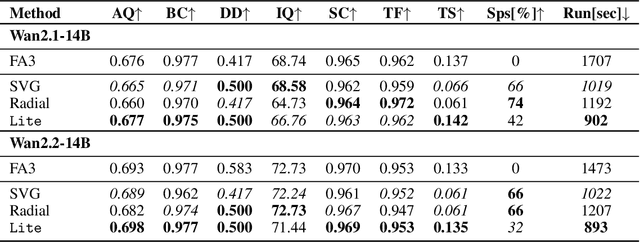
Diffusion Transformers, particularly for video generation, achieve remarkable quality but suffer from quadratic attention complexity, leading to prohibitive latency. Existing acceleration methods face a fundamental trade-off: dynamically estimating sparse attention patterns at each denoising step incurs high computational overhead and estimation errors, while static sparsity patterns remain fixed and often suboptimal throughout denoising. We identify a key structural property of diffusion attention, namely, its sparsity patterns exhibit strong temporal coherence across denoising steps. Tiles deemed non-essential at step $t$ typically remain so at step $t+δ$. Leveraging this observation, we introduce LiteAttention, a method that exploits temporal coherence to enable evolutionary computation skips across the denoising sequence. By marking non-essential tiles early and propagating skip decisions forward, LiteAttention eliminates redundant attention computations without repeated profiling overheads, combining the adaptivity of dynamic methods with the efficiency of static ones. We implement a highly optimized LiteAttention kernel on top of FlashAttention and demonstrate substantial speedups on production video diffusion models, with no degradation in quality. The code and implementation details will be publicly released.