 Add to Chrome
 Add to Firefox
 Add to Edge
Physics-conforming Latent Twins
Jun 13, 2026
Surrogate models are central to scientific machine learning, where they enable fast prediction, simulation, inference, and control for complex physical systems. For time-dependent problems, however, accurate interpolation of training trajectories is not sufficient: reliable surrogates should also respect the conservation laws, invariants, admissibility conditions, and dissipative structures that give those trajectories physical meaning. We introduce Physics-conforming Latent Twins, a framework for learning latent surrogate solution operators whose dynamics satisfy selected physical principles by design. The method builds on the Latent Twin formulation by jointly learning an encoder, a decoder, and a latent flow map between arbitrary time-indexed states, while constraining the latent dynamics to preserve or dissipate prescribed structural quantities. We develop a constraint-transfer viewpoint that connects physical structure in the original state space with compatible constraints in latent space, and prove structure-preservation bounds showing how latent enforcement improves control of physical defects after decoding. We also derive algebraic conditions for latent flow maps that preserve linear and quadratic invariants or enforce dissipative inequalities. Numerical experiments on representative ODE and PDE benchmarks demonstrate improved constraint satisfaction, structural fidelity, and qualitative long-time behavior while maintaining accurate surrogate prediction.

State-of-the-Art Stroke Lesion Segmentation at 1/1000th of Parameters
Mar 07, 2025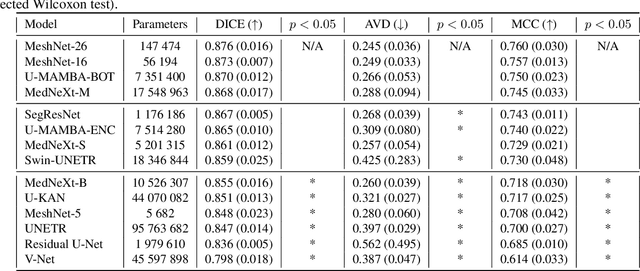
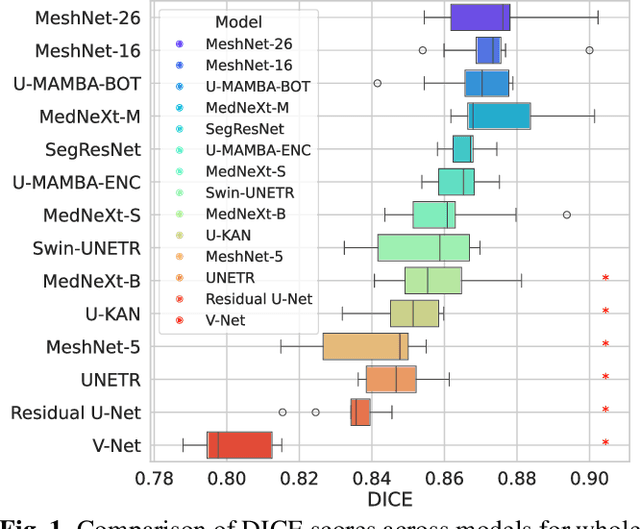
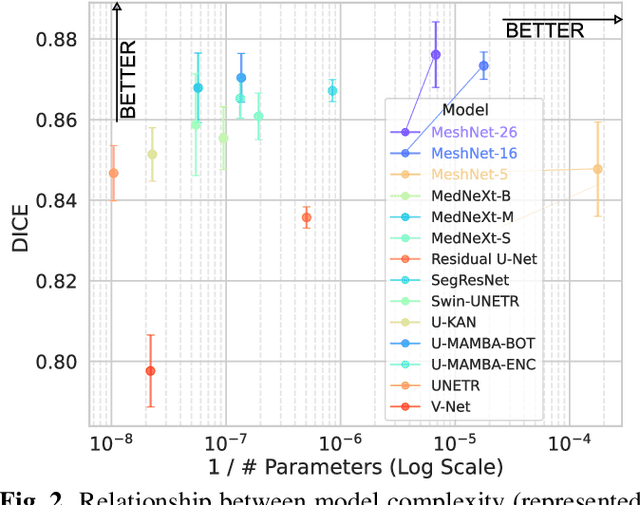
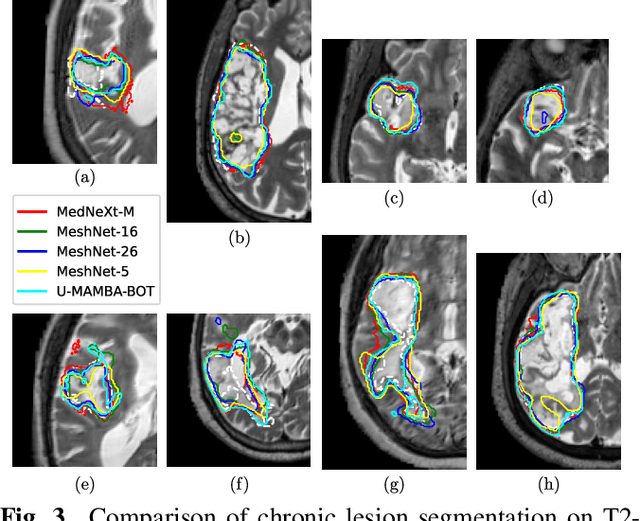
Efficient and accurate whole-brain lesion segmentation remains a challenge in medical image analysis. In this work, we revisit MeshNet, a parameter-efficient segmentation model, and introduce a novel multi-scale dilation pattern with an encoder-decoder structure. This innovation enables capturing broad contextual information and fine-grained details without traditional downsampling, upsampling, or skip-connections. Unlike previous approaches processing subvolumes or slices, we operate directly on whole-brain $256^3$ MRI volumes. Evaluations on the Aphasia Recovery Cohort (ARC) dataset demonstrate that MeshNet achieves superior or comparable DICE scores to state-of-the-art architectures such as MedNeXt and U-MAMBA at 1/1000th of parameters. Our results validate MeshNet's strong balance of efficiency and performance, making it particularly suitable for resource-limited environments such as web-based applications and opening new possibilities for the widespread deployment of advanced medical image analysis tools.