 Add to Chrome
 Add to Firefox
 Add to Edge
Regret Analysis of Sleeping Competing Bandits
Mar 20, 2026
The Competing Bandits framework is a recently emerging area that integrates multi-armed bandits in online learning with stable matching in game theory. While conventional models assume that all players and arms are constantly available, in real-world problems, their availability can vary arbitrarily over time. In this paper, we formulate this setting as Sleeping Competing Bandits. To analyze this problem, we naturally extend the regret definition used in existing competing bandits and derive regret bounds for the proposed model. We propose an algorithm that simultaneously achieves an asymptotic regret bound of $\mathrm{O}\left(NK\log T_{i}/Δ^2\right)$ under reasonable assumptions, where $N$ is the number of players, $K$ is the number of arms, $T_{i}$ is the number of rounds of each player $p_i$, and $Δ$ is the minimum reward gap. We also provide a regret lower bound of $\mathrmΩ\left( N(K-N+1)\log T_{i}/Δ^2 \right)$ under the same assumptions. This implies that our algorithm is asymptotically optimal in the regime where the number of arms $K$ is relatively larger than the number of players $N$.

Parametric Maxflows for Structured Sparse Learning with Convex Relaxations of Submodular Functions
Sep 14, 2015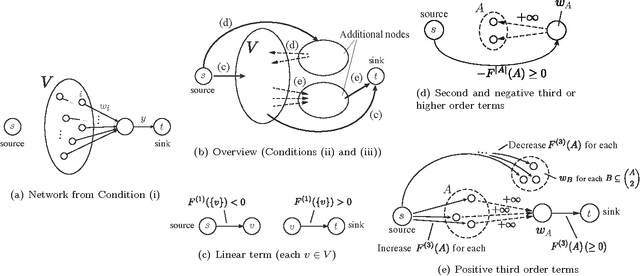
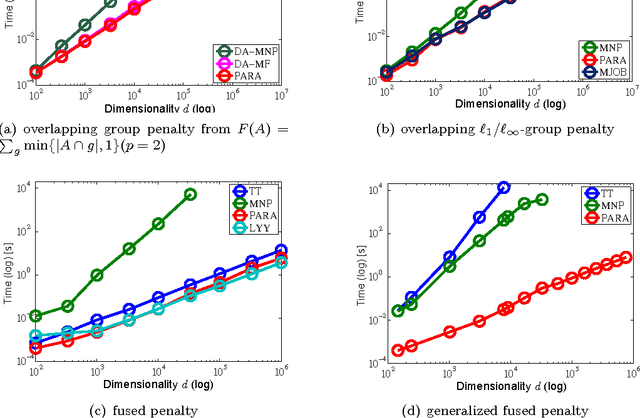
The proximal problem for structured penalties obtained via convex relaxations of submodular functions is known to be equivalent to minimizing separable convex functions over the corresponding submodular polyhedra. In this paper, we reveal a comprehensive class of structured penalties for which penalties this problem can be solved via an efficiently solvable class of parametric maxflow optimization. We then show that the parametric maxflow algorithm proposed by Gallo et al. and its variants, which runs, in the worst-case, at the cost of only a constant factor of a single computation of the corresponding maxflow optimization, can be adapted to solve the proximal problems for those penalties. Several existing structured penalties satisfy these conditions; thus, regularized learning with these penalties is solvable quickly using the parametric maxflow algorithm. We also investigate the empirical runtime performance of the proposed framework.