 Add to Chrome
 Add to Firefox
 Add to Edge
Genetic Algorithm for Program Synthesis
Nov 22, 2022
A deductive program synthesis tool takes a specification as input and derives a program that satisfies the specification. The drawback of this approach is that search spaces for such correct programs tend to be enormous, making it difficult to derive correct programs within a realistic timeout. To speed up such program derivation, we improve the search strategy of a deductive program synthesis tool, SuSLik, using evolutionary computation. Our cross-validation shows that the improvement brought by evolutionary computation generalises to unforeseen problems.

SeLFiE: Modular Semantic Reasoning for Induction in Isabelle/HOL
Oct 19, 2020
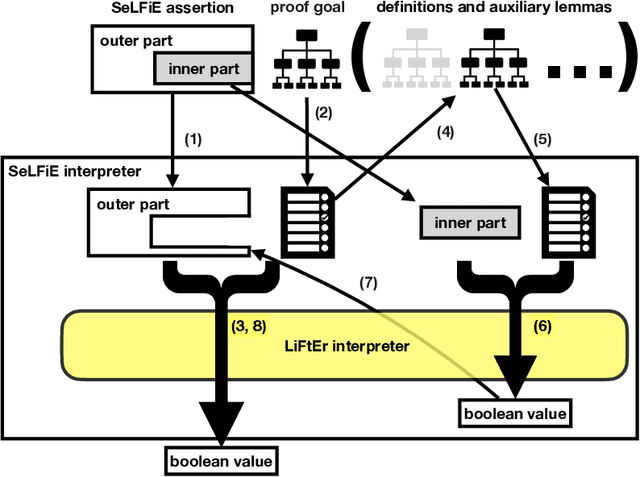

Proof assistants offer tactics to apply proof by induction, but these tactics rely on inputs given by human engineers. We address this problem withSeLFiE, a domain-specific language to encode experienced users' expertise on how to apply the induct tactic in Isabelle/HOL: when we apply an induction heuristic written in SeLFiE to an inductive problem and arguments to the induct tactic, the SeLFiE interpreter examines both the syntactic structure of the problem and semantics of the relevant constants to judge whether the arguments to the induct tactic are plausible for that problem according to the heuristic. SeLFiE facilitates the intricate interaction between syntactic and semantic analyses using semantic constructs while maintaining the modularity of each analysis.
Faster Smarter Induction in Isabelle/HOL with SeLFiE
Oct 09, 2020


Proof by induction is a long-standing challenge in Computer Science. Induction tactics of proof assistants facilitate proof by induction, but rely on humans to manually specify how to apply induction. In this paper, we present SeLFiE, a domain-specific language to encode experienced users' expertise on how to apply the induct tactic in Isabelle/HOL: when we apply an induction heuristic written in SeLFiE to an inductive problem and arguments to the induct tactic, the SeLFiE interpreter examines both the syntactic structure of the problem and semantics of the relevant constants to judge whether the arguments to the induct tactic are plausible according to the heuristic. Then, we present semantic_induct, an automatic tool to recommend how to apply the induct tactic. Given an inductive problem, semantic_induct produces candidate arguments to the induct tactic and selects promising ones using heuristics written in SeLFiE. Our evaluation based on 254 inductive problems from nine problem domains show that semantic_induct achieved 15.7 percentage points of improvements in coincidence rates for the three most promising recommendations while achieving 43% of reduction in the median value for the execution time when compared to an existing tool, smart_induct.
Simple Dataset for Proof Method Recommendation in Isabelle/HOL (Dataset Description)
May 26, 2020Recently, a growing number of researchers have applied machine learning to assist users of interactive theorem provers. However, the expressive nature of underlying logics and esoteric structures of proof documents impede machine learning practitioners, who often do not have much expertise in formal logic, let alone Isabelle/HOL, from achieving a large scale success in this field. In this data description, we present a simple dataset that contains data on over 400k proof method applications along with over 100 extracted features for each in a format that can be processed easily without any knowledge about formal logic. Our simple data format allows machine learning practitioners to try machine learning tools to predict proof methods in Isabelle/HOL without requiring domain expertise in logic.
Towards United Reasoning for Automatic Induction in Isabelle/HOL
May 25, 2020
Inductive theorem proving is an important long-standing challenge in computer science. In this extended abstract, we first summarize the recent developments of proof by induction for Isabelle/HOL. Then, we propose united reasoning, a novel approach to further automating inductive theorem proving. Upon success, united reasoning takes the best of three schools of reasoning: deductive reasoning, inductive reasoning, and inductive reasoning, to prove difficult inductive problems automatically.
Smart Induction for Isabelle/HOL (System Description)
Jan 27, 2020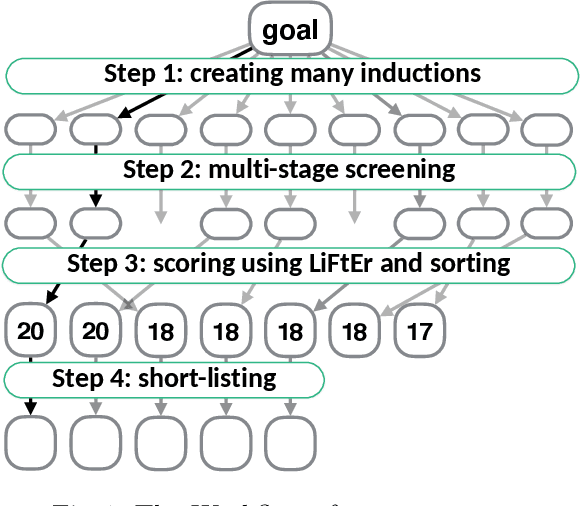
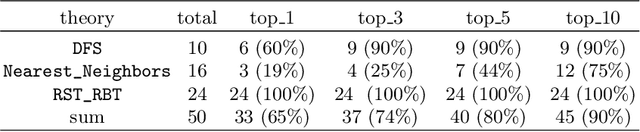

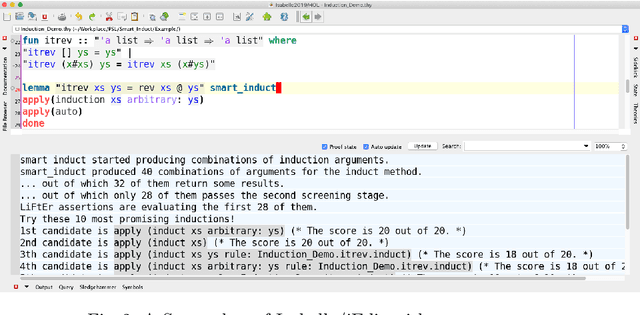
Proof assistants offer tactics to facilitate inductive proofs. However, it still requires human ingenuity to decide what arguments to pass to those induction tactics. To automate this process, we present smart_induct for Isabelle/HOL. Given an inductive problem in any problem domain, smart_induct lists promising arguments for the induct tactic without relying on a search. Our evaluation demonstrated smart_induct produces valuable recommendations across problem domains.
Designing Game of Theorems
Jun 20, 2019"Theorem proving is similar to the game of Go. So, we can probably improve our provers using deep learning, like DeepMind built the super-human computer Go program, AlphaGo." Such optimism has been observed among participants of AITP2017. But is theorem proving really similar to Go? In this paper, we first identify the similarities and differences between them and then propose a system in which various provers keep competing against each other and changing themselves until they prove conjectures provided by users.
Towards Evolutionary Theorem Proving for Isabelle/HOL
Apr 17, 2019Mechanized theorem proving is becoming the basis of reliable systems programming and rigorous mathematics. Despite decades of progress in proof automation, writing mechanized proofs still requires engineers' expertise and remains labor intensive. Recently, researchers have extracted heuristics of interactive proof development from existing large proof corpora using supervised learning. However, such existing proof corpora present only one way of proving conjectures, while there are often multiple equivalently effective ways to prove one conjecture. In this abstract, we identify challenges in discovering heuristics for automatic proof search and propose our novel approach to improve heuristics of automatic proof search in Isabelle/HOL using evolutionary computation.
Towards Machine Learning Mathematical Induction
Dec 04, 2018Mathematical induction lies at the heart of mathematics and computer science. However, automated theorem proving of inductive problems is still limited in its power. In this abstract, we first summarize our progress in automating inductive theorem proving for Isabelle/HOL. Then, we present MiLkMaId, our approach to suggesting promising applications of mathematical induction without completing a proof search.
PaMpeR: Proof Method Recommendation System for Isabelle/HOL
Jun 19, 2018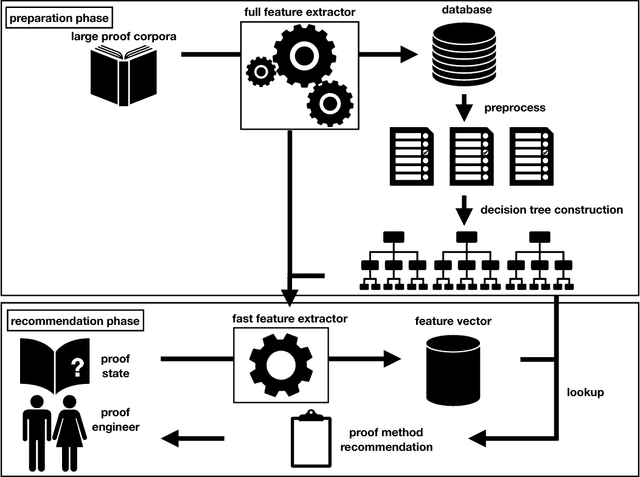
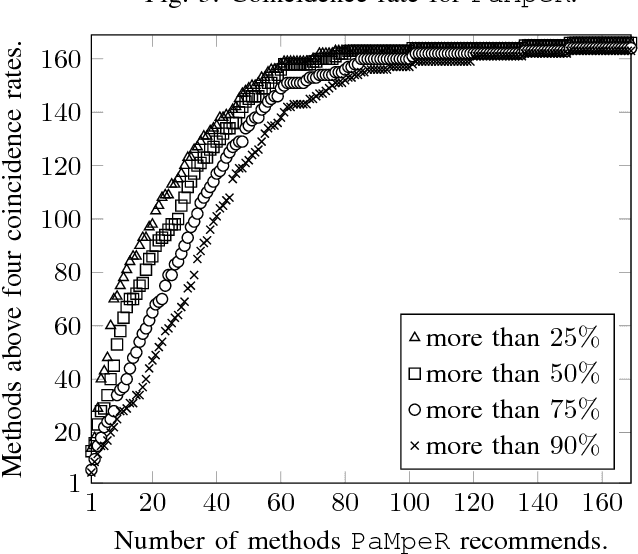


Deciding which sub-tool to use for a given proof state requires expertise specific to each ITP. To mitigate this problem, we present PaMpeR, a Proof Method Recommendation system for Isabelle/HOL. Given a proof state, PaMpeR recommends proof methods to discharge the proof goal and provides qualitative explanations as to why it suggests these methods. PaMpeR generates these recommendations based on existing hand-written proof corpora, thus transferring experienced users' expertise to new users. Our evaluation shows that PaMpeR correctly predicts experienced users' proof methods invocation especially when it comes to special purpose proof methods.