 Add to Chrome
 Add to Firefox
 Add to Edge
Hybrid Motion Planning with Deep Reinforcement Learning for Mobile Robot Navigation
Dec 31, 2025
Autonomous mobile robots operating in complex, dynamic environments face the dual challenge of navigating large-scale, structurally diverse spaces with static obstacles while safely interacting with various moving agents. Traditional graph-based planners excel at long-range pathfinding but lack reactivity, while Deep Reinforcement Learning (DRL) methods demonstrate strong collision avoidance but often fail to reach distant goals due to a lack of global context. We propose Hybrid Motion Planning with Deep Reinforcement Learning (HMP-DRL), a hybrid framework that bridges this gap. Our approach utilizes a graph-based global planner to generate a path, which is integrated into a local DRL policy via a sequence of checkpoints encoded in both the state space and reward function. To ensure social compliance, the local planner employs an entity-aware reward structure that dynamically adjusts safety margins and penalties based on the semantic type of surrounding agents. We validate the proposed method through extensive testing in a realistic simulation environment derived from real-world map data. Comprehensive experiments demonstrate that HMP-DRL consistently outperforms other methods, including state-of-the-art approaches, in terms of key metrics of robot navigation: success rate, collision rate, and time to reach the goal. Overall, these findings confirm that integrating long-term path guidance with semantically-aware local control significantly enhances both the safety and reliability of autonomous navigation in complex human-centric settings.

Robot Navigation with Entity-Based Collision Avoidance using Deep Reinforcement Learning
Aug 26, 2024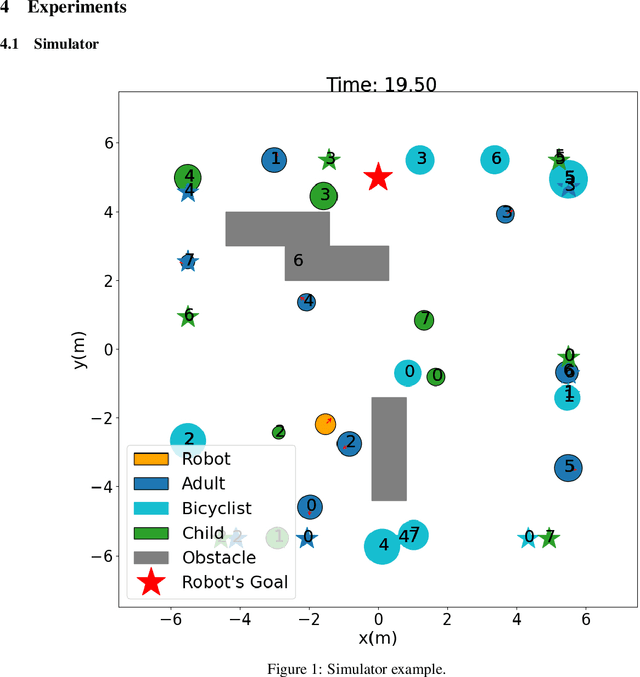

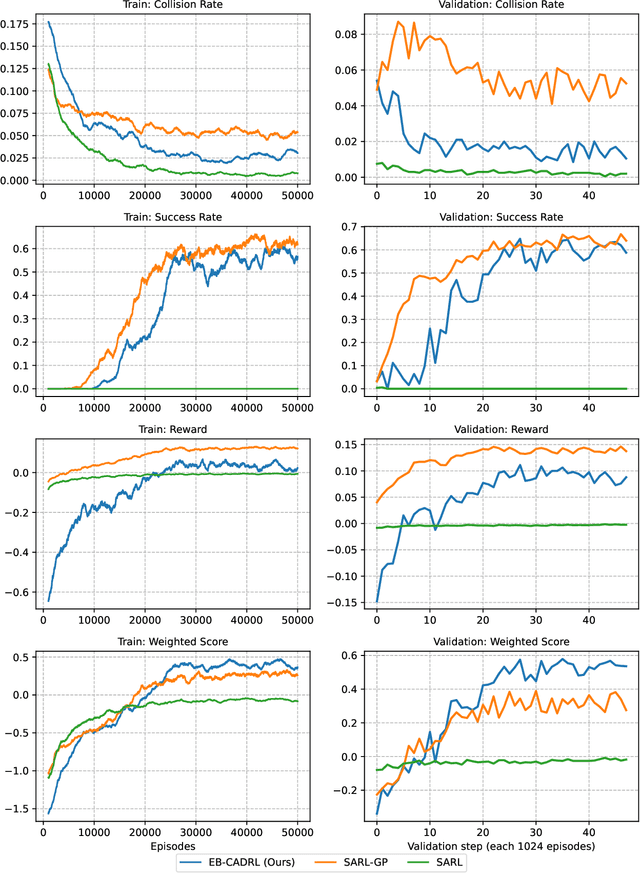
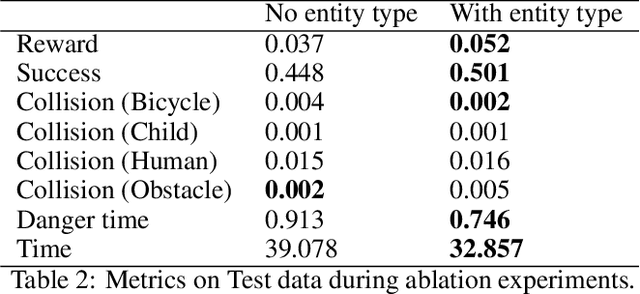
Efficient navigation in dynamic environments is crucial for autonomous robots interacting with various environmental entities, including both moving agents and static obstacles. In this study, we present a novel methodology that enhances the robot's interaction with different types of agents and obstacles based on specific safety requirements. This approach uses information about the entity types, improving collision avoidance and ensuring safer navigation. We introduce a new reward function that penalizes the robot for collisions with different entities such as adults, bicyclists, children, and static obstacles, and additionally encourages the robot's proximity to the goal. It also penalizes the robot for being close to entities, and the safe distance also depends on the entity type. Additionally, we propose an optimized algorithm for training and testing, which significantly accelerates train, validation, and test steps and enables training in complex environments. Comprehensive experiments conducted using simulation demonstrate that our approach consistently outperforms conventional navigation and collision avoidance methods, including state-of-the-art techniques. To sum up, this work contributes to enhancing the safety and efficiency of navigation systems for autonomous robots in dynamic, crowded environments.