 Add to Chrome
 Add to Firefox
 Add to Edge
Ksurf-Drone: Attention Kalman Filter for Contextual Bandit Optimization in Cloud Resource Allocation
Nov 12, 2025
Resource orchestration and configuration parameter search are key concerns for container-based infrastructure in cloud data centers. Large configuration search space and cloud uncertainties are often mitigated using contextual bandit techniques for resource orchestration including the state-of-the-art Drone orchestrator. Complexity in the cloud provider environment due to varying numbers of virtual machines introduces variability in workloads and resource metrics, making orchestration decisions less accurate due to increased nonlinearity and noise. Ksurf, a state-of-the-art variance-minimizing estimator method ideal for highly variable cloud data, enables optimal resource estimation under conditions of high cloud variability. This work evaluates the performance of Ksurf on estimation-based resource orchestration tasks involving highly variable workloads when employed as a contextual multi-armed bandit objective function model for cloud scenarios using Drone. Ksurf enables significantly lower latency variance of $41\%$ at p95 and $47\%$ at p99, demonstrates a $4\%$ reduction in CPU usage and 7 MB reduction in master node memory usage on Kubernetes, resulting in a $7\%$ cost savings in average worker pod count on VarBench Kubernetes benchmark.

Horizontal Federated Learning and Secure Distributed Training for Recommendation System with Intel SGX
Jul 11, 2022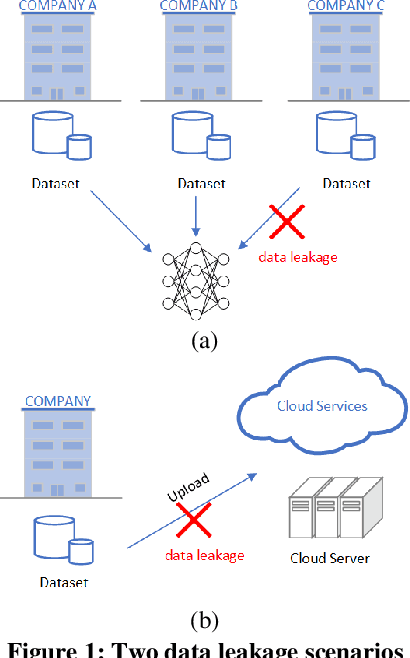
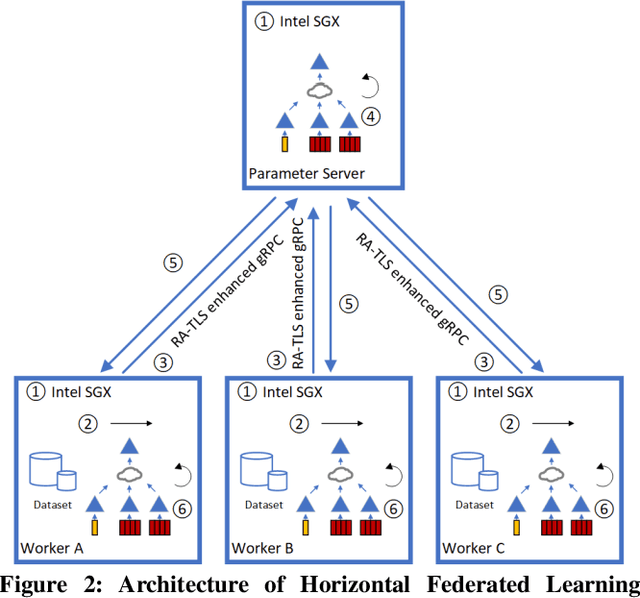
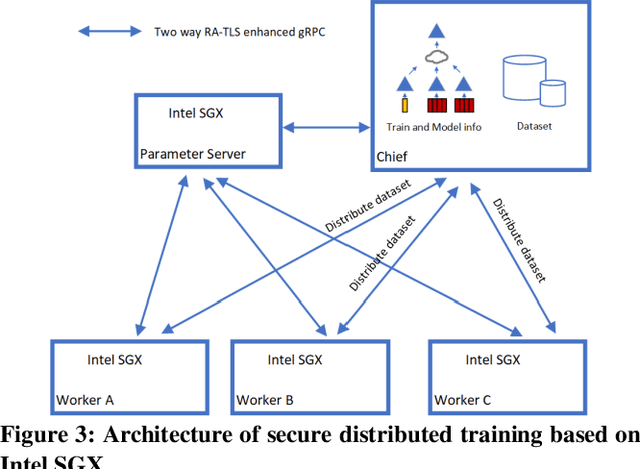
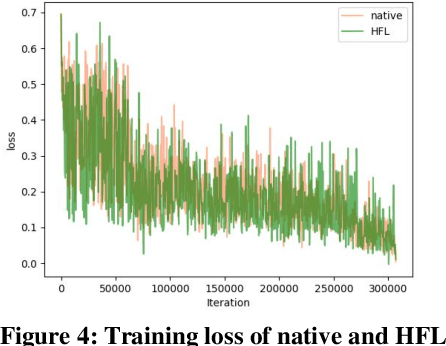
With the advent of big data era and the development of artificial intelligence and other technologies, data security and privacy protection have become more important. Recommendation systems have many applications in our society, but the model construction of recommendation systems is often inseparable from users' data. Especially for deep learning-based recommendation systems, due to the complexity of the model and the characteristics of deep learning itself, its training process not only requires long training time and abundant computational resources but also needs to use a large amount of user data, which poses a considerable challenge in terms of data security and privacy protection. How to train a distributed recommendation system while ensuring data security has become an urgent problem to be solved. In this paper, we implement two schemes, Horizontal Federated Learning and Secure Distributed Training, based on Intel SGX(Software Guard Extensions), an implementation of a trusted execution environment, and TensorFlow framework, to achieve secure, distributed recommendation system-based learning schemes in different scenarios. We experiment on the classical Deep Learning Recommendation Model (DLRM), which is a neural network-based machine learning model designed for personalization and recommendation, and the results show that our implementation introduces approximately no loss in model performance. The training speed is within acceptable limits.