 Add to Chrome
 Add to Firefox
 Add to Edge
Label Shift Estimation With Incremental Prior Update
Apr 02, 2026
An assumption often made in supervised learning is that the training and testing sets have the same label distribution. However, in real-life scenarios, this assumption rarely holds. For example, medical diagnosis result distributions change over time and across locations; fraud detection models must adapt as patterns of fraudulent activity shift; the category distribution of social media posts changes based on trending topics and user demographics. In the task of label shift estimation, the goal is to estimate the changing label distribution $p_t(y)$ in the testing set, assuming the likelihood $p(x|y)$ does not change, implying no concept drift. In this paper, we propose a new approach for post-hoc label shift estimation, unlike previous methods that perform moment matching with confusion matrix estimated from a validation set or maximize the likelihood of the new data with an expectation-maximization algorithm. We aim to incrementally update the prior on each sample, adjusting each posterior for more accurate label shift estimation. The proposed method is based on intuitive assumptions on classifiers that are generally true for modern probabilistic classifiers. The proposed method relies on a weaker notion of calibration compared to other methods. As a post-hoc approach for label shift estimation, the proposed method is versatile and can be applied to any black-box probabilistic classifier. Experiments on CIFAR-10 and MNIST show that the proposed method consistently outperforms the current state-of-the-art maximum likelihood-based methods under different calibrations and varying intensities of label shift.
* SIAM SDM 2025

Instance-Wise Monotonic Calibration by Constrained Transformation
Jul 09, 2025Deep neural networks often produce miscalibrated probability estimates, leading to overconfident predictions. A common approach for calibration is fitting a post-hoc calibration map on unseen validation data that transforms predicted probabilities. A key desirable property of the calibration map is instance-wise monotonicity (i.e., preserving the ranking of probability outputs). However, most existing post-hoc calibration methods do not guarantee monotonicity. Previous monotonic approaches either use an under-parameterized calibration map with limited expressive ability or rely on black-box neural networks, which lack interpretability and robustness. In this paper, we propose a family of novel monotonic post-hoc calibration methods, which employs a constrained calibration map parameterized linearly with respect to the number of classes. Our proposed approach ensures expressiveness, robustness, and interpretability while preserving the relative ordering of the probability output by formulating the proposed calibration map as a constrained optimization problem. Our proposed methods achieve state-of-the-art performance across datasets with different deep neural network models, outperforming existing calibration methods while being data and computation-efficient. Our code is available at https://github.com/YunruiZhang/Calibration-by-Constrained-Transformation
Revisit Time Series Classification Benchmark: The Impact of Temporal Information for Classification
Mar 26, 2025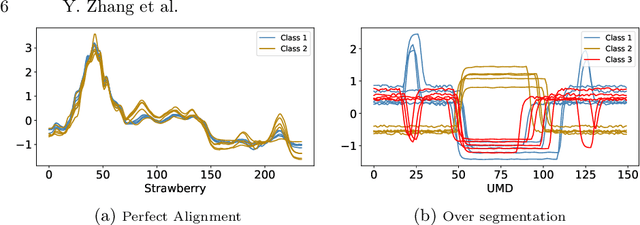
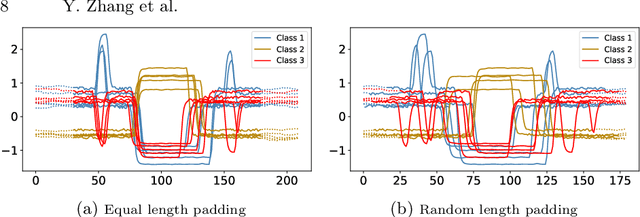
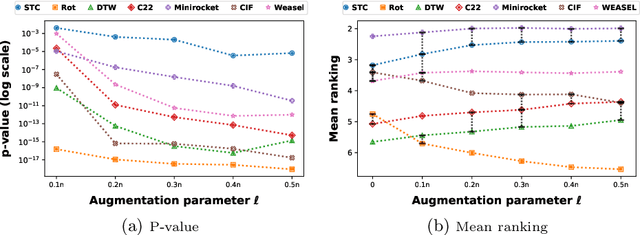
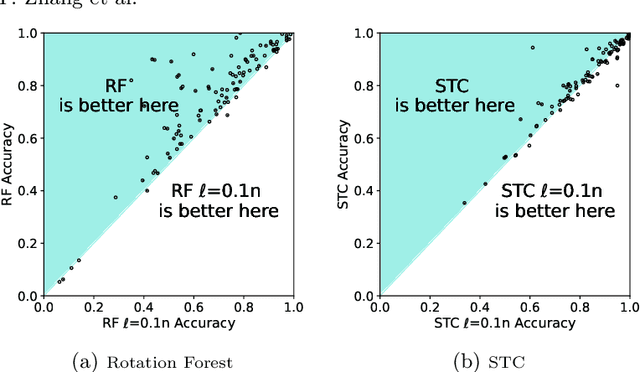
Time series classification is usually regarded as a distinct task from tabular data classification due to the importance of temporal information. However, in this paper, by performing permutation tests that disrupt temporal information on the UCR time series classification archive, the most widely used benchmark for time series classification, we identify a significant proportion of datasets where temporal information has little to no impact on classification. Many of these datasets are tabular in nature or rely mainly on tabular features, leading to potentially biased evaluations of time series classifiers focused on temporal information. To address this, we propose UCR Augmented, a benchmark based on the UCR time series classification archive designed to evaluate classifiers' ability to extract and utilize temporal information. Testing classifiers from seven categories on this benchmark revealed notable shifts in performance rankings. Some previously overlooked approaches perform well, while others see their performance decline significantly when temporal information is crucial. UCR Augmented provides a more robust framework for assessing time series classifiers, ensuring fairer evaluations. Our code is available at https://github.com/YunruiZhang/Revisit-Time-Series-Classification-Benchmark.