 Add to Chrome
 Add to Firefox
 Add to Edge
Vision-driven Preference Synthesis for Mitigating Hallucinations in VLMs
Jun 24, 2026
Vision-Language Models (VLMs) have shown strong performance in visual understanding, yet they still suffer from hallucinations, generating content that is not grounded in the image. Preference alignment is a promising approach to improve visual faithfulness, but its success depends heavily on how preference pairs are constructed. Existing methods exhibit two key limitations; (a) intervention-based methods often introduce significant deviation from the policy distribution, and (b) sampling-based methods often underuse visual information during the construction. In this paper, we propose ViPSy (Vision-driven Preference Synthesis), a framework for constructing preference data that are both policy-aligned and visually grounded. Our framework consists of two stages; in the first stage, ViPSy derives a visual cue from recurring object-level content across semantically aligned image variants, so preference construction can rely on visual information rather than language priors. In the second stage, ViPSy conditions the policy's own rollouts on this cue, allowing candidates to be guided by visually grounded content while staying close to the policy's response distribution. The resulting candidates remain close to the policy's response distribution while better leveraging visual information from the image. Experiments show that the resulting VLM, preference-aligned with ViPSy-constructed preference pairs, achieves a new state-of-the-art in hallucination mitigation. Compared with the previous state-of-the-art method, it reduces hallucination rates on AMBER and Object HalBench by 35.7% and 24.5%, respectively. The resulting model further improves on general visual grounding benchmarks, e.g., MMStar, MMVP, and CV-Bench, while also yielding gains in semantic segmentation and ImageNet linear probing, underscoring the effectiveness of our framework in enhancing the model's visual capabilities.

Learning from the Undesirable: Robust Adaptation of Language Models without Forgetting
Nov 17, 2025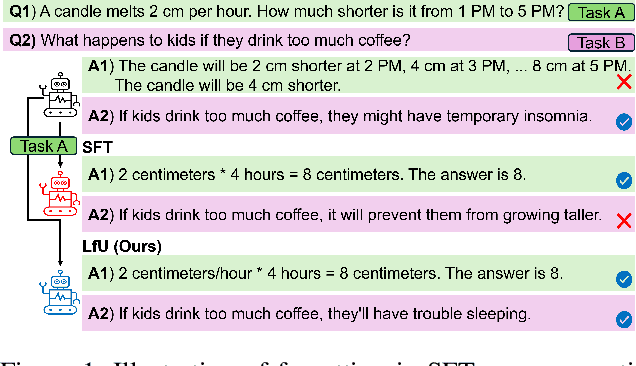
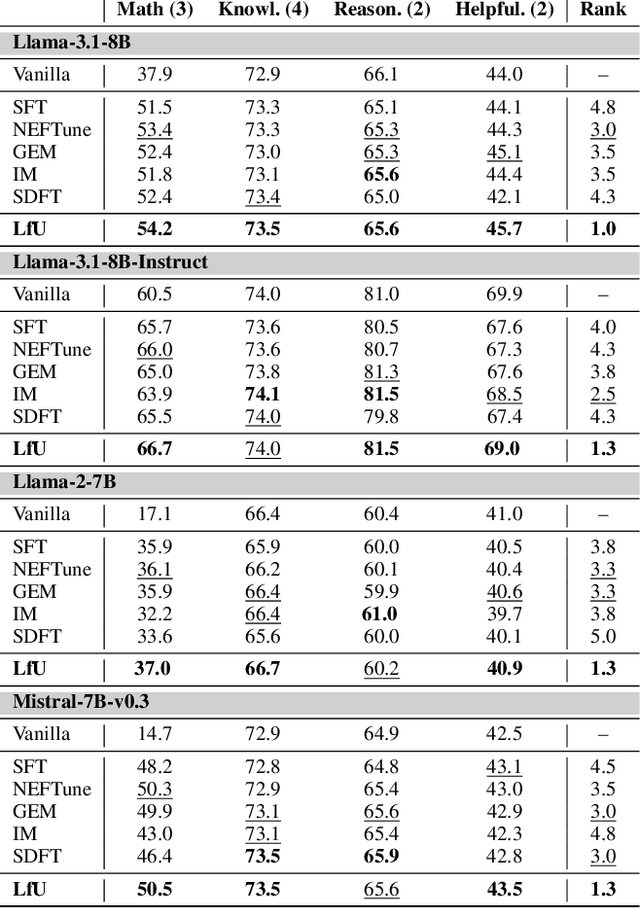

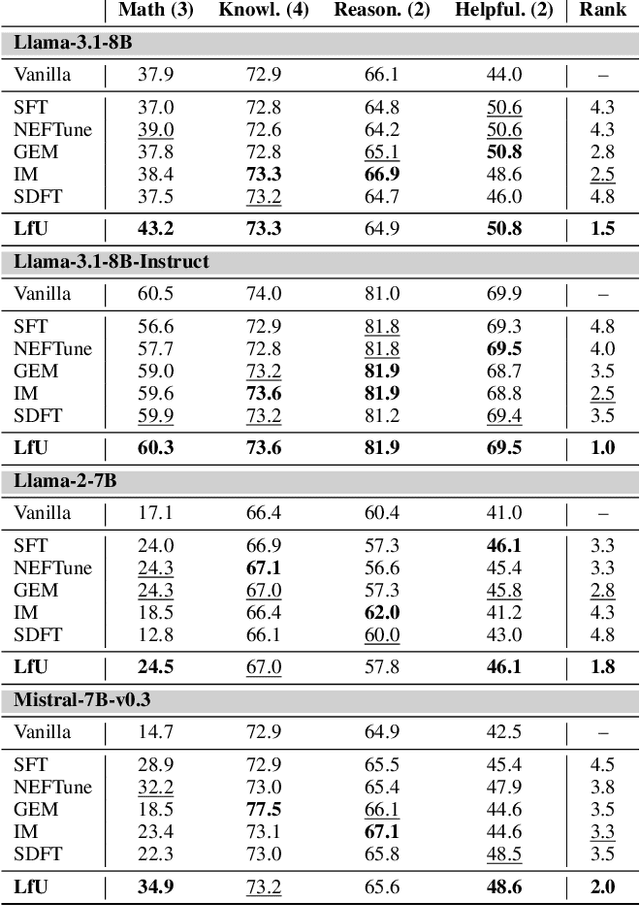
Language models (LMs) are often adapted through supervised fine-tuning (SFT) to specialize their capabilities for downstream tasks. However, in typical scenarios where the fine-tuning data is limited, e.g., compared to pre-training, SFT can lead LMs to overfit, causing them to rely on spurious patterns within the target task or to compromise other broadly useful capabilities as a side effect of narrow specialization. In this paper, we propose Learning-from-the-Undesirable (LfU), a simple yet effective regularization scheme for SFT to mitigate overfitting issues when fine-tuning LMs with limited data. Specifically, we aim to regularize the fine-tuning process to favor solutions that are resilient to "undesirable" model updates, e.g., gradient ascent steps that steer the model toward undesirable behaviors. To this end, we propose a novel form of consistency regularization that directly aligns internal representations of the model with those after an undesirable update. By leveraging representation-level data augmentation through undesirable updates, LfU effectively promotes generalization under limited data. Our experiments on diverse LM downstream tasks show that LfU serves as an effective prior that enhances adaptability while preserving pretrained knowledge. For example, our LM from LfU achieves a 16.8% average improvement on math tasks compared to vanilla SFT on the same dataset, where the latter even leads to degraded performance on those tasks. Furthermore, LfU exhibits improved robustness to prompt variations, e.g., yielding a 92.1% lower standard deviation in output performances compared to SFT, highlighting its versatile effects.