 Add to Chrome
 Add to Firefox
 Add to Edge
InfoAffect: A Dataset for Affective Analysis of Infographics
Nov 09, 2025
Infographics are widely used to convey complex information, yet their affective dimensions remain underexplored due to the scarcity of data resources. We introduce a 3.5k-sample affect-annotated InfoAffect dataset, which combines textual content with real-world infographics. We first collect the raw data from six domains and aligned them via preprocessing, the accompanied-text-priority method, and three strategies to guarantee the quality and compliance. After that we construct an affect table and use it to constrain annotation. Five state-of-the-art multimodal large language models (MLLMs) then analyze both modalities, and their outputs are fused with Reciprocal Rank Fusion (RRF) algorithm to yield robust affects and confidences. We conducted a user study with two experiments to validate usability and assess InfoAffect dataset using the Composite Affect Consistency Index (CACI), achieving an overall score of 0.986, which indicates high accuracy.

C5: Towards Better Conversation Comprehension and Contextual Continuity for ChatGPT
Aug 10, 2023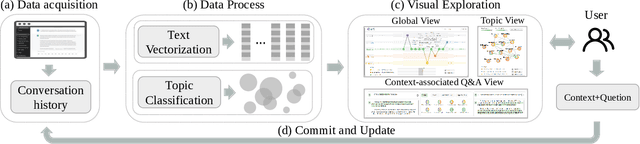
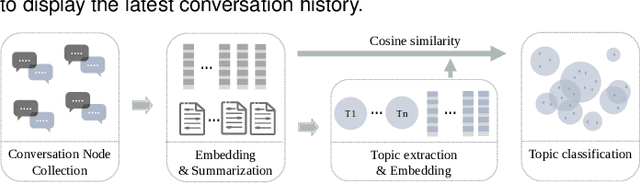
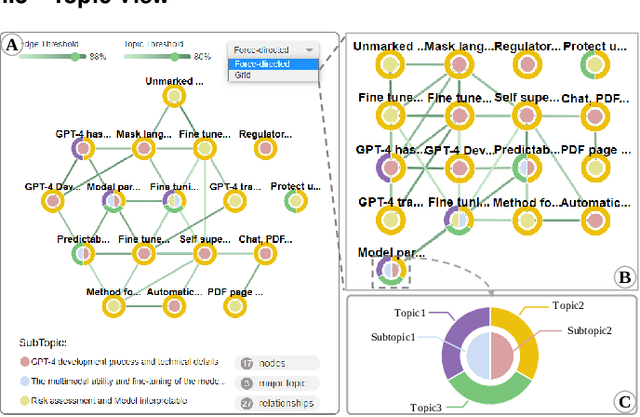
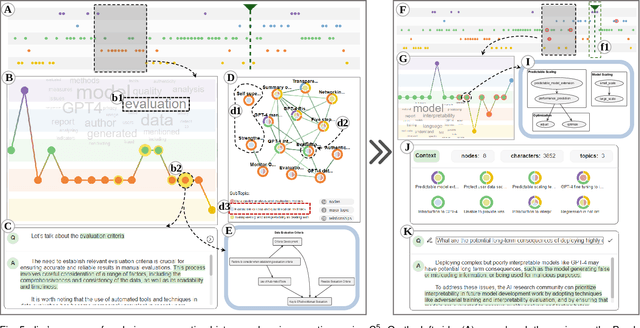
Large language models (LLMs), such as ChatGPT, have demonstrated outstanding performance in various fields, particularly in natural language understanding and generation tasks. In complex application scenarios, users tend to engage in multi-turn conversations with ChatGPT to keep contextual information and obtain comprehensive responses. However, human forgetting and model contextual forgetting remain prominent issues in multi-turn conversation scenarios, which challenge the users' conversation comprehension and contextual continuity for ChatGPT. To address these challenges, we propose an interactive conversation visualization system called C5, which includes Global View, Topic View, and Context-associated Q\&A View. The Global View uses the GitLog diagram metaphor to represent the conversation structure, presenting the trend of conversation evolution and supporting the exploration of locally salient features. The Topic View is designed to display all the question and answer nodes and their relationships within a topic using the structure of a knowledge graph, thereby display the relevance and evolution of conversations. The Context-associated Q\&A View consists of three linked views, which allow users to explore individual conversations deeply while providing specific contextual information when posing questions. The usefulness and effectiveness of C5 were evaluated through a case study and a user study.