 Add to Chrome
 Add to Firefox
 Add to Edge
Incremental Residual Reinforcement Learning Toward Real-World Learning for Social Navigation
Apr 09, 2026
As the demand for mobile robots continues to increase, social navigation has emerged as a critical task, driving active research into deep reinforcement learning (RL) approaches. However, because pedestrian dynamics and social conventions vary widely across different regions, simulations cannot easily encompass all possible real-world scenarios. Real-world RL, in which agents learn while operating directly in physical environments, presents a promising solution to this issue. Nevertheless, this approach faces significant challenges, particularly regarding constrained computational resources on edge devices and learning efficiency. In this study, we propose incremental residual RL (IRRL). This method integrates incremental learning, which is a lightweight process that operates without a replay buffer or batch updates, with residual RL, which enhances learning efficiency by training only on the residuals relative to a base policy. Through the simulation experiments, we demonstrated that, despite lacking a replay buffer, IRRL achieved performance comparable to those of conventional replay buffer-based methods and outperformed existing incremental learning approaches. Furthermore, the real-world experiments confirmed that IRRL can enable robots to effectively adapt to previously unseen environments through the real-world learning.

COLSON: Controllable Learning-Based Social Navigation via Diffusion-Based Reinforcement Learning
Mar 18, 2025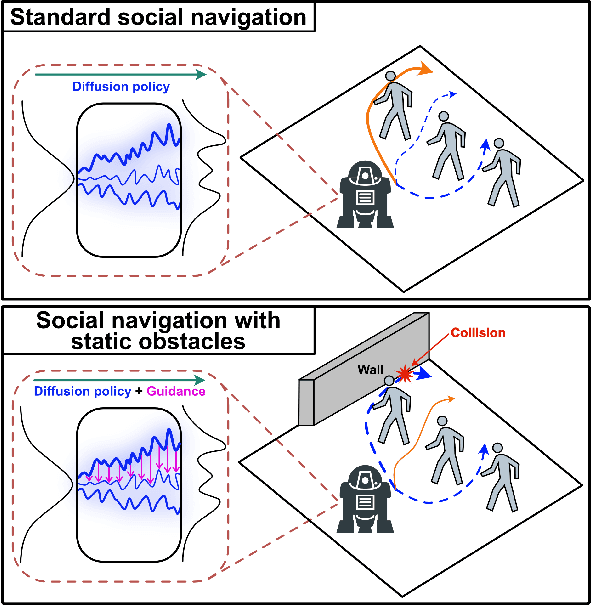
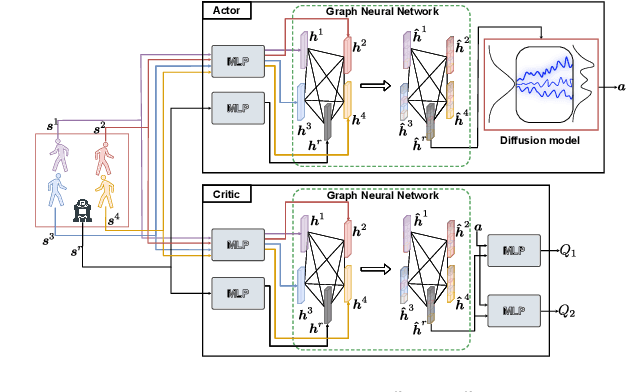
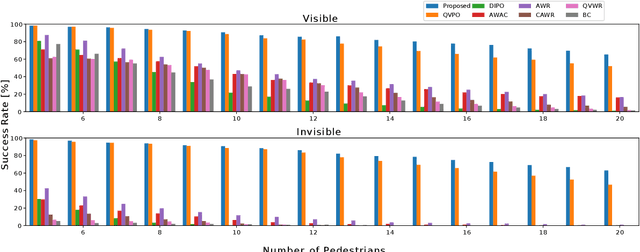
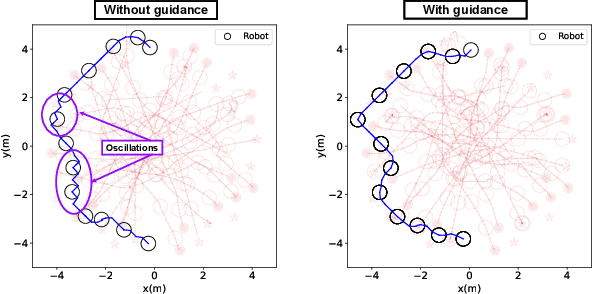
Mobile robot navigation in dynamic environments with pedestrian traffic is a key challenge in the development of autonomous mobile service robots. Recently, deep reinforcement learning-based methods have been actively studied and have outperformed traditional rule-based approaches owing to their optimization capabilities. Among these, methods that assume a continuous action space typically rely on a Gaussian distribution assumption, which limits the flexibility of generated actions. Meanwhile, the application of diffusion models to reinforcement learning has advanced, allowing for more flexible action distributions compared with Gaussian distribution-based approaches. In this study, we applied a diffusion-based reinforcement learning approach to social navigation and validated its effectiveness. Furthermore, by leveraging the characteristics of diffusion models, we propose an extension that enables post-training action smoothing and adaptation to static obstacle scenarios not considered during the training steps.