 Add to Chrome
 Add to Firefox
 Add to Edge
Coarse-to-Fine Registration of Jawbone CT and Intraoral Scan Data Using GeDi and ICP with Pseudo-IOS Ground Truth
Aug 03, 2026
In digital dentistry and oral surgery, the registration of jawbone CT and intraoral scanner (IOS) data is essential for integrating internal bone structure with high-resolution dental surface geometry. However, this registration is challenging because the two modalities share only a limited region in common, and their true correspondence is generally unknown. This uncertainty has prevented rigorous quantitative evaluation of registration accuracy. In this study, we propose a pseudoIOS evaluation framework in which a point cloud emulating an intraoral scan is generated from CT data within the same coordinate frame, so that the transformation between them is known by construction and can serve as a true ground truth. Using this framework, we propose a coarse-to-fine registration method that combines a domain-generalizable local descriptor (GeDi) for initialization-independent global alignment with the iterative closest point (ICP) algorithm for local refinement, and also evaluate the influence of metal artifacts on registration. In experiments on seven cases, ICP alone frequently converged to local minima from a perturbed initial position, whereas GeDi$+$ICP maintained submillimeter mean absolute error (MAE) across all evaluated jaw and artifact conditions (0.55-0.69 mm). A three-way repeated-measures analysis confirmed that GeDi$+$ICP was significantly more accurate than GeDi alone. Metal artifacts had a statistically detectable overall effect, but their absolute impact on GeDi$+$ICP was small.

Three-dimensional Generative Adversarial Nets for Unsupervised Metal Artifact Reduction
Nov 19, 2019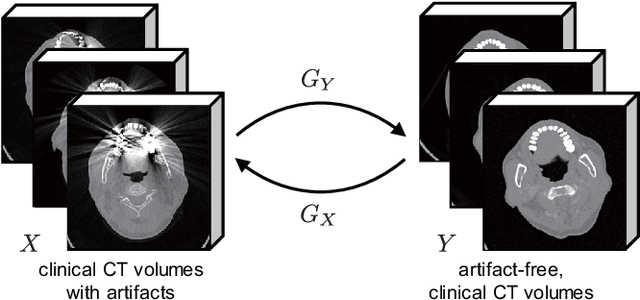
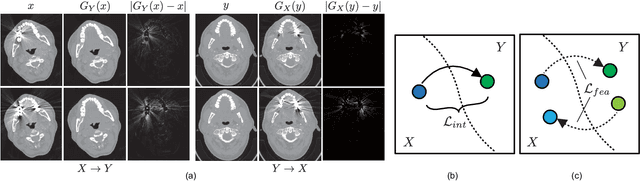
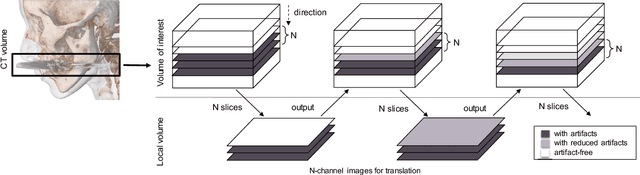
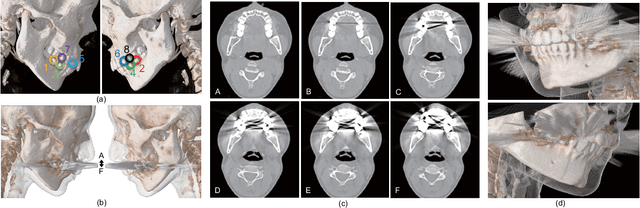
The reduction of metal artifacts in computed tomography (CT) images, specifically for strong artifacts generated from multiple metal objects, is a challenging issue in medical imaging research. Although there have been some studies on supervised metal artifact reduction through the learning of synthesized artifacts, it is difficult for simulated artifacts to cover the complexity of the real physical phenomena that may be observed in X-ray propagation. In this paper, we introduce metal artifact reduction methods based on an unsupervised volume-to-volume translation learned from clinical CT images. We construct three-dimensional adversarial nets with a regularized loss function designed for metal artifacts from multiple dental fillings. The results of experiments using 915 CT volumes from real patients demonstrate that the proposed framework has an outstanding capacity to reduce strong artifacts and to recover underlying missing voxels, while preserving the anatomical features of soft tissues and tooth structures from the original images.