 Add to Chrome
 Add to Firefox
 Add to Edge
Deep Learning Network-Temporal Models For Traffic Prediction
Mar 12, 2026
Time series analysis is critical for emerging net- work intelligent control and management functions. However, existing statistical-based and shallow machine learning models have shown limited prediction capabilities on multivariate time series. The intricate topological interdependency and complex temporal patterns in network data demand new model approaches. In this paper, based on a systematic multivariate time series model study, we present two deep learning models aiming for learning both temporal patterns and network topological correlations at the same time: a customized network-temporal graph attention network (GAT) model and a fine-tuned multi-modal large language model (LLM) with a clustering overture. Both models are studied against an LSTM model that already outperforms the statistical methods. Through extensive training and performance studies on a real-world network dataset, the LLM-based model demonstrates superior overall prediction and generalization performance, while the GAT model shows its strength in reducing prediction variance across the time series and horizons. More detailed analysis also reveals important insights into correlation variability and prediction distribution discrepancies over time series and different prediction horizons.

Automated and Explainable Denial of Service Analysis for AI-Driven Intrusion Detection Systems
Nov 06, 2025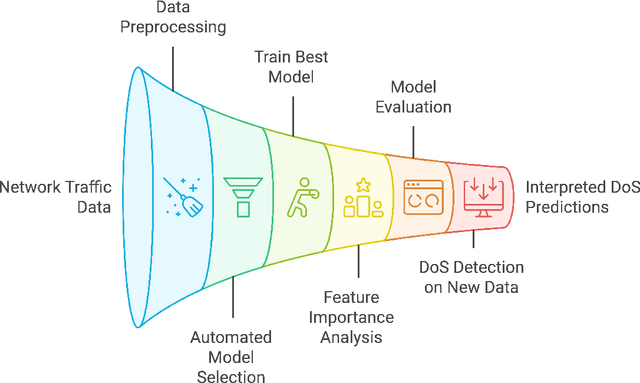
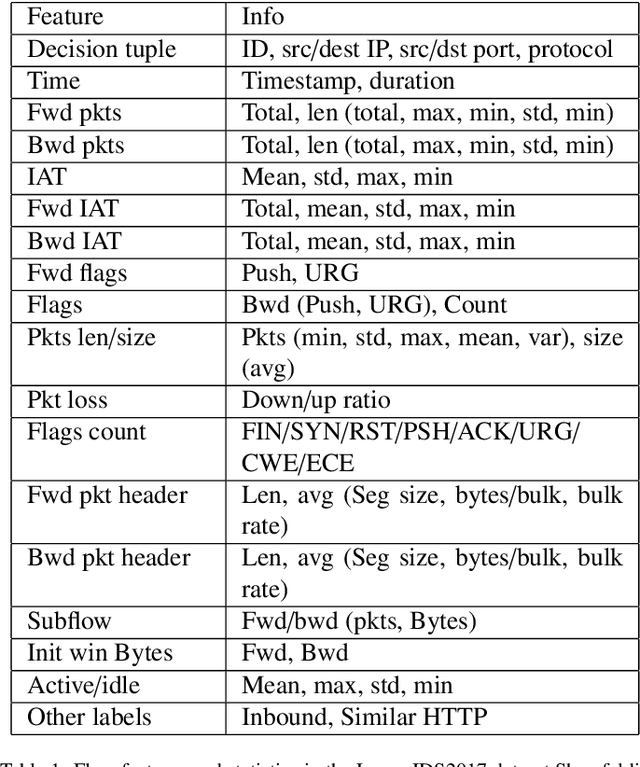
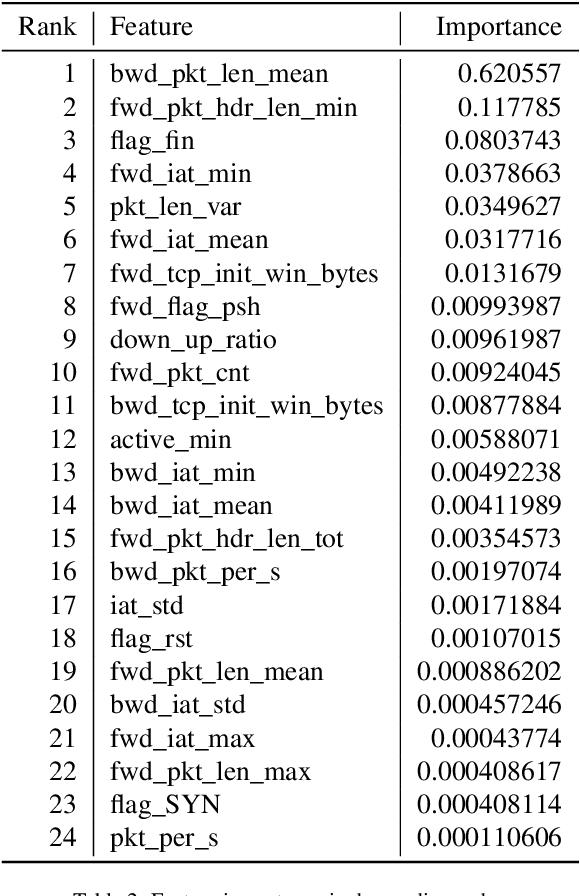
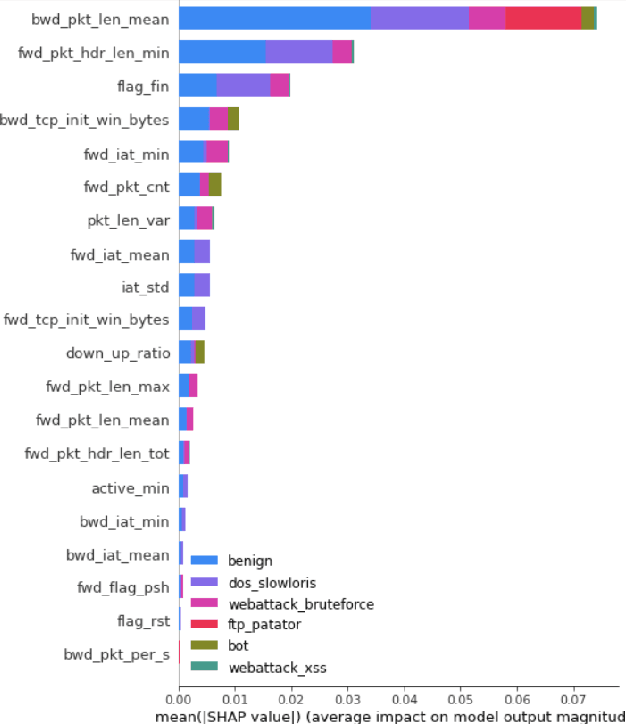
With the increasing frequency and sophistication of Distributed Denial of Service (DDoS) attacks, it has become critical to develop more efficient and interpretable detection methods. Traditional detection systems often struggle with scalability and transparency, hindering real-time response and understanding of attack vectors. This paper presents an automated framework for detecting and interpreting DDoS attacks using machine learning (ML). The proposed method leverages the Tree-based Pipeline Optimization Tool (TPOT) to automate the selection and optimization of ML models and features, reducing the need for manual experimentation. SHapley Additive exPlanations (SHAP) is incorporated to enhance model interpretability, providing detailed insights into the contribution of individual features to the detection process. By combining TPOT's automated pipeline selection with SHAP interpretability, this approach improves the accuracy and transparency of DDoS detection. Experimental results demonstrate that key features such as mean backward packet length and minimum forward packet header length are critical in detecting DDoS attacks, offering a scalable and explainable cybersecurity solution.
Redefining DDoS Attack Detection Using A Dual-Space Prototypical Network-Based Approach
Jun 04, 2024Distributed Denial of Service (DDoS) attacks pose an increasingly substantial cybersecurity threat to organizations across the globe. In this paper, we introduce a new deep learning-based technique for detecting DDoS attacks, a paramount cybersecurity challenge with evolving complexity and scale. Specifically, we propose a new dual-space prototypical network that leverages a unique dual-space loss function to enhance detection accuracy for various attack patterns through geometric and angular similarity measures. This approach capitalizes on the strengths of representation learning within the latent space (a lower-dimensional representation of data that captures complex patterns for machine learning analysis), improving the model's adaptability and sensitivity towards varying DDoS attack vectors. Our comprehensive evaluation spans multiple training environments, including offline training, simulated online training, and prototypical network scenarios, to validate the model's robustness under diverse data abundance and scarcity conditions. The Multilayer Perceptron (MLP) with Attention, trained with our dual-space prototypical design over a reduced training set, achieves an average accuracy of 94.85% and an F1-Score of 94.71% across our tests, showcasing its effectiveness in dynamic and constrained real-world scenarios.
Advancing DDoS Attack Detection: A Synergistic Approach Using Deep Residual Neural Networks and Synthetic Oversampling
Jan 06, 2024Distributed Denial of Service (DDoS) attacks pose a significant threat to the stability and reliability of online systems. Effective and early detection of such attacks is pivotal for safeguarding the integrity of networks. In this work, we introduce an enhanced approach for DDoS attack detection by leveraging the capabilities of Deep Residual Neural Networks (ResNets) coupled with synthetic oversampling techniques. Because of the inherent class imbalance in many cyber-security datasets, conventional methods often struggle with false negatives, misclassifying subtle DDoS patterns as benign. By applying the Synthetic Minority Over-sampling Technique (SMOTE) to the CICIDS dataset, we balance the representation of benign and malicious data points, enabling the model to better discern intricate patterns indicative of an attack. Our deep residual network, tailored for this specific task, further refines the detection process. Experimental results on a real-world dataset demonstrate that our approach achieves an accuracy of 99.98%, significantly outperforming traditional methods. This work underscores the potential of combining advanced data augmentation techniques with deep learning models to bolster cyber-security defenses.