 Add to Chrome
 Add to Firefox
 Add to Edge
Structured Nonparametric Variational Inference for Dependent Latent Modeling
Jun 13, 2026
Variational inference (VI) is a core engine of modern AI, enabling scalable approximate Bayesian learning and uncertainty-aware training of large probabilistic and generative models. In this paper, we propose Structured Nonparametric Variational Inference (SN-VI), a novel framework for modeling complex dependencies among latent variables in posterior approximation, leveraging multivariate spline techniques. Unlike traditional methods that rely on the mean-field assumption, SN-VI preserves intricate latent variable dependencies, providing a flexible and accurate approximation of posteriors with arbitrary shapes. We establish rigorous theoretical guarantees, including the derivation of the lower bound for the variational objective and proof of asymptotic consistency in posterior estimation. To facilitate practical implementation, we develop an algorithm that automatically identifies dependent latent variables and their underlying dependence structure, without requiring manual specification. Simulation studies validate the effectiveness of SN-VI in approximating posterior distributions with bounded support and complex dependencies. The proposed method has been successfully applied to high-dimensional structured data, including computer vision datasets and spatial transcriptomics. In these applications, SN-VI demonstrates improved generative model performance and effectively uncovers coupled biological signals through the learned dependency structure.

Nonparametric Automatic Differentiation Variational Inference with Spline Approximation
Mar 10, 2024

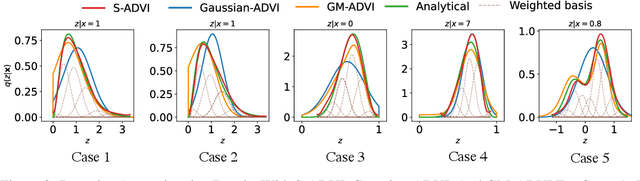
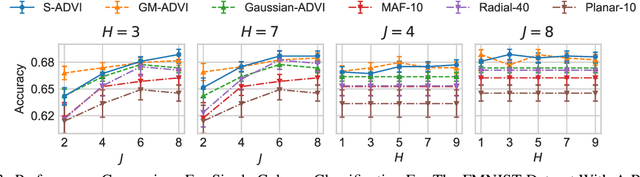
Automatic Differentiation Variational Inference (ADVI) is efficient in learning probabilistic models. Classic ADVI relies on the parametric approach to approximate the posterior. In this paper, we develop a spline-based nonparametric approximation approach that enables flexible posterior approximation for distributions with complicated structures, such as skewness, multimodality, and bounded support. Compared with widely-used nonparametric variational inference methods, the proposed method is easy to implement and adaptive to various data structures. By adopting the spline approximation, we derive a lower bound of the importance weighted autoencoder and establish the asymptotic consistency. Experiments demonstrate the efficiency of the proposed method in approximating complex posterior distributions and improving the performance of generative models with incomplete data.