 Add to Chrome
 Add to Firefox
 Add to Edge
Software Engineering for and with GUI Agent
Aug 10, 2026
GUI agents have advanced rapidly, producing a growing body of frameworks, benchmarks, and applications. However, this growth has outpaced the maturity of the field. GUI agents remain technically brittle, incompletely engineered, and insufficiently validated for sustained real-world use. They are evolving into closed-loop software systems. Within these systems, model reasoning is coupled with interface perception, execution feedback, recovery, and human oversight. This evolution calls for a software engineering perspective that remains largely absent from existing research. We address this gap by reviewing 336 GUI-agent papers from January 2018 to April 2026. Five research questions examine the research landscape, architectures, evaluation, software lifecycle concerns, and future opportunities. Our findings show that the field has expanded sharply since 2024, while mobile and web settings remain dominant. Architectures increasingly adopt modular perceive-reason-act loops, but recovery, human escalation, safety enforcement, and auditability remain underdeveloped. This architectural imbalance extends to evaluation. Evaluations are becoming more interactive, but they remain centered on task success and are difficult to compare across protocols. More broadly, existing studies provide limited support for testing beyond benchmarks and for maintaining agents after release. Observability, privacy engineering, and systematic human oversight are also underdeveloped. Together, these findings show that capability improvements alone cannot ensure deployment readiness. Future research should connect dependable execution with lifecycle-centered testing and reproducible evaluation. It should also integrate permission and privacy controls with cost-aware, human-centered governance. This integration is necessary to build dependable, maintainable, secure, and deployable GUI-agent systems.

Toward Secure LLM Agents: Threat Surfaces, Attacks, Defenses, and Evaluation
Jun 09, 2026Large language model (LLM) agents are rapidly moving from conversational interfaces to software components that plan, invoke tools, maintain memory, and act on external environments. This transition changes the nature of security risk. In agentic settings, failures are no longer limited to unsafe text generation. Untrusted content may redirect control flow, misuse tool privileges, corrupt persistent state, leak sensitive information, or trigger harmful external actions. At the same time, research on LLM agent security is expanding quickly but remains fragmented across attack families, defense layers, application domains, and evaluation settings. This paper synthesizes 247 papers through a lifecycle-based, systems-oriented framework that models agent security around the interaction of information flow, delegated authority, and persistent state. We organize the literature around four questions: how LLM agent security should be modeled, which threat surfaces and attack families dominate, what defenses have been proposed and with what tradeoffs, and how security claims are evaluated. We find that prompt injection and tool-mediated control-flow hijacking still dominate the field, while persistent state corruption and multi-agent propagation are becoming central emerging concerns. We further find that current defenses provide useful building blocks but remain weakly compositional, and that existing benchmarks still underrepresent long-horizon, stateful, and deployment-sensitive risks. We argue that secure LLM agents require explicit trust boundaries, principled privilege control, provenance-aware state management, and evaluation practices aligned with realistic operational settings.
Practical Non-Intrusive GUI Exploration Testing with Visual-based Robotic Arms
Dec 17, 2023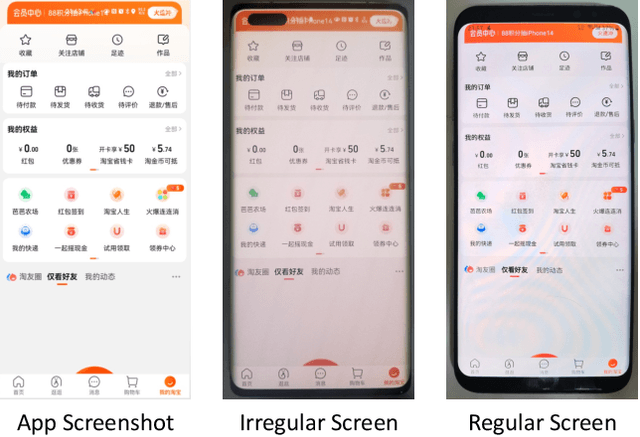
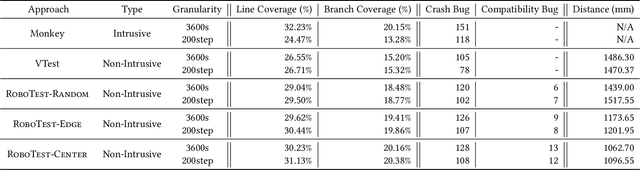
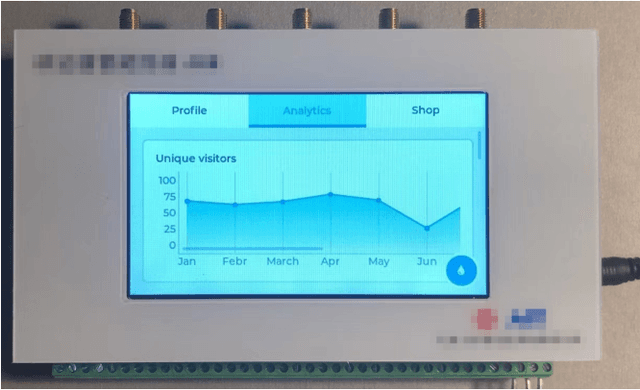
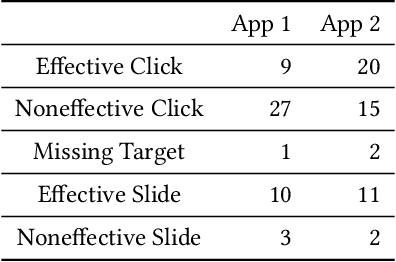
GUI testing is significant in the SE community. Most existing frameworks are intrusive and only support some specific platforms. With the development of distinct scenarios, diverse embedded systems or customized operating systems on different devices do not support existing intrusive GUI testing frameworks. Some approaches adopt robotic arms to replace the interface invoking of mobile apps under test and use computer vision technologies to identify GUI elements. However, some challenges are unsolved. First, existing approaches assume that GUI screens are fixed so that they cannot be adapted to diverse systems with different screen conditions. Second, existing approaches use XY-plane robotic arms, which cannot flexibly simulate testing operations. Third, existing approaches ignore compatibility bugs and only focus on crash bugs. A more practical approach is required for the non-intrusive scenario. We propose a practical non-intrusive GUI testing framework with visual robotic arms. RoboTest integrates novel GUI screen and widget detection algorithms, adaptive to detecting screens of different sizes and then to extracting GUI widgets from the detected screens. Then, a set of testing operations is applied with a 4-DOF robotic arm, which effectively and flexibly simulates human testing operations. During app exploration, RoboTest integrates the Principle of Proximity-guided exploration strategy, choosing close widgets of the previous targets to reduce robotic arm movement overhead and improve exploration efficiency. RoboTest can effectively detect some compatibility bugs beyond crash bugs with a GUI comparison on different devices of the same test operations. We evaluate RoboTest with 20 mobile apps, with a case study on an embedded system. The results show that RoboTest can effectively, efficiently, and generally explore AUTs to find bugs and reduce exploration time overhead.