 Add to Chrome
 Add to Firefox
 Add to Edge
The Price of Isolation: Estimating the Ecosystem Cost of Symmetric Two-Sided A/B Testing
Aug 05, 2026
On two-sided content platforms, symmetric two-sided isolation (assigning matched fractions of creators and viewers to isolated treatment and control submarkets) is widely used for creator-side and cold-start experiments because it removes cross-arm marketplace interference. Isolation, however, thins each viewer's candidate catalog, and intuition suggests the resulting engagement cost should fade as the platform grows: a small fraction of a vast catalog is still vast. We show that, in an order-statistics model of engagement, whether this intuition holds depends on the upper tail of match quality. Extreme-value theory yields tail-class loss laws with a sharp dichotomy: for light or bounded tails the loss vanishes as the candidate pool grows, whereas under heavy tails it converges to a size-independent constant, so expanding the candidate pool, even by orders of magnitude, does not asymptotically eliminate the cost. Evidence from two production experiments on a platform with millions of active creators is consistent with this picture: a pure A/A traffic sweep reveals a measurable, depth-graded engagement cost; a one-sided catalog ablation independently shows that per-viewer thinning contributes to the loss; and a tail index calibrated on the small exploration pool predicts an effect consistent with the one observed in the far larger full-catalog ablation. Isolation thus carries a price that experimenters should budget for, like any other cost. We give practitioners a preflight procedure that estimates it before launch, sizes traffic accordingly, and recommends a fallback design when the predicted cost exceeds a chosen tolerance.

On the Dimensionality of Word Embedding
Dec 11, 2018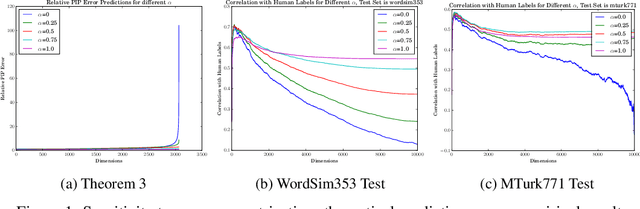
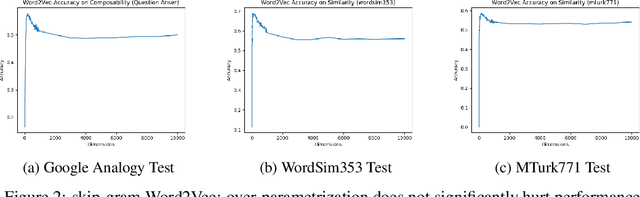
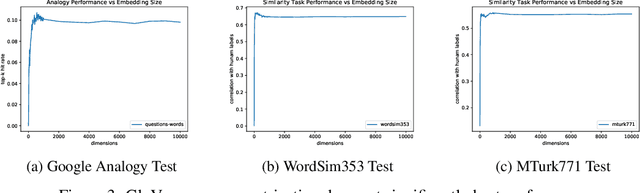
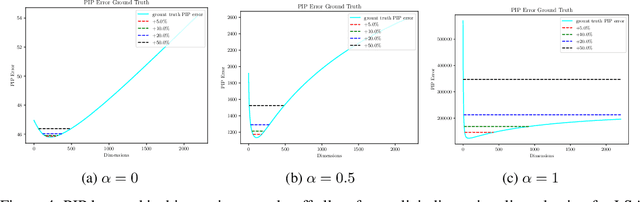
In this paper, we provide a theoretical understanding of word embedding and its dimensionality. Motivated by the unitary-invariance of word embedding, we propose the Pairwise Inner Product (PIP) loss, a novel metric on the dissimilarity between word embeddings. Using techniques from matrix perturbation theory, we reveal a fundamental bias-variance trade-off in dimensionality selection for word embeddings. This bias-variance trade-off sheds light on many empirical observations which were previously unexplained, for example the existence of an optimal dimensionality. Moreover, new insights and discoveries, like when and how word embeddings are robust to over-fitting, are revealed. By optimizing over the bias-variance trade-off of the PIP loss, we can explicitly answer the open question of dimensionality selection for word embedding.
A Deep Causal Inference Approach to Measuring the Effects of Forming Group Loans in Online Non-profit Microfinance Platform
Jun 08, 2017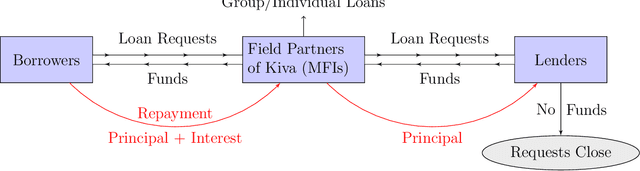
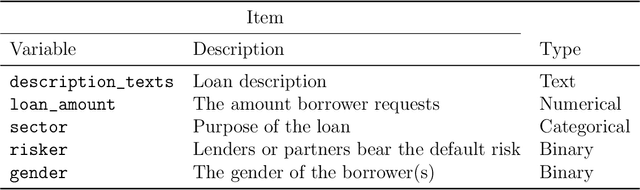
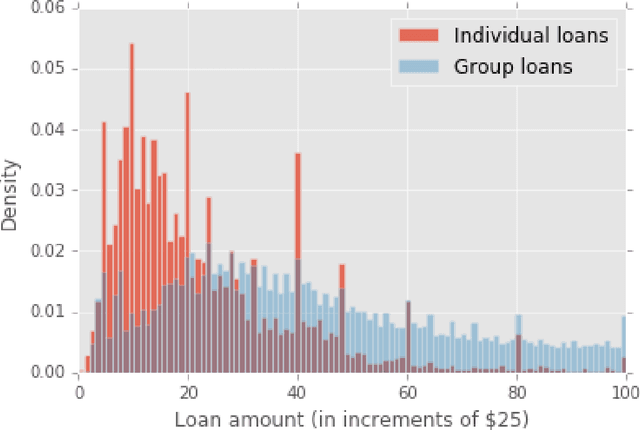

Kiva is an online non-profit crowdsouring microfinance platform that raises funds for the poor in the third world. The borrowers on Kiva are small business owners and individuals in urgent need of money. To raise funds as fast as possible, they have the option to form groups and post loan requests in the name of their groups. While it is generally believed that group loans pose less risk for investors than individual loans do, we study whether this is the case in a philanthropic online marketplace. In particular, we measure the effect of group loans on funding time while controlling for the loan sizes and other factors. Because loan descriptions (in the form of texts) play an important role in lenders' decision process on Kiva, we make use of this information through deep learning in natural language processing. In this aspect, this is the first paper that uses one of the most advanced deep learning techniques to deal with unstructured data in a way that can take advantage of its superior prediction power to answer causal questions. We find that on average, forming group loans speeds up the funding time by about 3.3 days.