 Add to Chrome
 Add to Firefox
 Add to Edge
SSG: Scaled Spatial Guidance for Multi-Scale Visual Autoregressive Generation
Feb 05, 2026
Visual autoregressive (VAR) models generate images through next-scale prediction, naturally achieving coarse-to-fine, fast, high-fidelity synthesis mirroring human perception. In practice, this hierarchy can drift at inference time, as limited capacity and accumulated error cause the model to deviate from its coarse-to-fine nature. We revisit this limitation from an information-theoretic perspective and deduce that ensuring each scale contributes high-frequency content not explained by earlier scales mitigates the train-inference discrepancy. With this insight, we propose Scaled Spatial Guidance (SSG), training-free, inference-time guidance that steers generation toward the intended hierarchy while maintaining global coherence. SSG emphasizes target high-frequency signals, defined as the semantic residual, isolated from a coarser prior. To obtain this prior, we leverage a principled frequency-domain procedure, Discrete Spatial Enhancement (DSE), which is devised to sharpen and better isolate the semantic residual through frequency-aware construction. SSG applies broadly across VAR models leveraging discrete visual tokens, regardless of tokenization design or conditioning modality. Experiments demonstrate SSG yields consistent gains in fidelity and diversity while preserving low latency, revealing untapped efficiency in coarse-to-fine image generation. Code is available at https://github.com/Youngwoo-git/SSG.

B4DL: A Benchmark for 4D LiDAR LLM in Spatio-Temporal Understanding
Aug 07, 2025Understanding dynamic outdoor environments requires capturing complex object interactions and their evolution over time. LiDAR-based 4D point clouds provide precise spatial geometry and rich temporal cues, making them ideal for representing real-world scenes. However, despite their potential, 4D LiDAR remains underexplored in the context of Multimodal Large Language Models (MLLMs) due to the absence of high-quality, modality-specific annotations and the lack of MLLM architectures capable of processing its high-dimensional composition. To address these challenges, we introduce B4DL, a new benchmark specifically designed for training and evaluating MLLMs on 4D LiDAR understanding. In addition, we propose a scalable data generation pipeline and an MLLM model that, for the first time, directly processes raw 4D LiDAR by bridging it with language understanding. Combined with our dataset and benchmark, our model offers a unified solution for spatio-temporal reasoning in dynamic outdoor environments. We provide rendered 4D LiDAR videos, generated dataset, and inference outputs on diverse scenarios at: https://mmb4dl.github.io/mmb4dl/
Memorization or Reasoning? Exploring the Idiom Understanding of LLMs
May 22, 2025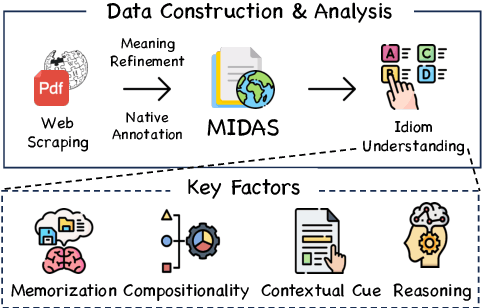
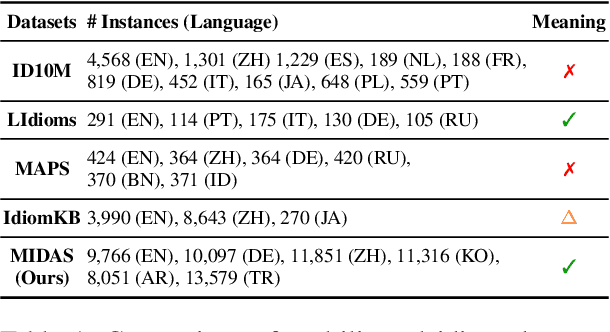
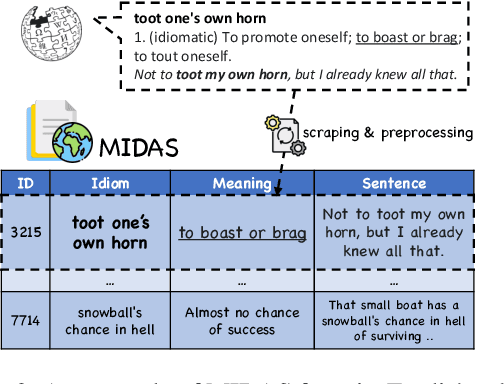
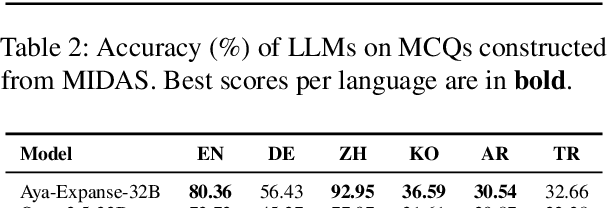
Idioms have long posed a challenge due to their unique linguistic properties, which set them apart from other common expressions. While recent studies have leveraged large language models (LLMs) to handle idioms across various tasks, e.g., idiom-containing sentence generation and idiomatic machine translation, little is known about the underlying mechanisms of idiom processing in LLMs, particularly in multilingual settings. To this end, we introduce MIDAS, a new large-scale dataset of idioms in six languages, each paired with its corresponding meaning. Leveraging this resource, we conduct a comprehensive evaluation of LLMs' idiom processing ability, identifying key factors that influence their performance. Our findings suggest that LLMs rely not only on memorization, but also adopt a hybrid approach that integrates contextual cues and reasoning, especially when processing compositional idioms. This implies that idiom understanding in LLMs emerges from an interplay between internal knowledge retrieval and reasoning-based inference.