 Add to Chrome
 Add to Firefox
 Add to Edge
Optimal Pattern Detection Tree for Symbolic Rule-Based Classification
May 14, 2026
Pattern discovery in data plays a crucial role across diverse domains, including healthcare, risk assessment, and machinery maintenance. In contrast to black-box deep learning models, symbolic rule discovery emerges as a key data mining task, generating human-interpretable rules that offer both transparency and intuitive explainability. This paper introduces the Optimal Pattern Detection Tree (OPDT), a rule-based machine learning model based on novel mixed-integer programming to discover a single optimal pattern in data through binary classification. To incorporate prior knowledge and compliance requirements, we further introduce the Branching Structure Constraints (BSC) framework, which enables decision makers to encode domain knowledge and constraints directly into the model. This optimization-based approach discovers a hidden underlying pattern in datasets, when it exists, by identifying an optimal rule that maximizes coverage while minimizing the false positive rate due to misclassification. Our computational experiments show that OPDT discovers a pattern with optimality guarantees on moderately sized datasets within reasonable runtime.
* Published in Transactions on Machine Learning Research (TMLR). 26 pages, 4 figures. OpenReview URL: https://openreview.net/forum?id=RJ6eMDcDCv

TSKANMixer: Kolmogorov-Arnold Networks with MLP-Mixer Model for Time Series Forecasting
Feb 25, 2025


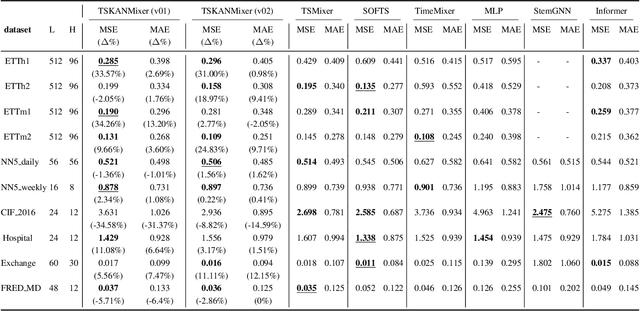
Time series forecasting has long been a focus of research across diverse fields, including economics, energy, healthcare, and traffic management. Recent works have introduced innovative architectures for time series models, such as the Time-Series Mixer (TSMixer), which leverages multi-layer perceptrons (MLPs) to enhance prediction accuracy by effectively capturing both spatial and temporal dependencies within the data. In this paper, we investigate the capabilities of the Kolmogorov-Arnold Networks (KANs) for time-series forecasting by modifying TSMixer with a KAN layer (TSKANMixer). Experimental results demonstrate that TSKANMixer tends to improve prediction accuracy over the original TSMixer across multiple datasets, ranking among the top-performing models compared to other time series approaches. Our results show that the KANs are promising alternatives to improve the performance of time series forecasting by replacing or extending traditional MLPs.