 Add to Chrome
 Add to Firefox
 Add to Edge
Surgical Robot, Path Planning, Joint Space, Riemannian Manifolds
Mar 16, 2026
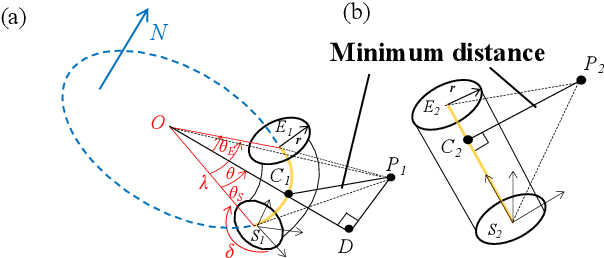
Robotic surgery for minimally invasive surgery can reduce the surgeon's workload by autonomously guiding robotic forceps. Movement of the robot is restricted around a fixed insertion port. The robot often encounters angle limitations during operation. Also, the surface of the abdominal cavity is non-concave, making it computationally expensive to find the desired path.In this work, to solve these problems, we propose a method for path planning in joint space by transforming the position into a Riemannian manifold. An edge cost function is defined to search for a desired path in the joint space and reduce the range of motion of the joints. We found that the organ is mostly non-concave, making it easy to find the optimal path using gradient descent method. Experimental results demonstrated that the proposed method reduces the range of joint angle movement compared to calculations in position space.

S-RRT*-based Obstacle Avoidance Autonomous Motion Planner for Continuum-rigid Manipulator
Sep 27, 2024


Continuum robots are compact and flexible, making them suitable for use in the industries and in medical surgeries. Rapidly-exploring random trees (RRT) are a highly efficient path planning method, and its variant, S-RRT, can generate smooth feasible paths for the end-effector. By combining RRT with inverse instantaneous kinematics (IIK), complete motion planning for the continuum arm can be achieved. Due to the high degrees of freedom of continuum arms, the null space in IIK can be utilized for obstacle avoidance. In this work, we propose a novel approach that uses the S-RRT* algorithm to create paths for the continuum-rigid manipulator. By employing IIK and null space techniques, continuous joint configurations are generated that not only track the path but also enable obstacle avoidance. Simulation results demonstrate that our method effectively handles motion planning and obstacle avoidance while generating high-quality end-effector paths in complex environments. Furthermore, compared to similar IIK methods, our approach exhibits superior computation time.