 Add to Chrome
 Add to Firefox
 Add to Edge
Digital Linguistic Bias in Spanish: Evidence from Lexical Variation in LLMs
Feb 10, 2026
This study examines the extent to which Large Language Models (LLMs) capture geographic lexical variation in Spanish, a language that exhibits substantial regional variation. Treating LLMs as virtual informants, we probe their dialectal knowledge using two survey-style question formats: Yes-No questions and multiple-choice questions. To this end, we exploited a large-scale, expert-curated database of Spanish lexical variation. Our evaluation covers more than 900 lexical items across 21 Spanish-speaking countries and is conducted at both the country and dialectal area levels. Across both evaluation formats, the results reveal systematic differences in how LLMs represent Spanish language varieties. Lexical variation associated with Spain, Equatorial Guinea, Mexico & Central America, and the La Plata River is recognized more accurately by the models, while the Chilean variety proves particularly difficult for the models to distinguish. Importantly, differences in the volume of country-level digital resources do not account for these performance patterns, suggesting that factors beyond data quantity shape dialectal representation in LLMs. By providing a fine-grained, large-scale evaluation of geographic lexical variation, this work advances empirical understanding of dialectal knowledge in LLMs and contributes new evidence to discussions of Digital Linguistic Bias in Spanish.

Contextualized Word Vector-based Methods for Discovering Semantic Differences with No Training nor Word Alignment
May 19, 2023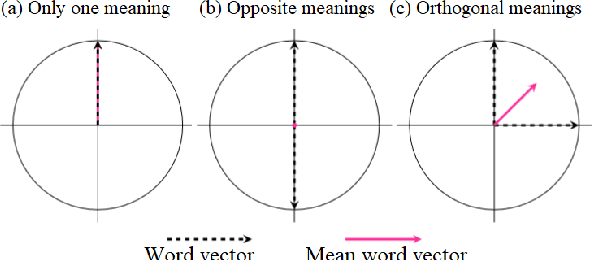
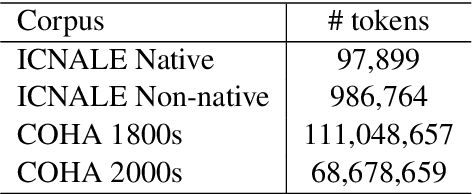
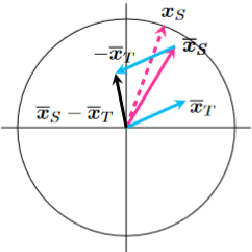
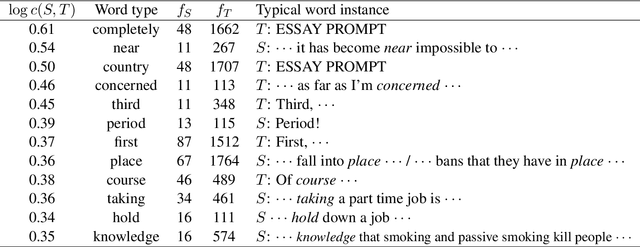
In this paper, we propose methods for discovering semantic differences in words appearing in two corpora based on the norms of contextualized word vectors. The key idea is that the coverage of meanings is reflected in the norm of its mean word vector. The proposed methods do not require the assumptions concerning words and corpora for comparison that the previous methods do. All they require are to compute the mean vector of contextualized word vectors and its norm for each word type. Nevertheless, they are (i) robust for the skew in corpus size; (ii) capable of detecting semantic differences in infrequent words; and (iii) effective in pinpointing word instances that have a meaning missing in one of the two corpora for comparison. We show these advantages for native and non-native English corpora and also for historical corpora.