 Add to Chrome
 Add to Firefox
 Add to Edge
Knowledge Distillation with Structured Chain-of-Thought for Text-to-SQL
Dec 18, 2025
Deploying accurate Text-to-SQL systems at the enterprise level faces a difficult trilemma involving cost, security and performance. Current solutions force enterprises to choose between expensive, proprietary Large Language Models (LLMs) and low-performing Small Language Models (SLMs). Efforts to improve SLMs often rely on distilling reasoning from large LLMs using unstructured Chain-of-Thought (CoT) traces, a process that remains inherently ambiguous. Instead, we hypothesize that a formal, structured reasoning representation provides a clearer, more reliable teaching signal, as the Text-to-SQL task requires explicit and precise logical steps. To evaluate this hypothesis, we propose Struct-SQL, a novel Knowledge Distillation (KD) framework that trains an SLM to emulate a powerful large LLM. Consequently, we adopt a query execution plan as a formal blueprint to derive this structured reasoning. Our SLM, distilled with structured CoT, achieves an absolute improvement of 8.1% over an unstructured CoT distillation baseline. A detailed error analysis reveals that a key factor in this gain is a marked reduction in syntactic errors. This demonstrates that teaching a model to reason using a structured logical blueprint is beneficial for reliable SQL generation in SLMs.

Improved Batching Strategy For Irregular Time-Series ODE
Jul 12, 2022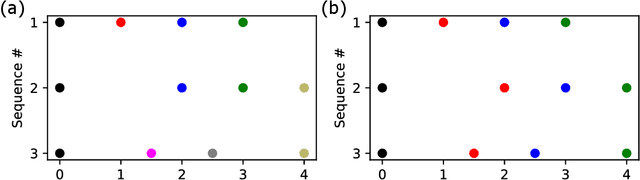
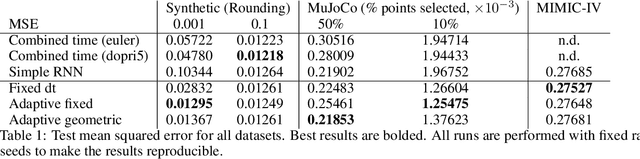
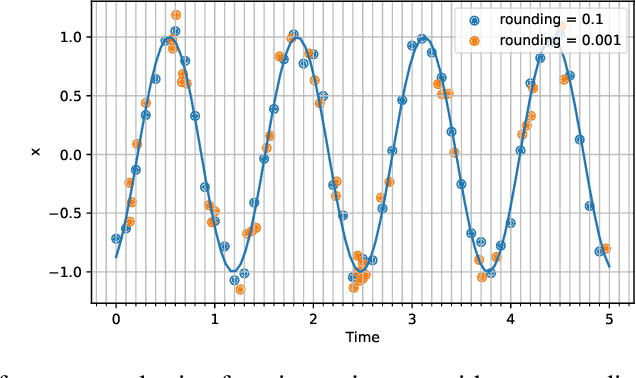
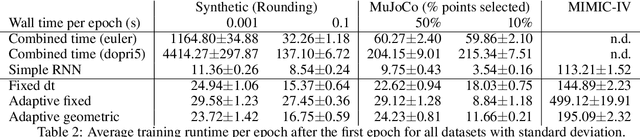
Irregular time series data are prevalent in the real world and are challenging to model with a simple recurrent neural network (RNN). Hence, a model that combines the use of ordinary differential equations (ODE) and RNN was proposed (ODE-RNN) to model irregular time series with higher accuracy, but it suffers from high computational costs. In this paper, we propose an improvement in the runtime on ODE-RNNs by using a different efficient batching strategy. Our experiments show that the new models reduce the runtime of ODE-RNN significantly ranging from 2 times up to 49 times depending on the irregularity of the data while maintaining comparable accuracy. Hence, our model can scale favorably for modeling larger irregular data sets.