 Add to Chrome
 Add to Firefox
 Add to Edge
Bilateral Intent-Enhanced Sequential Recommendation with Embedding Perturbation-Based Contrastive Learning
Apr 03, 2026
Accurately modeling users' evolving preferences from sequential interactions remains a central challenge in recommender systems. Recent studies emphasize the importance of capturing multiple latent intents underlying user behaviors. However, existing methods often fail to effectively exploit collective intent signals shared across users and items, leading to information isolation and limited robustness. Meanwhile, current contrastive learning approaches struggle to construct views that are both semantically consistent and sufficiently discriminative. In this work, we propose BIPCL, an end-to-end Bilateral Intent-enhanced, Embedding Perturbation-based Contrastive Learning framework. BIPCL explicitly integrates multi-intent signals into both item and sequence representations via a bilateral intent-enhancement mechanism. Specifically, shared intent prototypes on the user and item sides capture collective intent semantics distilled from behaviorally similar entities, which are subsequently integrated into representation learning. This design alleviates information isolation and improves robustness under sparse supervision. To construct effective contrastive views without disrupting temporal or structural dependencies, BIPCL injects bounded, direction-aware perturbations directly into structural item embeddings. On this basis, BIPCL further enforces multi-level contrastive alignment across interaction- and intent-level representations. Extensive experiments on benchmark datasets demonstrate that BIPCL consistently outperforms state-of-the-art baselines, with ablation studies confirming the contribution of each component.

Dual-View Disentangled Multi-Intent Learning for Enhanced Collaborative Filtering
Jun 13, 2025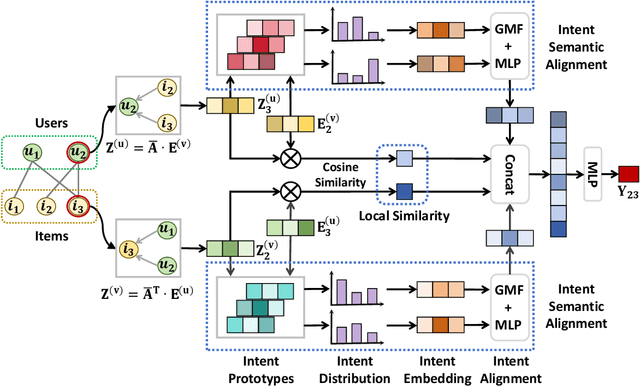
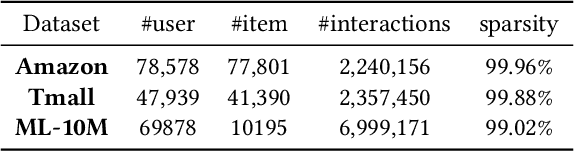
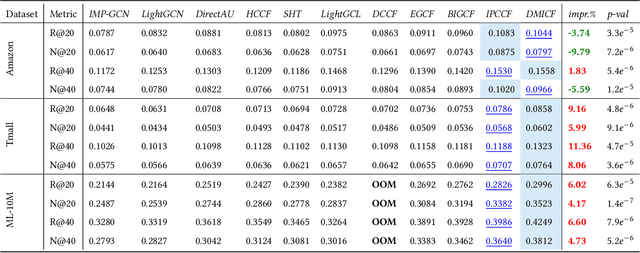
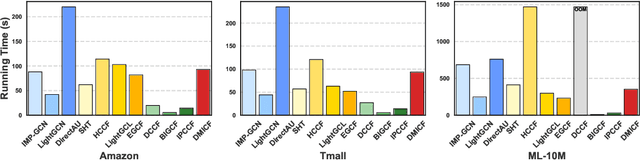
Disentangling user intentions from implicit feedback has become a promising strategy to enhance recommendation accuracy and interpretability. Prior methods often model intentions independently and lack explicit supervision, thus failing to capture the joint semantics that drive user-item interactions. To address these limitations, we propose DMICF, a unified framework that explicitly models interaction-level intent alignment while leveraging structural signals from both user and item perspectives. DMICF adopts a dual-view architecture that jointly encodes user-item interaction graphs from both sides, enabling bidirectional information fusion. This design enhances robustness under data sparsity by allowing the structural redundancy of one view to compensate for the limitations of the other. To model fine-grained user-item compatibility, DMICF introduces an intent interaction encoder that performs sub-intent alignment within each view, uncovering shared semantic structures that underlie user decisions. This localized alignment enables adaptive refinement of intent embeddings based on interaction context, thus improving the model's generalization and expressiveness, particularly in long-tail scenarios. Furthermore, DMICF integrates an intent-aware scoring mechanism that aggregates compatibility signals from matched intent pairs across user and item subspaces, enabling personalized prediction grounded in semantic congruence rather than entangled representations. To facilitate semantic disentanglement, we design a discriminative training signal via multi-negative sampling and softmax normalization, which pulls together semantically aligned intent pairs while pushing apart irrelevant or noisy ones. Extensive experiments demonstrate that DMICF consistently delivers robust performance across datasets with diverse interaction distributions.