 Add to Chrome
 Add to Firefox
 Add to Edge
Model Capacity Determines Grokking through Competing Memorisation and Generalisation Speeds
May 10, 2026
Existing accounts of grokking explain the phenomena in terms of mechanistic frameworks such as circuit efficiency or lazy-to-rich transitions. However, despite a known dependence between grokking and model size, how model capacity shapes grokking remains an open question. We give an information-theoretic account of this relationship on the task of modular arithmetic, showing that grokking does not immediately occur when a model becomes large enough to memorise the training set, but rather emerges as the outcome of a competition between two measurable timescales: a memorisation speed $T_{\text{mem}}(P)$ and a generalisation speed $T_{\text{gen}}(P)$, both of which are functions of model parameter count $P$. Adapting the information capacity framework of Morris et al. (2025), we estimate $T_{\text{mem}}(P)$ on random-label data of equivalent complexity and $T_{\text{gen}}(P)$ on the modular task itself, and show that grokking emerges close to the parameter scale where these timescales intersect. The framework also suggests an empirical model for predicting memorisation speed given model capacity and dataset complexity, recovering the previously reported empirical observation that larger models memorise faster. Overall, we motivate the formalisation of different learning timescales as important abstractions to study when explaining how model capacity shapes grokking on algorithmic tasks.

PAPERCLIP: Associating Astronomical Observations and Natural Language with Multi-Modal Models
Mar 13, 2024
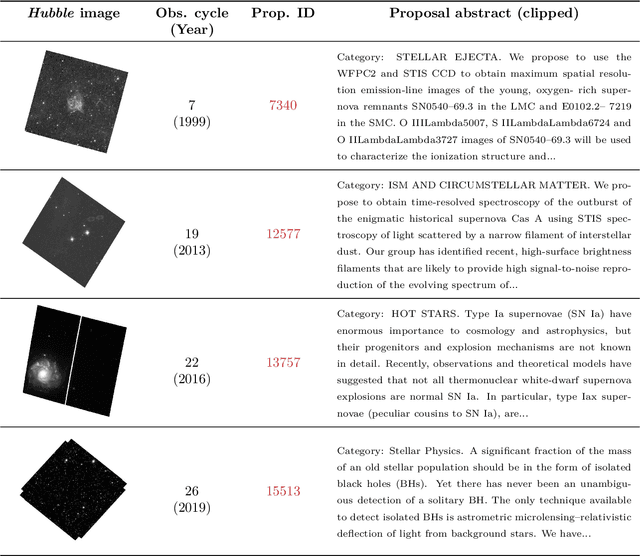
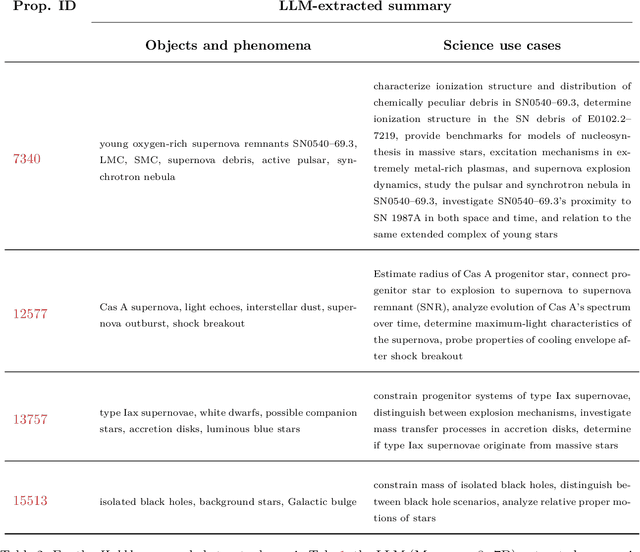
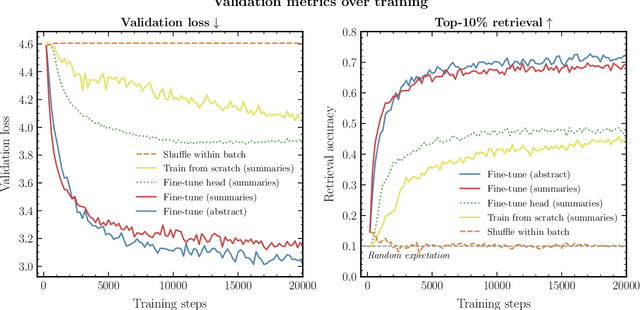
We present PAPERCLIP (Proposal Abstracts Provide an Effective Representation for Contrastive Language-Image Pre-training), a method which associates astronomical observations imaged by telescopes with natural language using a neural network model. The model is fine-tuned from a pre-trained Contrastive Language-Image Pre-training (CLIP) model using successful observing proposal abstracts and corresponding downstream observations, with the abstracts optionally summarized via guided generation using large language models (LLMs). Using observations from the Hubble Space Telescope (HST) as an example, we show that the fine-tuned model embodies a meaningful joint representation between observations and natural language through tests targeting image retrieval (i.e., finding the most relevant observations using natural language queries) and description retrieval (i.e., querying for astrophysical object classes and use cases most relevant to a given observation). Our study demonstrates the potential for using generalist foundation models rather than task-specific models for interacting with astronomical data by leveraging text as an interface.