 Add to Chrome
 Add to Firefox
 Add to Edge
WaveformQA: Benchmarking LLM Temporal Reasoning on Digital Waveforms
Jul 22, 2026
Large Language Models (LLMs) have demonstrated strong capabilities in code generation and reasoning, yet their ability to perform temporal reasoning over digital waveform data remains largely unexplored. Although reasoning over digital waveforms is a critical bottleneck in design verification, existing benchmarks primarily evaluate hardware description language (HDL) code generation and use waveforms only as supplementary context. This paper presents WaveformQA, an open-source question-answering benchmark for evaluating LLM temporal reasoning over digital waveforms. The benchmark comprises 360 questions with programmatically generated ground truths across eight categories of varying difficulty, including questions targeting multi-signal correlation and event ordering. Waveforms are generated from open-source design implementations, ensuring reproducibility and grounding the benchmark in real hardware behavior. Evaluation of frontier LLMs reveals that while models achieve reasonable accuracy on simple queries, performance degrades due to context window limitations and reasoning difficulties on complex temporal and multi-step questions. In addition, we show that an event-time JSON representation of waveforms improves LLM reasoning accuracy versus the standardized value change dump (VCD) format. The open-source framework supports extending to new question categories and importing new waveform sources, enabling researchers to rapidly prototype temporal reasoning experiments.

MRZ code extraction from visa and passport documents using convolutional neural networks
Sep 11, 2020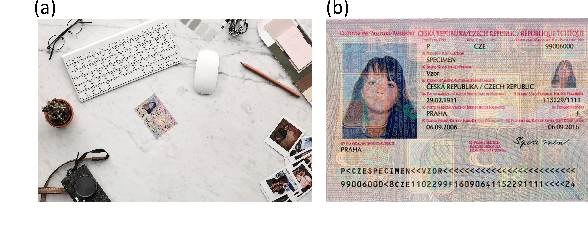
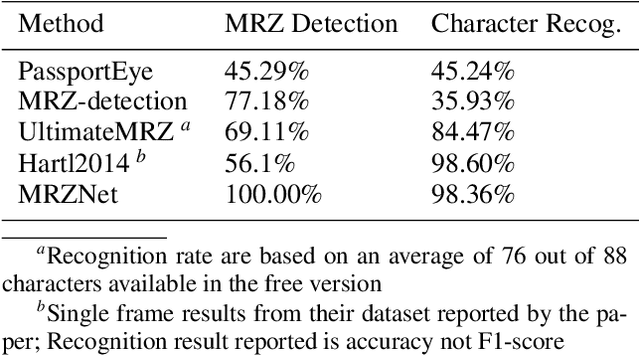

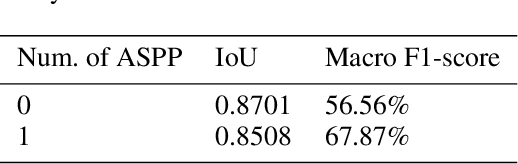
Detecting and extracting information from Machine-Readable Zone (MRZ) on passports and visas is becoming increasingly important for verifying document authenticity. However, computer vision methods for performing similar tasks, such as optical character recognition (OCR), fail to extract the MRZ given digital images of passports with reasonable accuracy. We present a specially designed model based on convolutional neural networks that is able to successfully extract MRZ information from digital images of passports of arbitrary orientation and size. Our model achieved 100% MRZ detection rate and 98.36% character recognition macro-f1 score on a passport and visa dataset.