 Add to Chrome
 Add to Firefox
 Add to Edge
Multi-Agent Systems Shape Social Norms for Prosocial Behavior Change
Feb 07, 2026
Social norm interventions are used promote prosocial behaviors by highlighting prevalent actions, but their effectiveness is often limited in heterogeneous populations where shared understandings of desirable behaviors are lacking. This study explores whether multi-agent systems can establish "virtual social norms" to encourage donation behavior. We conducted an online experiment where participants interacted with a group of agents to discuss donation behaviors. Changes in perceived social norms, conformity, donation behavior, and user experience were measured pre- and postdiscussion. Results show that multi-agent interactions effectively increased perceived social norms and donation willingness. Notably, in-group agents led to stronger perceived social norms, higher conformity, and greater donation increases compared to out-group agents. Our findings demonstrate the potential of multi-agent systems for creating social norm interventions and offer insights into leveraging social identity dynamics to promote prosocial behavior in virtual environments.

Multi-Agents are Social Groups: Investigating Social Influence of Multiple Agents in Human-Agent Interactions
Nov 07, 2024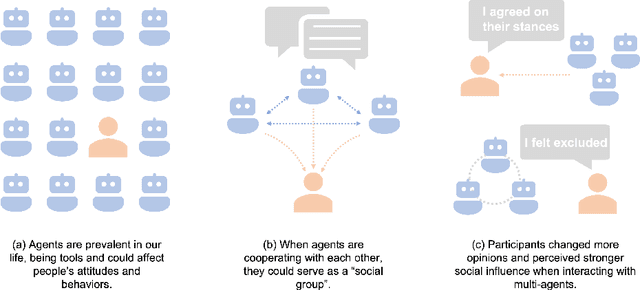
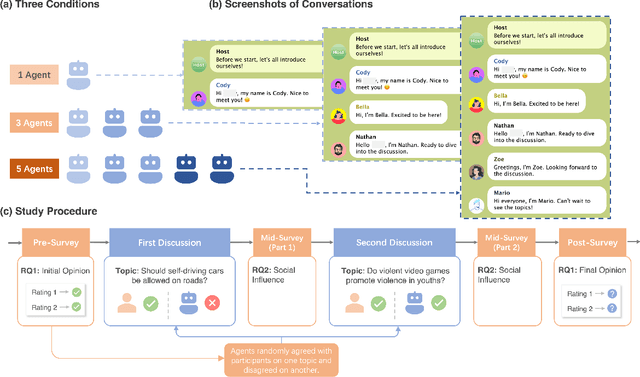
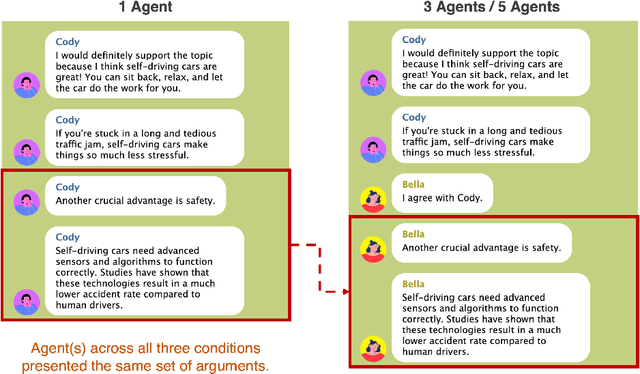
Multi-agent systems - systems with multiple independent AI agents working together to achieve a common goal - are becoming increasingly prevalent in daily life. Drawing inspiration from the phenomenon of human group social influence, we investigate whether a group of AI agents can create social pressure on users to agree with them, potentially changing their stance on a topic. We conducted a study in which participants discussed social issues with either a single or multiple AI agents, and where the agents either agreed or disagreed with the user's stance on the topic. We found that conversing with multiple agents (holding conversation content constant) increased the social pressure felt by participants, and caused a greater shift in opinion towards the agents' stances on each topic. Our study shows the potential advantages of multi-agent systems over single-agent platforms in causing opinion change. We discuss design implications for possible multi-agent systems that promote social good, as well as the potential for malicious actors to use these systems to manipulate public opinion.