 Add to Chrome
 Add to Firefox
 Add to Edge
Physics-based phenomenological characterization of cross-modal bias in multimodal models
Feb 24, 2026
The term 'algorithmic fairness' is used to evaluate whether AI models operate fairly in both comparative (where fairness is understood as formal equality, such as "treat like cases as like") and non-comparative (where unfairness arises from the model's inaccuracy, arbitrariness, or inscrutability) contexts. Recent advances in multimodal large language models (MLLMs) are breaking new ground in multimodal understanding, reasoning, and generation; however, we argue that inconspicuous distortions arising from complex multimodal interaction dynamics can lead to systematic bias. The purpose of this position paper is twofold: first, it is intended to acquaint AI researchers with phenomenological explainable approaches that rely on the physical entities that the machine experiences during training/inference, as opposed to the traditional cognitivist symbolic account or metaphysical approaches; second, it is to state that this phenomenological doctrine will be practically useful for tackling algorithmic fairness issues in MLLMs. We develop a surrogate physics-based model that describes transformer dynamics (i.e., semantic network structure and self-/cross-attention) to analyze the dynamics of cross-modal bias in MLLM, which are not fully captured by conventional embedding- or representation-level analyses. We support this position through multi-input diagnostic experiments: 1) perturbation-based analyses of emotion classification using Qwen2.5-Omni and Gemma 3n, and 2) dynamical analysis of Lorenz chaotic time-series prediction through the physical surrogate. Across two architecturally distinct MLLMs, we show that multimodal inputs can reinforce modality dominance rather than mitigate it, as revealed by structured error-attractor patterns under systematic label perturbation, complemented by dynamical analysis.

FiLoRA: Focus-and-Ignore LoRA for Controllable Feature Reliance
Feb 02, 2026Multimodal foundation models integrate heterogeneous signals across modalities, yet it remains poorly understood how their predictions depend on specific internal feature groups and whether such reliance can be deliberately controlled. Existing studies of shortcut and spurious behavior largely rely on post hoc analyses or feature removal, offering limited insight into whether reliance can be modulated without altering task semantics. We introduce FiLoRA (Focus-and-Ignore LoRA), an instruction-conditioned, parameter-efficient adaptation framework that enables explicit control over internal feature reliance while keeping the predictive objective fixed. FiLoRA decomposes adaptation into feature group-aligned LoRA modules and applies instruction-conditioned gating, allowing natural language instructions to act as computation-level control signals rather than task redefinitions. Across text--image and audio--visual benchmarks, we show that instruction-conditioned gating induces consistent and causal shifts in internal computation, selectively amplifying or suppressing core and spurious feature groups without modifying the label space or training objective. Further analyses demonstrate that FiLoRA yields improved robustness under spurious feature interventions, revealing a principled mechanism to regulate reliance beyond correlation-driven learning.
Speech Recognition-based Feature Extraction for Enhanced Automatic Severity Classification in Dysarthric Speech
Dec 05, 2024
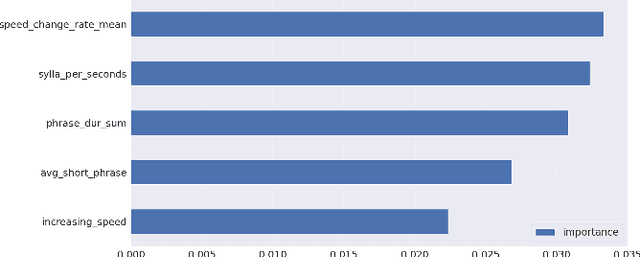

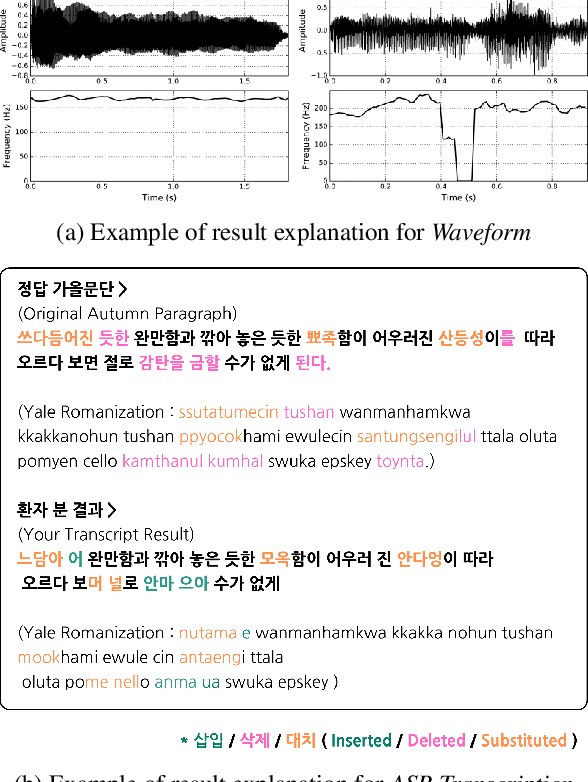
Due to the subjective nature of current clinical evaluation, the need for automatic severity evaluation in dysarthric speech has emerged. DNN models outperform ML models but lack user-friendly explainability. ML models offer explainable results at a feature level, but their performance is comparatively lower. Current ML models extract various features from raw waveforms to predict severity. However, existing methods do not encompass all dysarthric features used in clinical evaluation. To address this gap, we propose a feature extraction method that minimizes information loss. We introduce an ASR transcription as a novel feature extraction source. We finetune the ASR model for dysarthric speech, then use this model to transcribe dysarthric speech and extract word segment boundary information. It enables capturing finer pronunciation and broader prosodic features. These features demonstrated an improved severity prediction performance to existing features: balanced accuracy of 83.72%.
Inappropriate Pause Detection In Dysarthric Speech Using Large-Scale Speech Recognition
Feb 29, 2024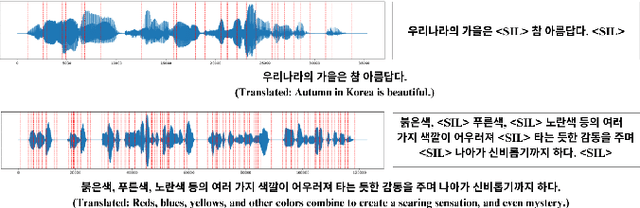

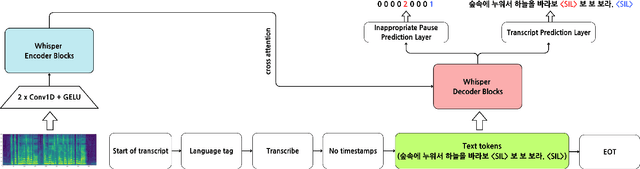
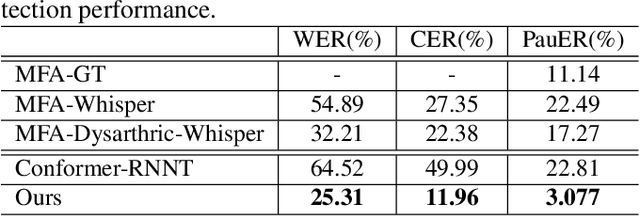
Dysarthria, a common issue among stroke patients, severely impacts speech intelligibility. Inappropriate pauses are crucial indicators in severity assessment and speech-language therapy. We propose to extend a large-scale speech recognition model for inappropriate pause detection in dysarthric speech. To this end, we propose task design, labeling strategy, and a speech recognition model with an inappropriate pause prediction layer. First, we treat pause detection as speech recognition, using an automatic speech recognition (ASR) model to convert speech into text with pause tags. According to the newly designed task, we label pause locations at the text level and their appropriateness. We collaborate with speech-language pathologists to establish labeling criteria, ensuring high-quality annotated data. Finally, we extend the ASR model with an inappropriate pause prediction layer for end-to-end inappropriate pause detection. Moreover, we propose a task-tailored metric for evaluating inappropriate pause detection independent of ASR performance. Our experiments show that the proposed method better detects inappropriate pauses in dysarthric speech than baselines. (Inappropriate Pause Error Rate: 14.47%)
DC CoMix TTS: An End-to-End Expressive TTS with Discrete Code Collaborated with Mixer
Jun 12, 2023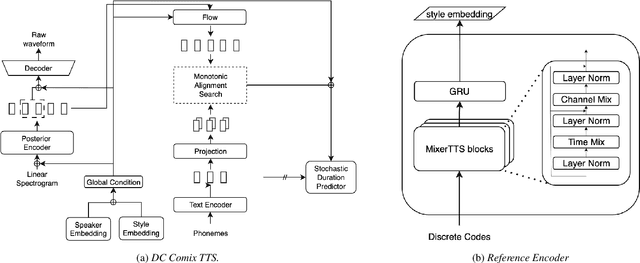
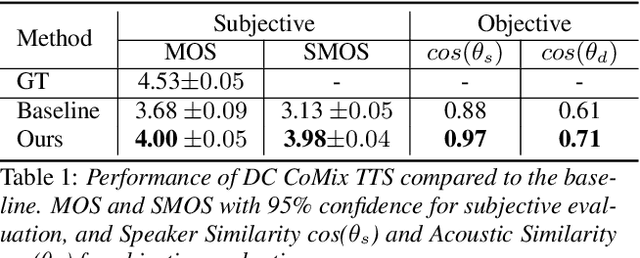
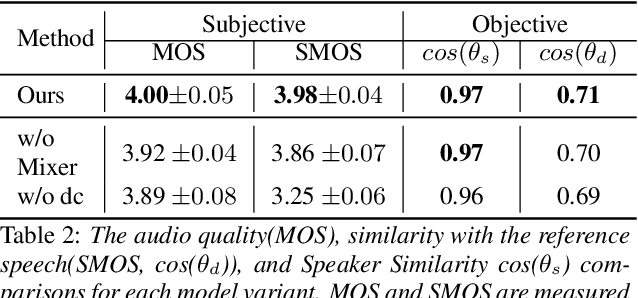
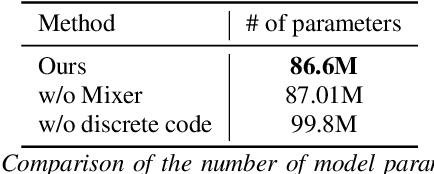
Despite the huge successes made in neutral TTS, content-leakage remains a challenge. In this paper, we propose a new input representation and simple architecture to achieve improved prosody modeling. Inspired by the recent success in the use of discrete code in TTS, we introduce discrete code to the input of the reference encoder. Specifically, we leverage the vector quantizer from the audio compression model to exploit the diverse acoustic information it has already been trained on. In addition, we apply the modified MLP-Mixer to the reference encoder, making the architecture lighter. As a result, we train the prosody transfer TTS in an end-to-end manner. We prove the effectiveness of our method through both subjective and objective evaluations. We demonstrate that the reference encoder learns better speaker-independent prosody when discrete code is utilized as input in the experiments. In addition, we obtain comparable results even when fewer parameters are inputted.