 Add to Chrome
 Add to Firefox
 Add to Edge
Auditing the Auditors: Does Community-based Moderation Get It Right?
Mar 17, 2026
Online social platforms increasingly rely on crowd-sourced systems to label misleading content at scale, but these systems must both aggregate users' evaluations and decide whose evaluations to trust. To address the latter, many platforms audit users by rewarding agreement with the final aggregate outcome, a design we term consensus-based auditing. We analyze the consequences of this design in X's Community Notes, which in September 2022 adopted consensus-based auditing that ties users' eligibility for participation to agreement with the eventual platform outcome. We find evidence of strategic conformity: minority contributors' evaluations drift toward the majority and their participation share falls on controversial topics, where independent signals matter most. We formalize this mechanism in a behavioral model in which contributors trade off private beliefs against anticipated penalties for disagreement. Motivated by these findings, we propose a two-stage auditing and aggregation algorithm that weights contributors by the stability of their past residuals rather than by agreement with the majority. The method first accounts for differences across content and contributors, and then measures how predictable each contributor's evaluations are relative to the latent-factor model. Contributors whose evaluations are consistently informative receive greater influence in aggregation, even when they disagree with the prevailing consensus. In the Community Notes data, this approach improves out-of-sample predictive performance while avoiding penalization of disagreement.

A Local Graph Limits Perspective on Sampling-Based GNNs
Oct 17, 2023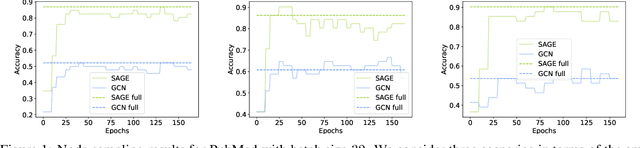
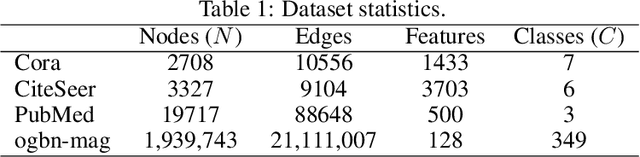
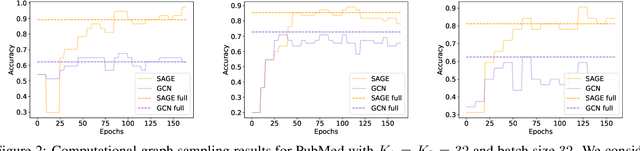
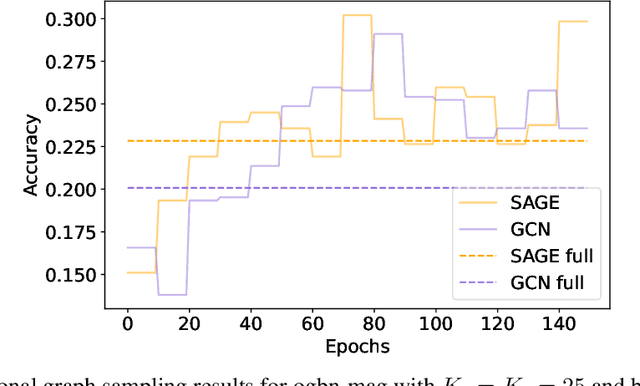
We propose a theoretical framework for training Graph Neural Networks (GNNs) on large input graphs via training on small, fixed-size sampled subgraphs. This framework is applicable to a wide range of models, including popular sampling-based GNNs, such as GraphSAGE and FastGCN. Leveraging the theory of graph local limits, we prove that, under mild assumptions, parameters learned from training sampling-based GNNs on small samples of a large input graph are within an $\epsilon$-neighborhood of the outcome of training the same architecture on the whole graph. We derive bounds on the number of samples, the size of the graph, and the training steps required as a function of $\epsilon$. Our results give a novel theoretical understanding for using sampling in training GNNs. They also suggest that by training GNNs on small samples of the input graph, practitioners can identify and select the best models, hyperparameters, and sampling algorithms more efficiently. We empirically illustrate our results on a node classification task on large citation graphs, observing that sampling-based GNNs trained on local subgraphs 12$\times$ smaller than the original graph achieve comparable performance to those trained on the input graph.