 Add to Chrome
 Add to Firefox
 Add to Edge
Introducing First-Principles Calculations: New Approach to Group Dynamics and Bridging Social Phenomena in TeNP-Chain Based Social Dynamics Simulations
Mar 06, 2024
This note considers an innovative interdisciplinary methodology that bridges the gap between the fundamental principles of quantum mechanics applied to the study of materials such as tellurium nanoparticles (TeNPs) and graphene and the complex dynamics of social systems. The basis for this approach lies in the metaphorical parallels drawn between the structural features of TeNPs and graphene and the behavioral patterns of social groups in the face of misinformation. TeNPs exhibit unique properties such as the strengthening of covalent bonds within telluric chains and the disruption of secondary structure leading to the separation of these chains. This is analogous to increased cohesion within social groups and disruption of information flow between different subgroups, respectively. . Similarly, the outstanding properties of graphene, such as high electrical conductivity, strength, and flexibility, provide additional aspects for understanding the resilience and adaptability of social structures in response to external stimuli such as fake news. This research note proposes a novel metaphorical framework for analyzing the spread of fake news within social groups, analogous to the structural features of telluric nanoparticles (TeNPs). We investigate how the strengthening of covalent bonds within TeNPs reflects the strengthening of social cohesion in groups that share common beliefs and values.

Note: Harnessing Tellurium Nanoparticles in the Digital Realm Plasmon Resonance, in the Context of Brewster's Angle and the Drude Model for Fake News Adsorption in Incomplete Information Games
Mar 05, 2024This note explores the innovative application of soliton theory and plasmonic phenomena in modeling user behavior and engagement within digital health platforms. By introducing the concept of soliton solutions, we present a novel approach to understanding stable patterns of health improvement behaviors over time. Additionally, we delve into the role of tellurium nanoparticles and their plasmonic properties in adsorbing fake news, thereby influencing user interactions and engagement levels. Through a theoretical framework that combines nonlinear dynamics with the unique characteristics of tellurium nanoparticles, we aim to provide new insights into the dynamics of user engagement in digital health environments. Our analysis highlights the potential of soliton theory in capturing the complex, nonlinear dynamics of user behavior, while the application of plasmonic phenomena offers a promising avenue for enhancing the sensitivity and effectiveness of digital health platforms. This research ventures into an uncharted territory where optical phenomena such as Brewster's Angle and Snell's Law, along with the concept of spin solitons, are metaphorically applied to address the challenge of fake news dissemination. By exploring the analogy between light refraction, reflection, and the propagation of information in digital platforms, we unveil a novel perspective on how the 'angle' at which information is presented can significantly affect its acceptance and spread. Additionally, we propose the use of tellurium nanoparticles to manage 'information waves' through mechanisms akin to plasmonic resonance and soliton dynamics. This theoretical exploration aims to bridge the gap between physical sciences and digital communication, offering insights into the development of strategies for mitigating misinformation.
Plasmon Resonance Model: Investigation of Analysis of Fake News Diffusion Model with Third Mover Intervention Using Soliton Solution in Non-Complete Information Game under Repeated Dilemma Condition
Mar 03, 2024In this research note, we propose a new approach to model the fake news diffusion process within the framework of incomplete information games. In particular, we use nonlinear partial differential equations to represent the phenomenon of plasmon resonance, in which the diffusion of fake news is rapidly amplified within a particular social group or communication network, and analyze its dynamics through a soliton solution approach. In addition, we consider how first mover, second mover, and third mover strategies interact within this nonlinear system and contribute to the amplification or suppression of fake news diffusion. The model aims to understand the mechanisms of fake news proliferation and provide insights into how to prevent or combat it. By combining concepts from the social sciences and the physical sciences, this study attempts to develop a new theoretical framework for the contemporary problem of fake news.
Note: Evolutionary Game Theory Focus Informational Health: The Cocktail Party Effect Through Werewolfgame under Incomplete Information and ESS Search Method Using Expected Gains of Repeated Dilemmas
Feb 27, 2024We explore the state of information disruption caused by the cocktail party effect within the framework of non-perfect information games and evolutive games with multiple werewolves. In particular, we mathematically model and analyze the effects on the gain of each strategy choice and the formation process of evolutionary stable strategies (ESS) under the assumption that the pollution risk of fake news is randomly assigned in the context of repeated dilemmas. We will develop the computational process in detail, starting with the construction of the gain matrix, modeling the evolutionary dynamics using the replicator equation, and identifying the ESS. In addition, numerical simulations will be performed to observe system behavior under different initial conditions and parameter settings to better understand the impact of the spread of fake news on strategy evolution. This research will provide theoretical insights into the complex issues of contemporary society regarding the authenticity of information and expand the range of applications of evolutionary game theory.
Perspective in Opinion Dynamics on Complex Convex Domains of Time Networks for Addiction, Forgetting
Nov 26, 2023This paper revises previous work and introduces changes in spatio-temporal scales. The paper presents a model that includes layers A and B with varying degrees of forgetting and dependence over time. We also model changes in dependence and forgetting in layers A, A', B, and B' under certain conditions. In addition, to discuss the formation of opinion clusters that have reinforcing or obstructive behaviors of forgetting and dependence and are conservative or brainwashing or detoxifying and less prone to filter bubbling, new clusters C and D that recommend, obstruct, block, or incite forgetting and dependence over time are Introduction. This introduction allows us to test hypotheses regarding the expansion of opinions in two dimensions over time and space, the state of development of opinion space, and the expansion of public opinion. Challenges in consensus building will be highlighted, emphasizing the dynamic nature of opinions and the need to consider factors such as dissent, distrust, and media influence. The paper proposes an extended framework that incorporates trust, distrust, and media influence into the consensus building model. We introduce network analysis using dimerizing as a method to gain deeper insights. In this context, we discuss network clustering, media influence, and consensus building. The location and distribution of dimers will be analyzed to gain insight into the structure and dynamics of the network. Dimertiling has been applied in various fields other than network analysis, such as physics and sociology. The paper concludes by emphasizing the importance of diverse perspectives, network analysis, and influential entities in consensus building. It also introduces torus-based visualizations that aid in understanding complex network structures.
The State of the Art when using GPUs in Devising Image Generation Methods Using Deep Learning
Sep 13, 2021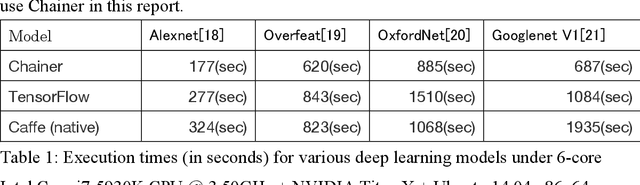
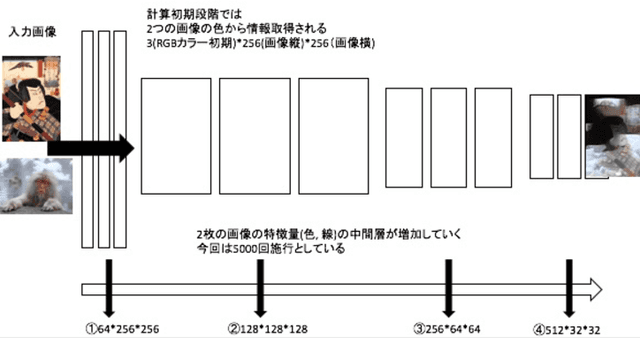
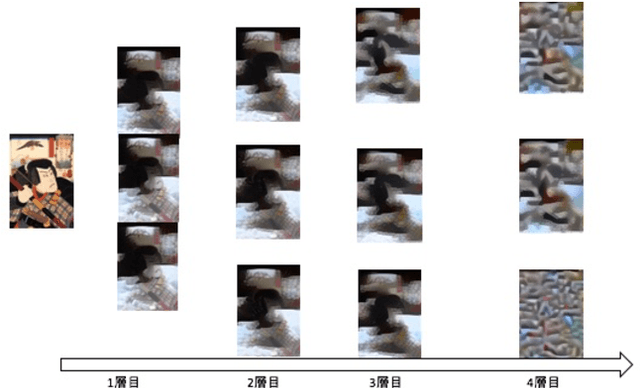
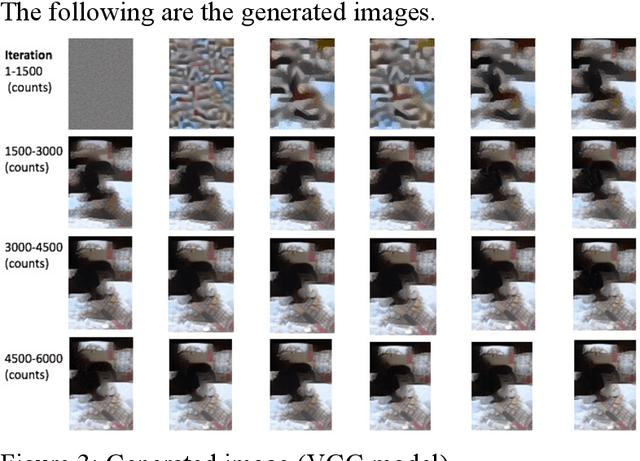
Deep learning is a technique for machine learning using multi-layer neural networks. It has been used for image synthesis and image recognition, but in recent years, it has also been used for various social detection and social labeling. In this analysis, we compared (1) the number of Iterations per minute between the GPU and CPU when using the VGG model and the NIN model, and (2) the number of Iterations per minute by the number of pixels when using the VGG model, using an image with 128 pixels. When the number of pixels was 64 or 128, the processing time was almost the same when using the GPU, but when the number of pixels was changed to 256, the number of iterations per minute decreased and the processing time increased by about three times. In this case study, since the number of pixels becomes core dumping when the number of pixels is 512 or more, we can consider that we should consider improvement in the vector calculation part. If we aim to achieve 8K highly saturated computer graphics using neural networks, we will need to consider an environment that allows computation even when the size of the image becomes even more highly saturated and massive, and parallel computation when performing image recognition and tuning.
* 13 pages