 Add to Chrome
 Add to Firefox
 Add to Edge
Leveraging Spatial Transcriptomics as Alternative to Manual Annotations for Deep Learning-Based Nuclei Analysis
Apr 26, 2026
Deep learning-based nuclei segmentation and classification in pathology images typically rely on large-scale pixel-level manual annotations, which are costly and difficult to obtain across diverse tissues and staining conditions. To address this limitation, we propose a framework that leverages spatial transcriptomics (ST) data as supervision for nuclei segmentation and classification. By incorporating cell-level ST data, we obtain gene expression profiles and corresponding nuclear masks from histopathological images. Gene expression profiles are converted into cell-type labels and used as training data for image-based classification. Because existing gene expression-based cell-type classification methods are not designed for image recognition, we introduce an image-oriented classification approach that bridges gene expression-based cell typing and image-based cell classification. To evaluate generalization, we conduct segmentation experiments on previously unseen organs and compare our method with conventional supervised models. Despite being trained on fewer organ types, our framework achieves higher segmentation accuracy, demonstrating strong transferability. Classification experiments further show consistent improvements over existing approaches.

Cell-Type Prototype-Informed Neural Network for Gene Expression Estimation from Pathology Images
Mar 19, 2026Estimating slide- and patch-level gene expression profiles from pathology images enables rapid and low-cost molecular analysis with broad clinical impact. Despite strong results, existing approaches treat gene expression as a mere slide- or spot-level signal and do not incorporate the fact that the measured expression arises from the aggregation of underlying cell-level expression. To explicitly introduce this missing cell-resolved guidance, we propose a Cell-type Prototype-informed Neural Network (CPNN) that leverages publicly available single-cell RNA-sequencing datasets. Since single-cell measurements are noisy and not paired with histology images, we first estimate cell-type prototypes-mean expression profiles that reflect stable gene-gene co-variation patterns.CPNN then learns cell-type compositional weights directly from images and models the relationship between prototypes and observed bulk or spatial expression, providing a biologically grounded and structurally regularized prediction framework. We evaluate CPNN on three slide-level datasets and three patch-level spatial transcriptomics datasets. Across all settings, CPNN achieves the highest performance in terms of Spearman correlation. Moreover, by visualizing the inferred compositional weights, our framework provides interpretable insights into which cell types drive the predicted expression. Code is publicly available at https://github.com/naivete5656/CPNN.
Towards Spatial Transcriptomics-guided Pathological Image Recognition with Batch-Agnostic Encoder
Mar 10, 2025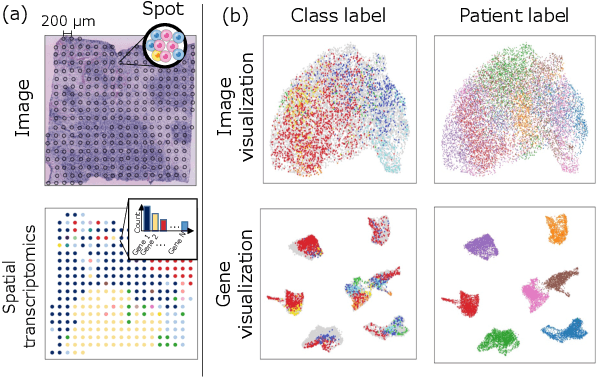
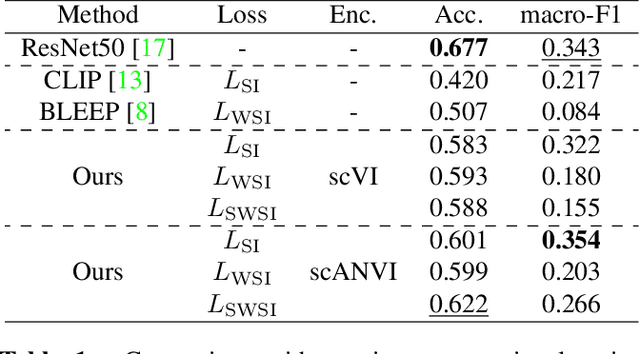
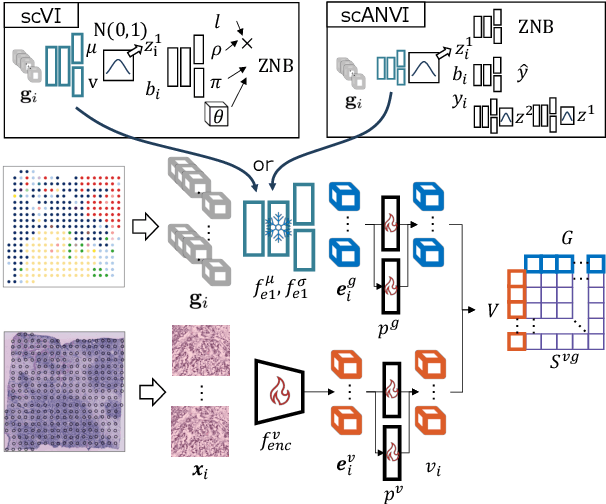
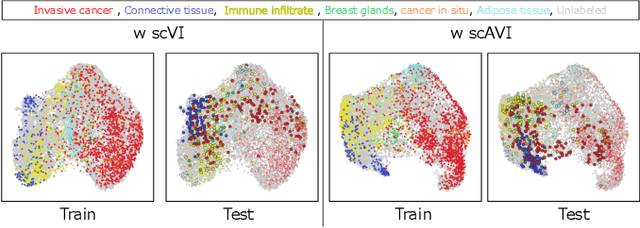
Spatial transcriptomics (ST) is a novel technique that simultaneously captures pathological images and gene expression profiling with spatial coordinates. Since ST is closely related to pathological features such as disease subtypes, it may be valuable to augment image representation with pathological information. However, there are no attempts to leverage ST for image recognition ({\it i.e,} patch-level classification of subtypes of pathological image.). One of the big challenges is significant batch effects in spatial transcriptomics that make it difficult to extract pathological features of images from ST. In this paper, we propose a batch-agnostic contrastive learning framework that can extract consistent signals from gene expression of ST in multiple patients. To extract consistent signals from ST, we utilize the batch-agnostic gene encoder that is trained in a variational inference manner. Experiments demonstrated the effectiveness of our framework on a publicly available dataset. Code is publicly available at https://github.com/naivete5656/TPIRBAE