 Add to Chrome
 Add to Firefox
 Add to Edge
Drift-to-Action Controllers: Budgeted Interventions with Online Risk Certificates
Mar 09, 2026
Deployed machine learning systems face distribution drift, yet most monitoring pipelines stop at alarms and leave the response underspecified under labeling, compute, and latency constraints. We introduce Drift2Act, a drift-to-action controller that treats monitoring as constrained decision-making with explicit safety. Drift2Act combines a sensing layer that maps unlabeled monitoring signals to a belief over drift types with an active risk certificate that queries a small set of delayed labels from a recent window to produce an anytime-valid upper bound $U_t(δ)$ on current risk. The certificate gates operation: if $U_t(δ) \le τ$, the controller selects low-cost actions (e.g., recalibration or test-time adaptation); if $U_t(δ) > τ$, it activates abstain/handoff and escalates to rollback or retraining under cooldowns. In a realistic streaming protocol with label delay and explicit intervention costs, Drift2Act achieves near-zero safety violations and fast recovery at moderate cost on WILDS Camelyon17, DomainNet, and a controlled synthetic drift stream, outperforming alarm-only monitoring, adapt-always adaptation, schedule-based retraining, selective prediction alone, and an ablation without certification. Overall, online risk certification enables reliable drift response and reframes monitoring as decision-making with safety.

T3C: Test-Time Tensor Compression with Consistency Guarantees
Jan 03, 2026We present T3C, a train-once, test-time budget-conditioned compression framework that exposes rank and precision as a controllable deployment knob. T3C combines elastic tensor factorization (maintained up to a maximal rank) with rank-tied mixed-precision quantization and a lightweight controller that maps a latency/energy/size budget token to per-layer rank/bit assignments; the policy snaps to hardware-aligned profiles and is monotone in the budget. A fast, layerwise consistency certificate, computed from spectral proxies and activation statistics, upper-bounds logit drift and regularizes training, yielding a practical reliability signal with negligible overhead. On ImageNet-1k, T3C shifts the vision Pareto frontier: for ResNet-50 at matched accuracy (\leq 0.5% drop), p50 latency is 1.18ms with a 38MB model, outperforming PTQ-8b (1.44ms, 88MB); for ViT-B/16, T3C reaches 2.30ms p50 with 59MB, improving over strong PTQ/QAT baselines. A single T3C checkpoint therefore provides predictable, certificate-backed accuracy-latency-size trade-offs on demand across devices.
BayesQ: Uncertainty-Guided Bayesian Quantization
Nov 11, 2025We present BayesQ, an uncertainty-guided post-training quantization framework that is the first to optimize quantization under the posterior expected loss. BayesQ fits a lightweight Gaussian posterior over weights (diagonal Laplace by default; optional K-FAC/low-rank), whitens by the posterior covariance, designs codebooks to minimize posterior-expected distortion, and allocates mixed precision via a greedy knapsack that maximizes marginal expected-loss reduction per bit under a global budget. For scalar quantizers, posterior-expected MSE yields closed-form tables; task-aware proxies are handled by short Monte Carlo on a small calibration set. An optional calibration-only distillation aligns the quantized model with the posterior predictive teacher. At matched average bits/weight of 3.0/3.5/4.0, BayesQ improves over strong PTQ baselines on ResNet-50 (ImageNet) and BERT-base (GLUE) e.g., vs. GPTQ by $+1.5/+0.7/+0.3$ top-1 percentage points on RN50 and $+1.1/+0.4/+0.2$ GLUE points on BERT, while requiring one-time preprocessing comparable to a GPTQ pass. BayesQ reframes low-bit quantization as uncertainty-aware risk minimization in a practical, post-training pipeline.
Simplex-FEM Networks (SiFEN): Learning A Triangulated Function Approximator
Nov 06, 2025We introduce Simplex-FEM Networks (SiFEN), a learned piecewise-polynomial predictor that represents f: R^d -> R^k as a globally C^r finite-element field on a learned simplicial mesh in an optionally warped input space. Each query activates exactly one simplex and at most d+1 basis functions via barycentric coordinates, yielding explicit locality, controllable smoothness, and cache-friendly sparsity. SiFEN pairs degree-m Bernstein-Bezier polynomials with a light invertible warp and trains end-to-end with shape regularization, semi-discrete OT coverage, and differentiable edge flips. Under standard shape-regularity and bi-Lipschitz warp assumptions, SiFEN achieves the classic FEM approximation rate M^(-m/d) with M mesh vertices. Empirically, on synthetic approximation tasks, tabular regression/classification, and as a drop-in head on compact CNNs, SiFEN matches or surpasses MLPs and KANs at matched parameter budgets, improves calibration (lower ECE/Brier), and reduces inference latency due to geometric locality. These properties make SiFEN a compact, interpretable, and theoretically grounded alternative to dense MLPs and edge-spline networks.
Enhancing Bangla Fake News Detection Using Bidirectional Gated Recurrent Units and Deep Learning Techniques
Mar 31, 2024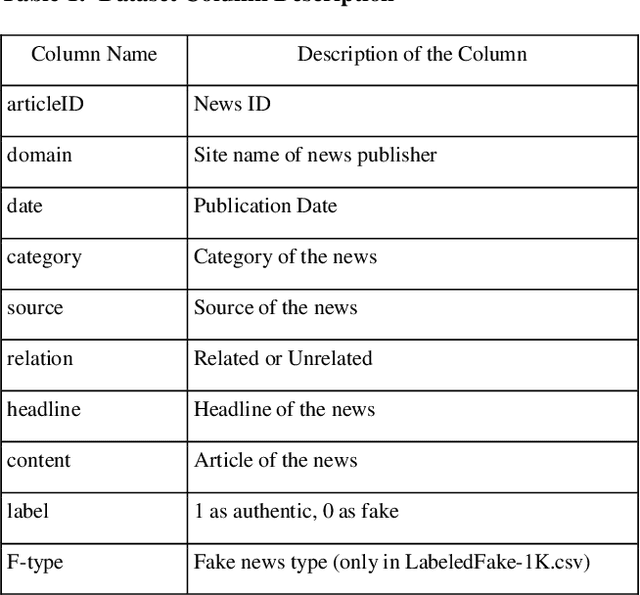
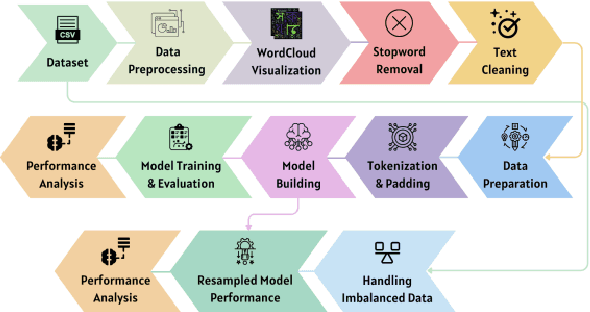

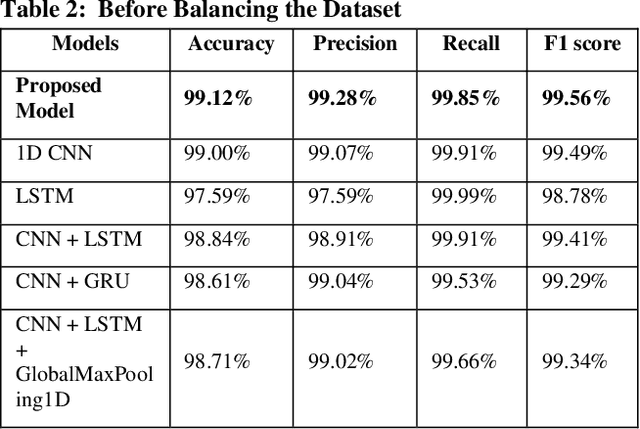
The rise of fake news has made the need for effective detection methods, including in languages other than English, increasingly important. The study aims to address the challenges of Bangla which is considered a less important language. To this end, a complete dataset containing about 50,000 news items is proposed. Several deep learning models have been tested on this dataset, including the bidirectional gated recurrent unit (GRU), the long short-term memory (LSTM), the 1D convolutional neural network (CNN), and hybrid architectures. For this research, we assessed the efficacy of the model utilizing a range of useful measures, including recall, precision, F1 score, and accuracy. This was done by employing a big application. We carry out comprehensive trials to show the effectiveness of these models in identifying bogus news in Bangla, with the Bidirectional GRU model having a stunning accuracy of 99.16%. Our analysis highlights the importance of dataset balance and the need for continual improvement efforts to a substantial degree. This study makes a major contribution to the creation of Bangla fake news detecting systems with limited resources, thereby setting the stage for future improvements in the detection process.