 Add to Chrome
 Add to Firefox
 Add to Edge
Bridging Robustness and Efficiency: Real-Time Low-Light Enhancement via Attention U-Net GAN
Jan 10, 2026
Recent advancements in Low-Light Image Enhancement (LLIE) have focused heavily on Diffusion Probabilistic Models, which achieve high perceptual quality but suffer from significant computational latency (often exceeding 2-4 seconds per image). Conversely, traditional CNN-based baselines offer real-time inference but struggle with "over-smoothing," failing to recover fine structural details in extreme low-light conditions. This creates a practical gap in the literature: the lack of a model that provides generative-level texture recovery at edge-deployable speeds. In this paper, we address this trade-off by proposing a hybrid Attention U-Net GAN. We demonstrate that the heavy iterative sampling of diffusion models is not strictly necessary for texture recovery. Instead, by integrating Attention Gates into a lightweight U-Net backbone and training within a conditional adversarial framework, we can approximate the high-frequency fidelity of generative models in a single forward pass. Extensive experiments on the SID dataset show that our method achieves a best-in-class LPIPS score of 0.112 among efficient models, significantly outperforming efficient baselines (SID, EnlightenGAN) while maintaining an inference latency of 0.06s. This represents a 40x speedup over latent diffusion models, making our approach suitable for near real-time applications.

DiMEx: Breaking the Cold Start Barrier in Data-Free Model Extraction via Latent Diffusion Priors
Jan 04, 2026Model stealing attacks pose an existential threat to Machine Learning as a Service (MLaaS), allowing adversaries to replicate proprietary models for a fraction of their training cost. While Data-Free Model Extraction (DFME) has emerged as a stealthy vector, it remains fundamentally constrained by the "Cold Start" problem: GAN-based adversaries waste thousands of queries converging from random noise to meaningful data. We propose DiMEx, a framework that weaponizes the rich semantic priors of pre-trained Latent Diffusion Models to bypass this initialization barrier entirely. By employing Random Embedding Bayesian Optimization (REMBO) within the generator's latent space, DiMEx synthesizes high-fidelity queries immediately, achieving 52.1 percent agreement on SVHN with just 2,000 queries - outperforming state-of-the-art GAN baselines by over 16 percent. To counter this highly semantic threat, we introduce the Hybrid Stateful Ensemble (HSE) defense, which identifies the unique "optimization trajectory" of latent-space attacks. Our results demonstrate that while DiMEx evades static distribution detectors, HSE exploits this temporal signature to suppress attack success rates to 21.6 percent with negligible latency.
Fine Grain Classification: Connecting Meta using Cross-Contrastive pre-training
Apr 29, 2025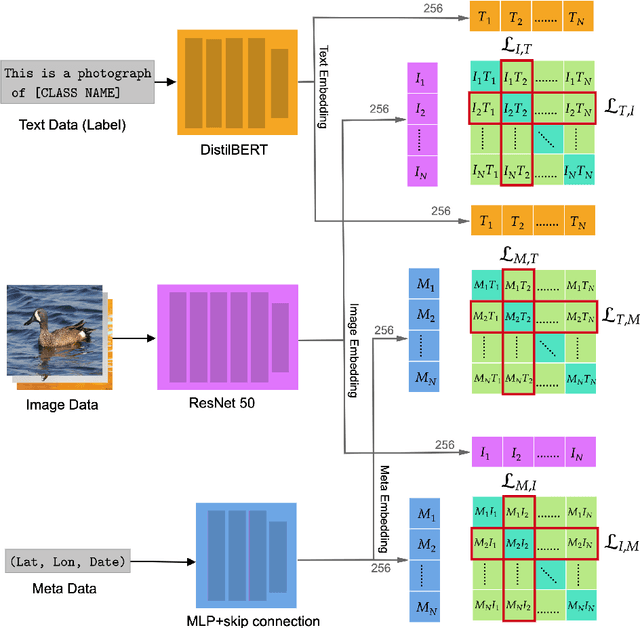
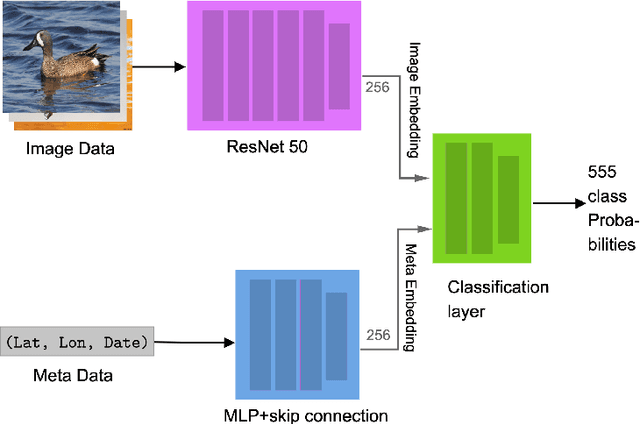
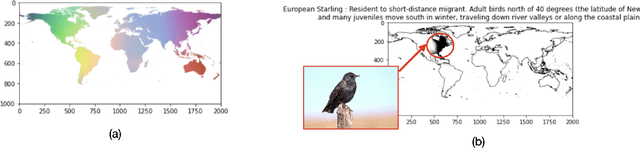
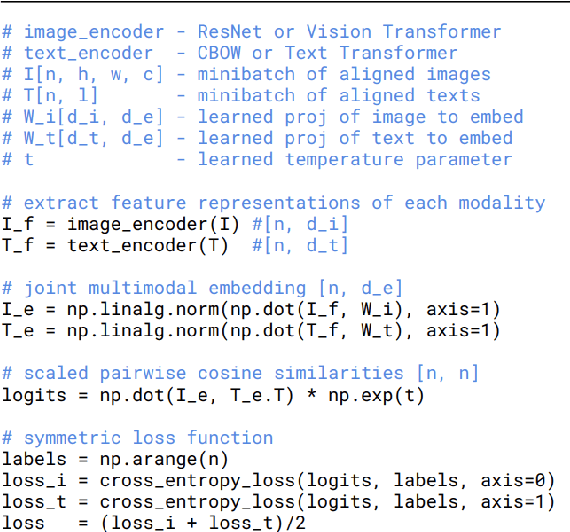
Fine-grained visual classification aims to recognize objects belonging to multiple subordinate categories within a super-category. However, this remains a challenging problem, as appearance information alone is often insufficient to accurately differentiate between fine-grained visual categories. To address this, we propose a novel and unified framework that leverages meta-information to assist fine-grained identification. We tackle the joint learning of visual and meta-information through cross-contrastive pre-training. In the first stage, we employ three encoders for images, text, and meta-information, aligning their projected embeddings to achieve better representations. We then fine-tune the image and meta-information encoders for the classification task. Experiments on the NABirds dataset demonstrate that our framework effectively utilizes meta-information to enhance fine-grained recognition performance. With the addition of meta-information, our framework surpasses the current baseline on NABirds by 7.83%. Furthermore, it achieves an accuracy of 84.44% on the NABirds dataset, outperforming many existing state-of-the-art approaches that utilize meta-information.