 Add to Chrome
 Add to Firefox
 Add to Edge
Task-Routed Mixture-of-Experts with Cognitive Appraisal for Implicit Sentiment Analysis
May 20, 2026
Implicit sentiment analysis is challenging because sentiment toward an aspect is often inferred from events rather than expressed through explicit opinion words. Existing models typically learn from the final polarity label, which provides limited guidance for reasoning about sentiment from the context. Motivated by cognitive appraisal theory, we propose an appraisal-aware multi-task learning (MTL) framework for implicit sentiment analysis that provides polarity prediction with two complementary auxiliary tasks: implicit sentiment detection and cognitive rationale generation. However, training several objectives with different targets and sharing a single backbone across tasks in MTL limits flexibility and can lead to task interference. To reduce interference among these related but distinct objectives, we adopt task-level mixture-of-experts models in which all tasks share a common set of experts, and task identity controls the sparse combination of these experts. Our method builds on an encoder-decoder architecture and replaces a subset of encoder and decoder blocks with these sparse mixtures. We use a task-conditioned router to select sparse expert mixtures for each task, and a task-separated routing objective to encourage different tasks to learn distinct expert-selection patterns. Experimental results show that our model outperforms recently proposed approaches, with strong gains on the implicit sentiment subset. Our code is available at https://github.com/yaping166/TRMoE-ISA.

Semantic-preserved Augmentation with Confidence-weighted Fine-tuning for Aspect Category Sentiment Analysis
Jun 08, 2025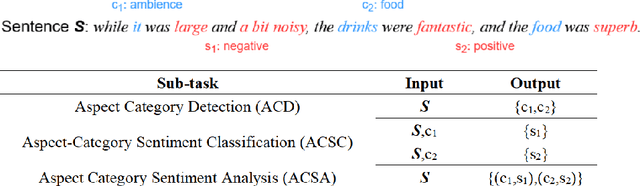
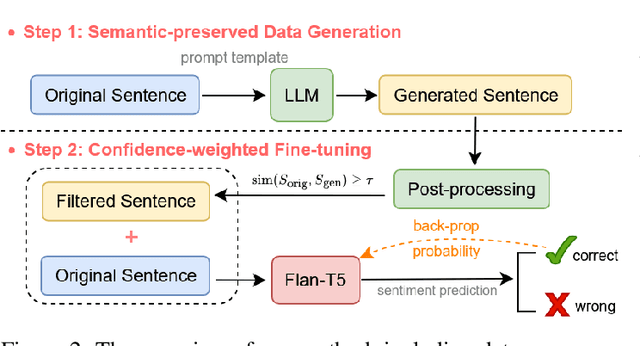
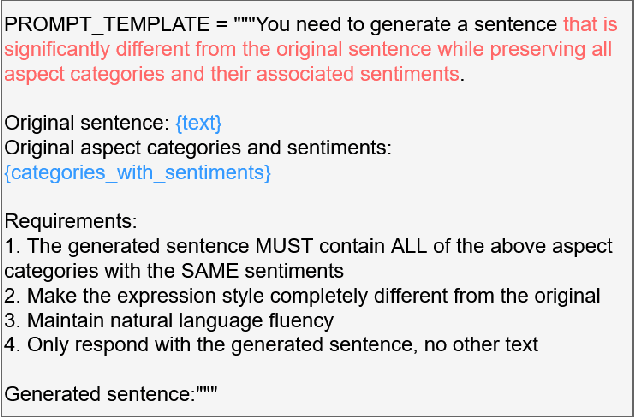
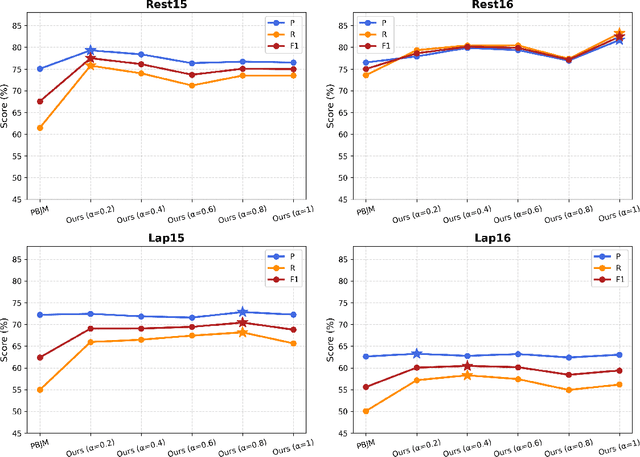
Large language model (LLM) is an effective approach to addressing data scarcity in low-resource scenarios. Recent existing research designs hand-crafted prompts to guide LLM for data augmentation. We introduce a data augmentation strategy for the aspect category sentiment analysis (ACSA) task that preserves the original sentence semantics and has linguistic diversity, specifically by providing a structured prompt template for an LLM to generate predefined content. In addition, we employ a post-processing technique to further ensure semantic consistency between the generated sentence and the original sentence. The augmented data increases the semantic coverage of the training distribution, enabling the model better to understand the relationship between aspect categories and sentiment polarities, enhancing its inference capabilities. Furthermore, we propose a confidence-weighted fine-tuning strategy to encourage the model to generate more confident and accurate sentiment polarity predictions. Compared with powerful and recent works, our method consistently achieves the best performance on four benchmark datasets over all baselines.
Text Data Augmentation for Large Language Models: A Comprehensive Survey of Methods, Challenges, and Opportunities
Jan 31, 2025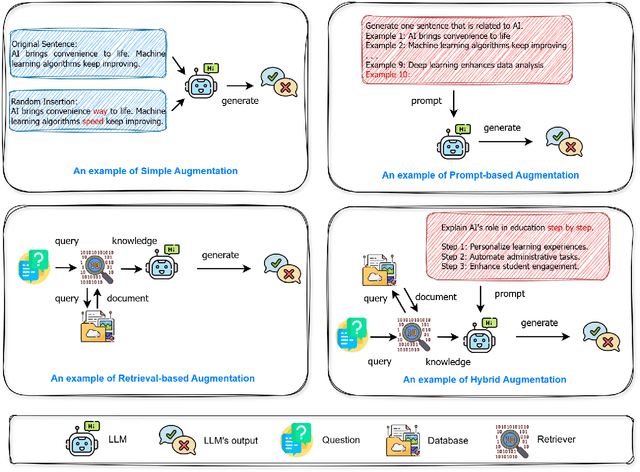
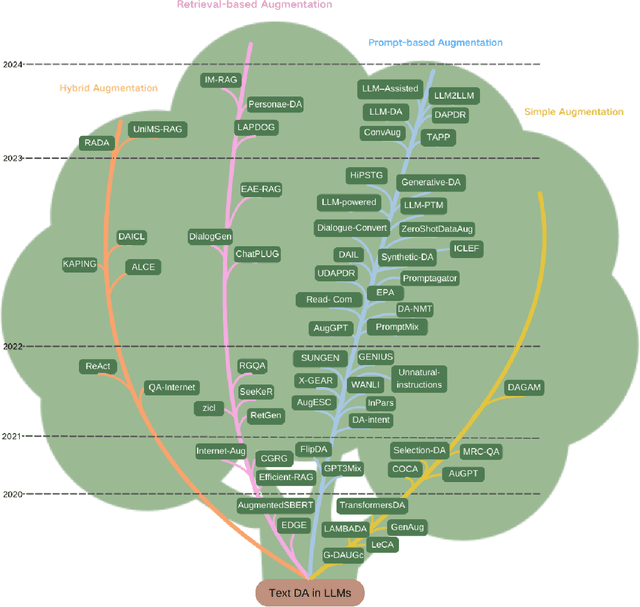
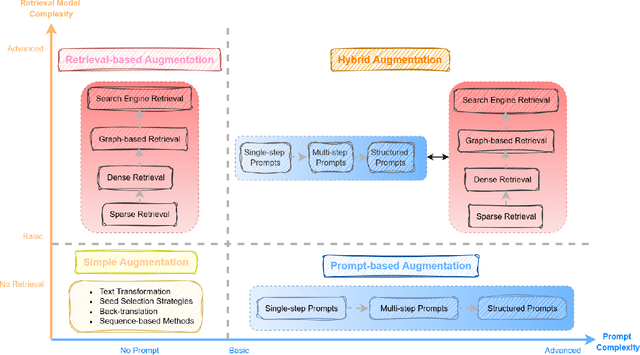
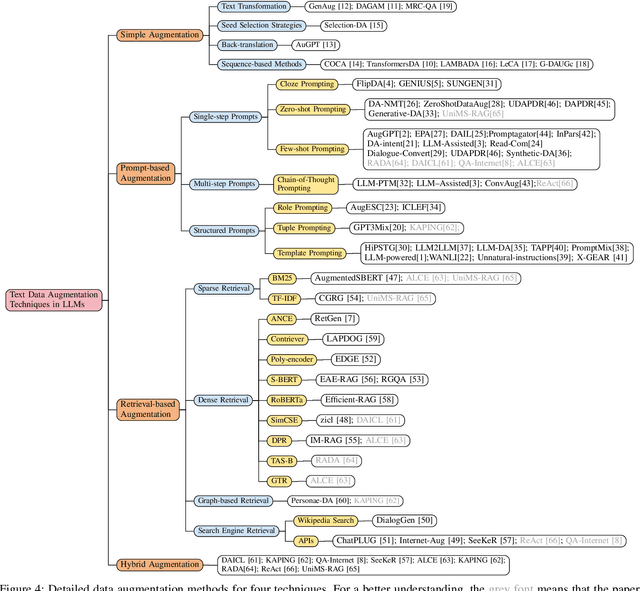
The increasing size and complexity of pre-trained language models have demonstrated superior performance in many applications, but they usually require large training datasets to be adequately trained. Insufficient training sets could unexpectedly make the model overfit and fail to cope with complex tasks. Large language models (LLMs) trained on extensive corpora have prominent text generation capabilities, which improve the quality and quantity of data and play a crucial role in data augmentation. Specifically, distinctive prompt templates are given in personalised tasks to guide LLMs in generating the required content. Recent promising retrieval-based techniques further improve the expressive performance of LLMs in data augmentation by introducing external knowledge to enable them to produce more grounded-truth data. This survey provides an in-depth analysis of data augmentation in LLMs, classifying the techniques into Simple Augmentation, Prompt-based Augmentation, Retrieval-based Augmentation and Hybrid Augmentation. We summarise the post-processing approaches in data augmentation, which contributes significantly to refining the augmented data and enabling the model to filter out unfaithful content. Then, we provide the common tasks and evaluation metrics. Finally, we introduce existing challenges and future opportunities that could bring further improvement to data augmentation.