 Add to Chrome
 Add to Firefox
 Add to Edge
A Data-Centric Approach to Multilingual E-Commerce Product Search: Case Study on Query-Category and Query-Item Relevance
Oct 24, 2025
Multilingual e-commerce search suffers from severe data imbalance across languages, label noise, and limited supervision for low-resource languages--challenges that impede the cross-lingual generalization of relevance models despite the strong capabilities of large language models (LLMs). In this work, we present a practical, architecture-agnostic, data-centric framework to enhance performance on two core tasks: Query-Category (QC) relevance (matching queries to product categories) and Query-Item (QI) relevance (matching queries to product titles). Rather than altering the model, we redesign the training data through three complementary strategies: (1) translation-based augmentation to synthesize examples for languages absent in training, (2) semantic negative sampling to generate hard negatives and mitigate class imbalance, and (3) self-validation filtering to detect and remove likely mislabeled instances. Evaluated on the CIKM AnalytiCup 2025 dataset, our approach consistently yields substantial F1 score improvements over strong LLM baselines, achieving competitive results in the official competition. Our findings demonstrate that systematic data engineering can be as impactful as--and often more deployable than--complex model modifications, offering actionable guidance for building robust multilingual search systems in the real-world e-commerce settings.

LDPKiT: Recovering Utility in LDP Schemes by Training with Noise^2
May 25, 2024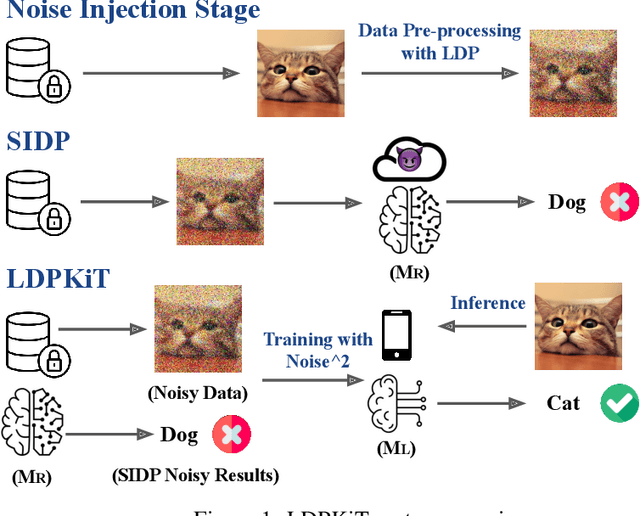
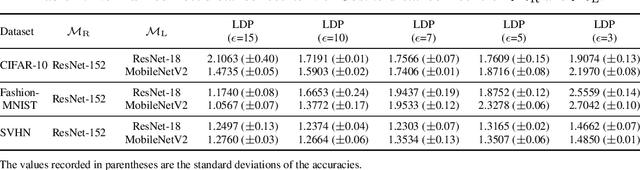
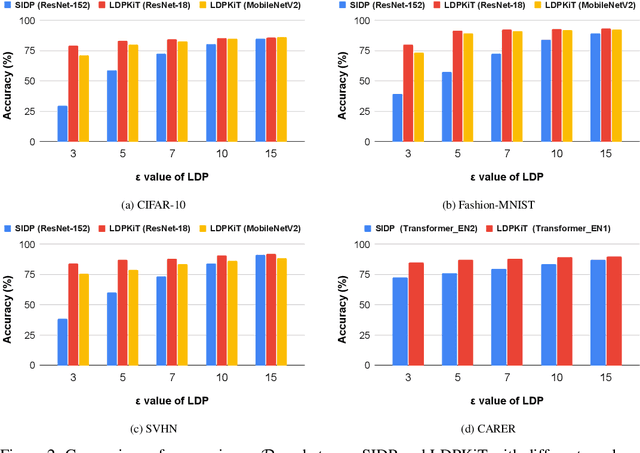
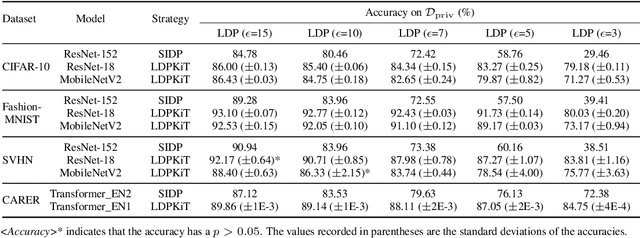
The adoption of large cloud-based models for inference has been hampered by concerns about the privacy leakage of end-user data. One method to mitigate this leakage is to add local differentially private noise to queries before sending them to the cloud, but this degrades utility as a side effect. Our key insight is that knowledge available in the noisy labels returned from performing inference on noisy inputs can be aggregated and used to recover the correct labels. We implement this insight in LDPKiT, which stands for Local Differentially-Private and Utility-Preserving Inference via Knowledge Transfer. LDPKiT uses the noisy labels returned from querying a set of noised inputs to train a local model (noise^2), which is then used to perform inference on the original set of inputs. Our experiments on CIFAR-10, Fashion-MNIST, SVHN, and CARER NLP datasets demonstrate that LDPKiT can improve utility without compromising privacy. For instance, on CIFAR-10, compared to a standard $\epsilon$-LDP scheme with $\epsilon=15$, which provides a weak privacy guarantee, LDPKiT can achieve nearly the same accuracy (within 1% drop) with $\epsilon=7$, offering an enhanced privacy guarantee. Moreover, the benefits of using LDPKiT increase at higher, more privacy-protective noise levels. For Fashion-MNIST and CARER, LDPKiT's accuracy on the sensitive dataset with $\epsilon=7$ not only exceeds the average accuracy of the standard $\epsilon$-LDP scheme with $\epsilon=7$ by roughly 20% and 9% but also outperforms the standard $\epsilon$-LDP scheme with $\epsilon=15$, a scenario with less noise and minimal privacy protection. We also perform Zest distance measurements to demonstrate that the type of distillation performed by LDPKiT is different from a model extraction attack.