 Add to Chrome
 Add to Firefox
 Add to Edge
CB-SLICE: Concept-Based Interpretable Error Slice Discovery
May 28, 2026
Despite strong average-case performance, deep learning models often exhibit systematic errors on specific population groups, known as error slices. Identifying these groups and the root causes of their failures is critical for model debugging and bias mitigation. However, existing error Slice Discovery Methods (SDMs) typically generate explanations disconnected from the model's inference process, thus only approximating the underlying error source and may be inaccurate. We address this limitation by leveraging Concept Bottleneck Models (CBMs), whose predictions are directly dependent on human-understandable semantic concepts. Since downstream task failures in CBMs commonly arise from concept mispredictions, concept representations provide a strong candidate for error slice identification, offering fine-grained explanations directly linked to the error source. Building on this insight, we introduce CB-SLICE, a concept-based SDM that groups samples with shared concept prediction failures and identifies the keyword concepts most responsible for each slice's failure mode. Across multiple benchmarks, we show that CB-SLICE outperforms state-of-the-art methods in uncovering well-known biases while providing richer and more faithful explanations of model errors.

Inference Graphs for CNN Interpretation
Oct 20, 2021
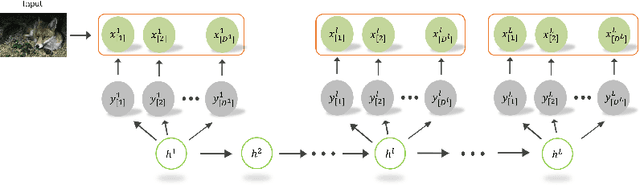


Convolutional neural networks (CNNs) have achieved superior accuracy in many visual related tasks. However, the inference process through intermediate layers is opaque, making it difficult to interpret such networks or develop trust in their operation. We propose to model the network hidden layers activity using probabilistic models. The activity patterns in layers of interest are modeled as Gaussian mixture models, and transition probabilities between clusters in consecutive modeled layers are estimated. Based on maximum-likelihood considerations, nodes and paths relevant for network prediction are chosen, connected, and visualized as an inference graph. We show that such graphs are useful for understanding the general inference process of a class, as well as explaining decisions the network makes regarding specific images.