 Add to Chrome
 Add to Firefox
 Add to Edge
Deep Generative Models for Synthetic Financial Data: Applications to Portfolio and Risk Modeling
Dec 29, 2025
Synthetic financial data provides a practical solution to the privacy, accessibility, and reproducibility challenges that often constrain empirical research in quantitative finance. This paper investigates the use of deep generative models, specifically Time-series Generative Adversarial Networks (TimeGAN) and Variational Autoencoders (VAEs) to generate realistic synthetic financial return series for portfolio construction and risk modeling applications. Using historical daily returns from the S and P 500 as a benchmark, we generate synthetic datasets under comparable market conditions and evaluate them using statistical similarity metrics, temporal structure tests, and downstream financial tasks. The study shows that TimeGAN produces synthetic data with distributional shapes, volatility patterns, and autocorrelation behaviour that are close to those observed in real returns. When applied to mean--variance portfolio optimization, the resulting synthetic datasets lead to portfolio weights, Sharpe ratios, and risk levels that remain close to those obtained from real data. The VAE provides more stable training but tends to smooth extreme market movements, which affects risk estimation. Finally, the analysis supports the use of synthetic datasets as substitutes for real financial data in portfolio analysis and risk simulation, particularly when models are able to capture temporal dynamics. Synthetic data therefore provides a privacy-preserving, cost-effective, and reproducible tool for financial experimentation and model development.

Applications of synthetic financial data in portfolio and risk modeling
Dec 25, 2025Synthetic financial data offers a practical way to address the privacy and accessibility challenges that limit research in quantitative finance. This paper examines the use of generative models, in particular TimeGAN and Variational Autoencoders (VAEs), for creating synthetic return series that support portfolio construction, trading analysis, and risk modeling. Using historical daily returns from the S and P 500 as a benchmark, we generate synthetic datasets under comparable market conditions and evaluate them using statistical similarity metrics, temporal structure tests, and downstream financial tasks. The study shows that TimeGAN produces synthetic data with distributional shapes, volatility patterns, and autocorrelation behaviour that are close to those observed in real returns. When applied to mean-variance portfolio optimization, the resulting synthetic datasets lead to portfolio weights, Sharpe ratios, and risk levels that remain close to those obtained from real data. The VAE provides more stable training but tends to smooth extreme market movements, which affects risk estimation. Finally, the analysis supports the use of synthetic datasets as substitutes for real financial data in portfolio analysis and risk simulation, particularly when models are able to capture temporal dynamics. Synthetic data therefore provides a privacy-preserving, cost-effective, and reproducible tool for financial experimentation and model development.
Synthetic Financial Data Generation for Enhanced Financial Modelling
Dec 25, 2025
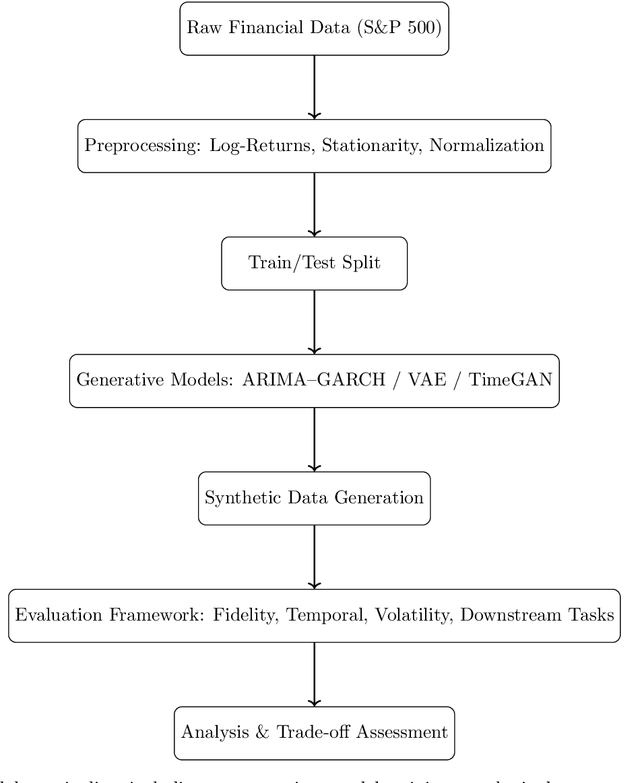

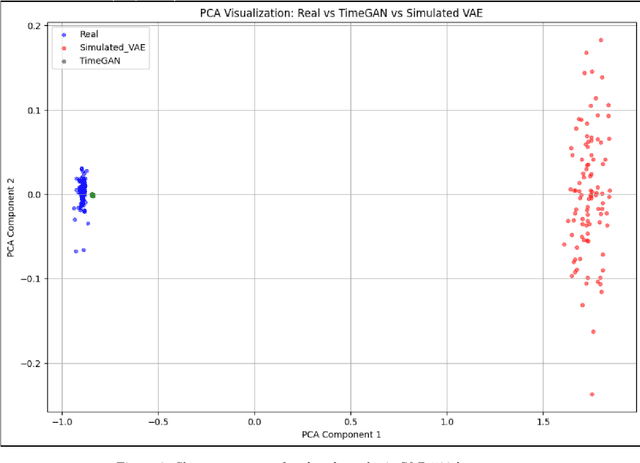
Data scarcity and confidentiality in finance often impede model development and robust testing. This paper presents a unified multi-criteria evaluation framework for synthetic financial data and applies it to three representative generative paradigms: the statistical ARIMA-GARCH baseline, Variational Autoencoders (VAEs), and Time-series Generative Adversarial Networks (TimeGAN). Using historical S and P 500 daily data, we evaluate fidelity (Maximum Mean Discrepancy, MMD), temporal structure (autocorrelation and volatility clustering), and practical utility in downstream tasks, specifically mean-variance portfolio optimization and volatility forecasting. Empirical results indicate that ARIMA-GARCH captures linear trends and conditional volatility but fails to reproduce nonlinear dynamics; VAEs produce smooth trajectories that underestimate extreme events; and TimeGAN achieves the best trade-off between realism and temporal coherence (e.g., TimeGAN attained the lowest MMD: 1.84e-3, average over 5 seeds). Finally, we articulate practical guidelines for selecting generative models according to application needs and computational constraints. Our unified evaluation protocol and reproducible codebase aim to standardize benchmarking in synthetic financial data research.
Bellman operator convergence enhancements in reinforcement learning algorithms
May 20, 2025This paper reviews the topological groundwork for the study of reinforcement learning (RL) by focusing on the structure of state, action, and policy spaces. We begin by recalling key mathematical concepts such as complete metric spaces, which form the foundation for expressing RL problems. By leveraging the Banach contraction principle, we illustrate how the Banach fixed-point theorem explains the convergence of RL algorithms and how Bellman operators, expressed as operators on Banach spaces, ensure this convergence. The work serves as a bridge between theoretical mathematics and practical algorithm design, offering new approaches to enhance the efficiency of RL. In particular, we investigate alternative formulations of Bellman operators and demonstrate their impact on improving convergence rates and performance in standard RL environments such as MountainCar, CartPole, and Acrobot. Our findings highlight how a deeper mathematical understanding of RL can lead to more effective algorithms for decision-making problems.