 Add to Chrome
 Add to Firefox
 Add to Edge
Diffusion Policy with Bayesian Expert Selection for Active Multi-Target Tracking
Apr 03, 2026
Active multi-target tracking requires a mobile robot to balance exploration for undetected targets with exploitation of uncertain tracked ones. Diffusion policies have emerged as a powerful approach for capturing diverse behavioral strategies by learning action sequences from expert demonstrations. However, existing methods implicitly select among strategies through the denoising process, without uncertainty quantification over which strategy to execute. We formulate expert selection for diffusion policies as an offline contextual bandit problem and propose a Bayesian framework for pessimistic, uncertainty-aware strategy selection. A multi-head Variational Bayesian Last Layer (VBLL) model predicts the expected tracking performance of each expert strategy given the current belief state, providing both a point estimate and predictive uncertainty. Following the pessimism principle for offline decision-making, a Lower Confidence Bound (LCB) criterion then selects the expert whose worst-case predicted performance is best, avoiding overcommitment to experts with unreliable predictions. The selected expert conditions a diffusion policy to generate corresponding action sequences. Experiments on simulated indoor tracking scenarios demonstrate that our approach outperforms both the base diffusion policy and standard gating methods, including Mixture-of-Experts selection and deterministic regression baselines.

Bayesian Optimization for Robust Identification of Ornstein-Uhlenbeck Model
Mar 09, 2025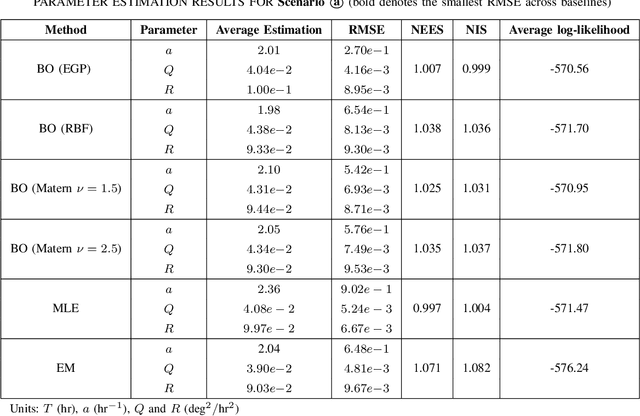
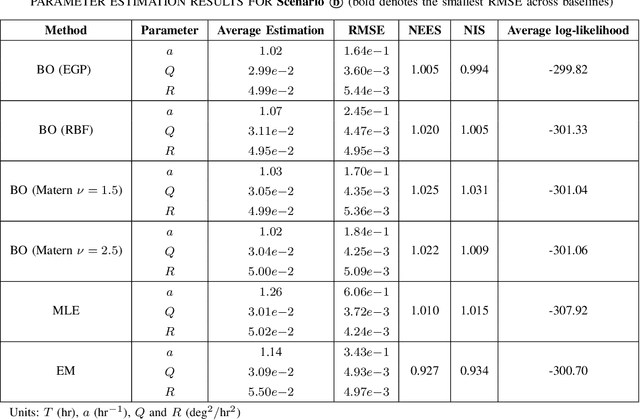
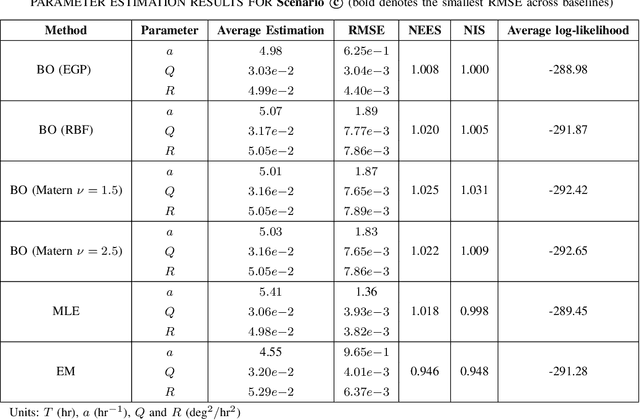
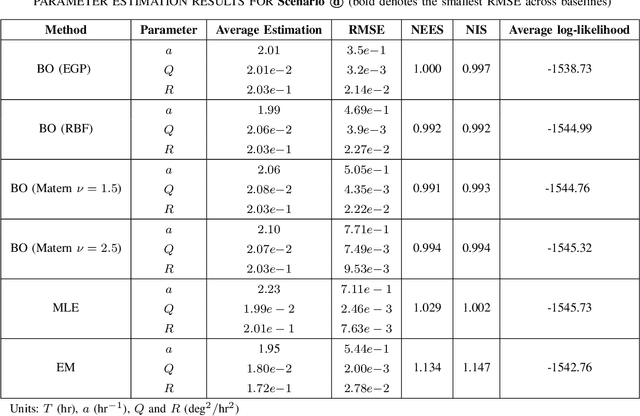
This paper deals with the identification of the stochastic Ornstein-Uhlenbeck (OU) process error model, which is characterized by an inverse time constant, and the unknown variances of the process and observation noises. Although the availability of the explicit expression of the log-likelihood function allows one to obtain the maximum likelihood estimator (MLE), this entails evaluating the nontrivial gradient and also often struggles with local optima. To address these limitations, we put forth a sample-efficient global optimization approach based on the Bayesian optimization (BO) framework, which relies on a Gaussian process (GP) surrogate model for the objective function that effectively balances exploration and exploitation to select the query points. Specifically, each evaluation of the objective is implemented efficiently through the Kalman filter (KF) recursion. Comprehensive experiments on various parameter settings and sampling intervals corroborate that BO-based estimator consistently outperforms MLE implemented by the steady-state KF approximation and the expectation-maximization algorithm (whose derivation is a side contribution) in terms of root mean-square error (RMSE) and statistical consistency, confirming the effectiveness and robustness of the BO for identification of the stochastic OU process. Notably, the RMSE values produced by the BO-based estimator are smaller than the classical Cram\'{e}r-Rao lower bound, especially for the inverse time constant, estimating which has been a long-standing challenge. This seemingly counterintuitive result can be explained by the data-driven prior for the learning parameters indirectly injected by BO through the GP prior over the objective function.