 Add to Chrome
 Add to Firefox
 Add to Edge
FairGlucose: A CGM Fairness Benchmark Reveals Subgroup Disparities Hidden in Population-Level Validation
Aug 18, 2026
As CGM-based AI tools approach clinical deployment, whether their accuracy is equitable across patient demographics remains insufficiently tested. To enable this evaluation, we constructed FairGlucose, a 300-patient CGM cohort balanced across 12 demographic strata (age x gender x type 1/type 2 diabetes), with 132,480 forecasting samples and 3,945 unique behavioral events (meals, exercise, medication) logged by 81 patients. Benchmarking 33 models across four families on 2-hour glucose forecasting, we find that population-level external validation can conceal substantial subgroup disparities. Aggregate out-of-distribution metrics appear stable (approximately 1.0), yet subgroup-level ratios range from 0.8 to 1.4, with T1D patients showing 6 mg/dL higher prediction error than T2D (p < 0.001). This disparity persists across all 33 models, suggesting a property of the prediction task rather than any single architecture. Further analysis shows that subgroup performance gaps align with the proportion of clinically hard cases, and that input-length sensitivity varies across demographics, motivating personalized configurations. Frontier LLMs underperform specialized neural models by 1-6 mg/dL; behavioral events contribute negligibly (approximately 0.1 mg/dL) even under oracle event access. These findings establish that population-level validation alone is insufficient for equity assessment of digital health AI, motivating subgroup-disaggregated reporting as a default standard.

Convolutional Deep Operator Networks for Learning Nonlinear Focused Ultrasound Wave Propagation in Heterogeneous Spinal Cord Anatomy
Dec 20, 2024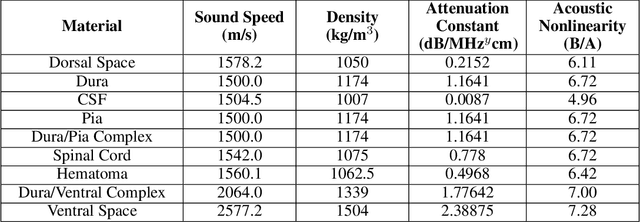
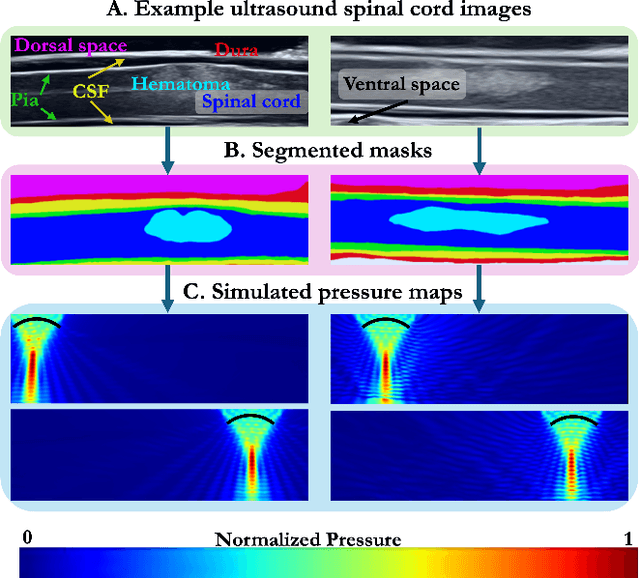
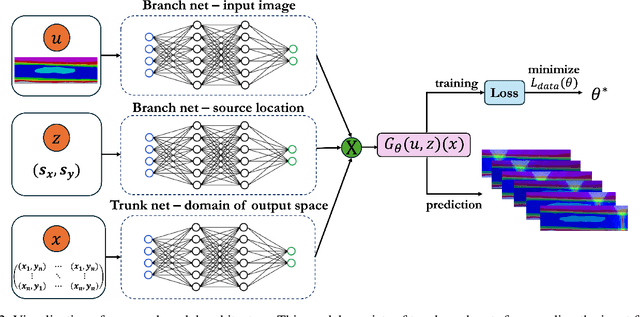
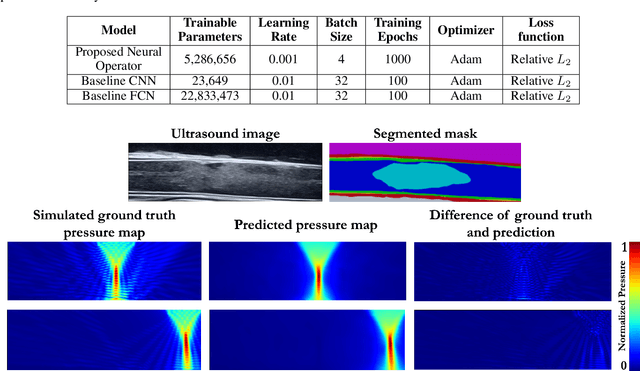
Focused ultrasound (FUS) therapy is a promising tool for optimally targeted treatment of spinal cord injuries (SCI), offering submillimeter precision to enhance blood flow at injury sites while minimizing impact on surrounding tissues. However, its efficacy is highly sensitive to the placement of the ultrasound source, as the spinal cord's complex geometry and acoustic heterogeneity distort and attenuate the FUS signal. Current approaches rely on computer simulations to solve the governing wave propagation equations and compute patient-specific pressure maps using ultrasound images of the spinal cord anatomy. While accurate, these high-fidelity simulations are computationally intensive, taking up to hours to complete parameter sweeps, which is impractical for real-time surgical decision-making. To address this bottleneck, we propose a convolutional deep operator network (DeepONet) to rapidly predict FUS pressure fields in patient spinal cords. Unlike conventional neural networks, DeepONets are well equipped to approximate the solution operator of the parametric partial differential equations (PDEs) that govern the behavior of FUS waves with varying initial and boundary conditions (i.e., new transducer locations or spinal cord geometries) without requiring extensive simulations. Trained on simulated pressure maps across diverse patient anatomies, this surrogate model achieves real-time predictions with only a 2% loss on the test set, significantly accelerating the modeling of nonlinear physical systems in heterogeneous domains. By facilitating rapid parameter sweeps in surgical settings, this work provides a crucial step toward precise and individualized solutions in neurosurgical treatments.