 Add to Chrome
 Add to Firefox
 Add to Edge
BRICKS-WM: Building Reusability via Interface Composition Kinetics for Structured World Models
Jun 15, 2026
Model-based Reinforcement Learning (MBRL) has achieved remarkable success in continuous control by leveraging latent world models. However, prevailing approaches typically rely on monolithic latent dynamics, entangling environment dynamics into a coupled process. This coupling severely limits reusability: altering the agent necessitates retraining the entire world from scratch, even if the environment remains constant. To address this, we introduce BRICKS-WM (Building Reusability via Interface Composition Kinetics for Structured World Models), a framework for the modular assembly of structured world models. Driven by the insight that the physical world is composed of independent entities, we posit that global dynamics can be modeled as a composition of distinct dynamical modules interacting via latent interfaces. As a minimal instantiation, we factorize the latent state space into an actuated Agent module and an external Background module, bridged by a learned latent interface. Unlike prior object-centric methods that prioritize visual segmentation, BRICKS-WM enforces a functional separation in transition dynamics, ensuring that background dynamics remains agnostic to the agent's dynamics. Empirically, BRICKS-WM achieves control performance comparable to strong monolithic baselines when trained from scratch, and enables the reuse of frozen background dynamics across agents.

TACO: Temporal Consensus Optimization for Continual Neural Mapping
Feb 05, 2026Neural implicit mapping has emerged as a powerful paradigm for robotic navigation and scene understanding. However, real-world robotic deployment requires continual adaptation to changing environments under strict memory and computation constraints, which existing mapping systems fail to support. Most prior methods rely on replaying historical observations to preserve consistency and assume static scenes. As a result, they cannot adapt to continual learning in dynamic robotic settings. To address these challenges, we propose TACO (TemporAl Consensus Optimization), a replay-free framework for continual neural mapping. We reformulate mapping as a temporal consensus optimization problem, where we treat past model snapshots as temporal neighbors. Intuitively, our approach resembles a model consulting its own past knowledge. We update the current map by enforcing weighted consensus with historical representations. Our method allows reliable past geometry to constrain optimization while permitting unreliable or outdated regions to be revised in response to new observations. TACO achieves a balance between memory efficiency and adaptability without storing or replaying previous data. Through extensive simulated and real-world experiments, we show that TACO robustly adapts to scene changes, and consistently outperforms other continual learning baselines.
UDON: Uncertainty-weighted Distributed Optimization for Multi-Robot Neural Implicit Mapping under Extreme Communication Constraints
Sep 16, 2025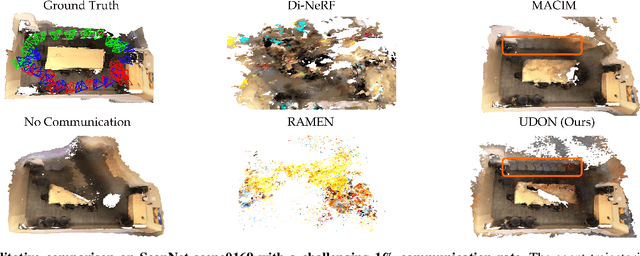
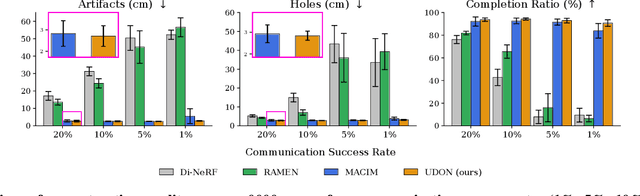
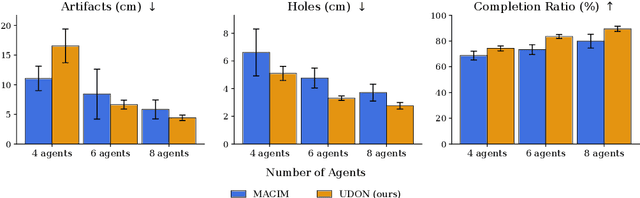
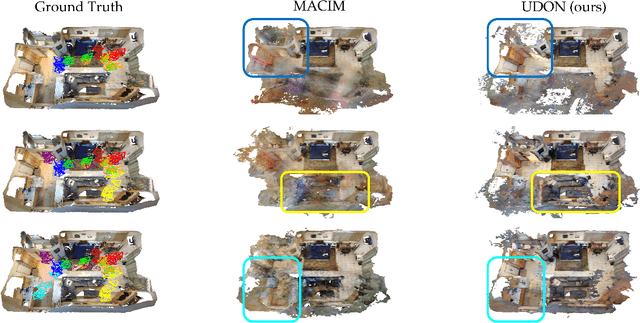
Multi-robot mapping with neural implicit representations enables the compact reconstruction of complex environments. However, it demands robustness against communication challenges like packet loss and limited bandwidth. While prior works have introduced various mechanisms to mitigate communication disruptions, performance degradation still occurs under extremely low communication success rates. This paper presents UDON, a real-time multi-agent neural implicit mapping framework that introduces a novel uncertainty-weighted distributed optimization to achieve high-quality mapping under severe communication deterioration. The uncertainty weighting prioritizes more reliable portions of the map, while the distributed optimization isolates and penalizes mapping disagreement between individual pairs of communicating agents. We conduct extensive experiments on standard benchmark datasets and real-world robot hardware. We demonstrate that UDON significantly outperforms existing baselines, maintaining high-fidelity reconstructions and consistent scene representations even under extreme communication degradation (as low as 1% success rate).