 Add to Chrome
 Add to Firefox
 Add to Edge
More Correct Mass, Worse Answers: Why Power Sampling Can Fail and How to Fix It
Aug 14, 2026
Power Sampling sharpens a language model's distribution over complete generation trajectories, offering a verifier-free way to improve reasoning at inference time. It also has the potential to serve as a general-purpose front end for a broad range of downstream sampling methods. However, we uncover a striking paradox: Power Sampling can drive more probability mass toward correct trajectories while degrading the downstream inference it is intended to enhance. Using self-consistency as a representative case, we observe accuracy drops of up to 18.5 percentage points across models and reasoning benchmarks. We trace this paradox to two mismatches. Dose mismatch arises because a fixed exponent induces drastically different amounts of distributional change across problems. Coverage mismatch arises because global sharpening concentrates mass on a narrow set of dominant paths: high pass@k, often interpreted as evidence of preserved diversity, can therefore coexist with the loss of broad reasoning-path support required for downstream aggregation, search, and selection. Guided by this diagnosis, we replace uniform trajectory exponentiation with a deformation-controlled, support-preserving Power target that calibrates sharpening across problems while limiting the suppression of moderate-probability paths. In a same-budget instantiation with weighted self-consistency, the repaired sampler reverses the losses caused by global Power and outperforms standard multi-sample inference across reasoning benchmarks.

PooL: Pheromone-inspired Communication Framework forLarge Scale Multi-Agent Reinforcement Learning
Feb 20, 2022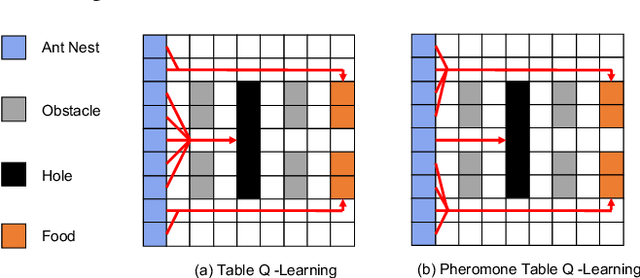

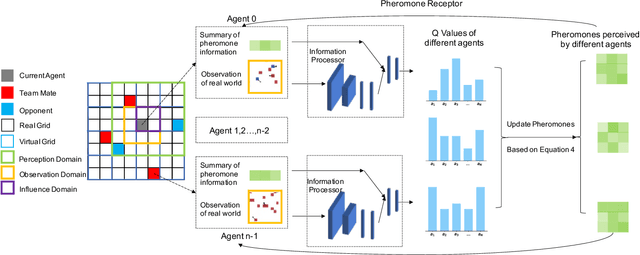
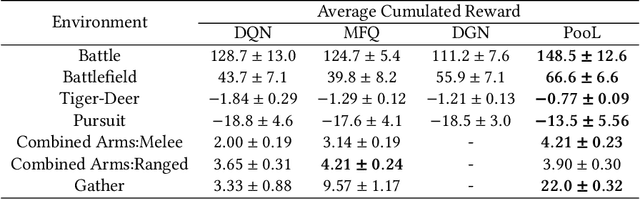
Being difficult to scale poses great problems in multi-agent coordination. Multi-agent Reinforcement Learning (MARL) algorithms applied in small-scale multi-agent systems are hard to extend to large-scale ones because the latter is far more dynamic and the number of interactions increases exponentially with the growing number of agents. Some swarm intelligence algorithms simulate the release and utilization mechanism of pheromones to control large-scale agent coordination. Inspired by such algorithms, \textbf{PooL}, an \textbf{p}her\textbf{o}m\textbf{o}ne-based indirect communication framework applied to large scale multi-agent reinforcement \textbf{l}earning is proposed in order to solve the large-scale multi-agent coordination problem. Pheromones released by agents of PooL are defined as outputs of most reinforcement learning algorithms, which reflect agents' views of the current environment. The pheromone update mechanism can efficiently organize the information of all agents and simplify the complex interactions among agents into low-dimensional representations. Pheromones perceived by agents can be regarded as a summary of the views of nearby agents which can better reflect the real situation of the environment. Q-Learning is taken as our base model to implement PooL and PooL is evaluated in various large-scale cooperative environments. Experiments show agents can capture effective information through PooL and achieve higher rewards than other state-of-arts methods with lower communication costs.